JEE MAIN 2023 · 30 JAN S1Thin lenses: lens formula, lens maker's formula and powerTRANSCRIBED
A person has been using spectacles of power −1.0 diopter for distant vision and a separate reading glass of power 2.0 diopters. What is the least distance of distinct vision for this person:
- A
- B
- C
- D
JEE MAIN 2023 · 24 JAN S1Thin lenses: lens formula, lens maker's formula and powerTRANSCRIBED
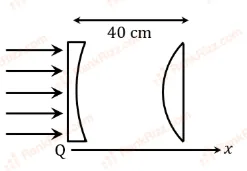
As shown in the figure, a combination of a thin plano-concave lens and a thin plano-convex lens is used to image an object placed at infinity. The radius of curvature of both the lenses is 30 cm and refraction index of the material for both the lenses is 1.75. Both the lenses are placed at distance of 40 cm from each other. Due to the combination, the image of the object is formed at distance x= ______ cm, from concave lens.
JEE MAIN 2023 · 24 JAN S1Thin lenses: lens formula, lens maker's formula and powerTRANSCRIBED
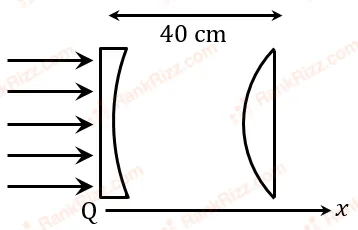
As shown in the figure, a combination of a thin plano-concave lens and a thin plano-convex lens is used to image an object placed at infinity. The radius of curvature of both the lenses is 30 cm and refraction index of the material for both the lenses is 1.75. Both the lenses are placed at distance of 40 cm from each other. Due to the combination, the image of the object is formed at distance x = _____ cm, from concave lens.
JEE MAIN 2023 · 12 APR S1Thin lenses: lens formula, lens maker's formula and powerTRANSCRIBED
Two convex lenses of focal length 20 cm each are placed coaxially with a separation of 60 cm between them. The image of the distant object formed by the combination is at _____ cm from the first lens.
JEE MAIN 2023 · 24 JAN S2Thin lenses: lens formula, lens maker's formula and powerTRANSCRIBED
A convex lens of refractive index 1.5 and focal length 18 cm in air, is immersed in water. The change in the focal length of the lens will be _____ cm.
(Given refractive index of water = 34)
JEE MAIN 2023 · 13 APR S2Thin lenses: lens formula, lens maker's formula and powerTRANSCRIBED
A bi convex lens of focal length 10 cm is cut in two identical parts along a plane perpendicular to the principal axis. The power of each lens after cut is _____ D.
JEE MAIN 2023 · 10 APR S2Thin lenses: lens formula, lens maker's formula and powerTRANSCRIBED
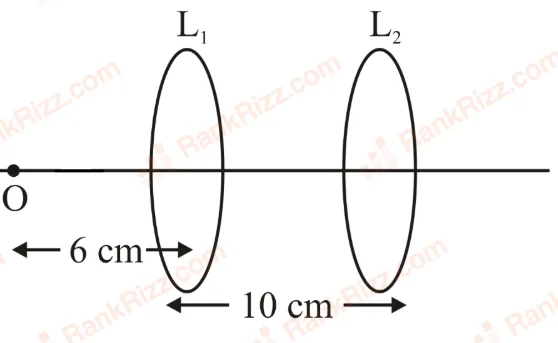
A point object O is placed in front of two thin symmetrical coaxial convex lenses L1 and L2 with focal length 24 cm and 9 cm respectively. The distance between two lenses is 10 cm and the object is placed 6 cm away from lens L1 as shown in the figure. The distance between the object and the image formed by the system of two lenses is _______ cm.
JEE MAIN 2023 · 11 APR S1Thin lenses: lens formula, lens maker's formula and powerTRANSCRIBED
The radius of curvature of each surface of a convex lens having refractive index 1.8 is 20 cm. The lens is now immersed in a liquid of refractive index 1.5. The ratio of power of lens in air to its power in the liquid will be x : 1. The value of x is _______
JEE MAIN 2023 · 25 JAN S2Thin lenses: lens formula, lens maker's formula and powerTRANSCRIBED
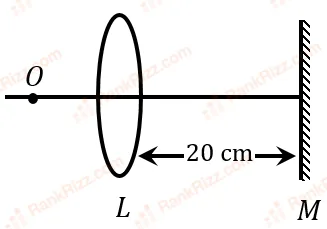
An object is placed on the principal axis of convex lens of focal length 10 cm as shown. A plane mirror is placed on the other side of lens at a distance of 20 cm. The image produced by the plane mirror is 5 cm inside the mirror. The distance of the object from the lens is _____ cm.
JEE MAIN 2022 · 28 JUL S2Thin lenses: lens formula, lens maker's formula and powerTRANSCRIBED
The power of a lens (biconvex) is 1.25 m−1 in particular medium. Refractive index of the lens is 1.5 and radii of curvature are 20 cm and 40 cm respectively. The refractive index of surrounding medium:
- A
- B
- C
- D
JEE MAIN 2022 · 27 JUN S2Thin lenses: lens formula, lens maker's formula and powerTRANSCRIBED
A convex lens has power P. It is cut into two halves along its principal axis. Further one piece (out of the two halves) is cut into two halves perpendicular to the principal axis (as shown in figures). Choose the incorrect option for the reported pieces.
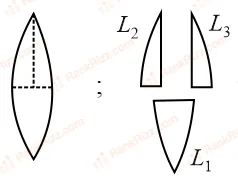
- A
Power of L1=2P
- B
Power of L2=2P
- C
Power of L3=2P
- D
Power of L1=P
JEE MAIN 2022 · 25 JUL S2Thin lenses: lens formula, lens maker's formula and powerTRANSCRIBED
For an object placed at a distance 2.4 m from a lens, a sharp focused image is observed on a screen placed at a distance 12 cm from the lens. A glass plate of refractive index 1.5 and thickness 1 cm is introduced between lens and screen such that the glass plate plane faces parallel to the screen. By what distance should the object be shifted so that a sharp focused image is observed again on the screen?
- A
- B
- C
- D
JEE MAIN 2022 · 24 JUN S1Thin lenses: lens formula, lens maker's formula and powerTRANSCRIBED
Two identical thin biconvex lenses of focal length 15 cm and refractive index 1.5 are in contact with each other. The space between the lenses is filled with a liquid of refractive index 1.25. The focal length of the combination is ______ cm.
JEE MAIN 2022 · 29 JUN S1Thin lenses: lens formula, lens maker's formula and powerTRANSCRIBED
A parallel beam of light is allowed to fall on a transparent spherical globe of diameter 30 cm and refractive index 1.5. The distance from the centre of the globe at which beam of light can converge is ______ mm.
JEE MAIN 2022 · 25 JUL S2Thin lenses: lens formula, lens maker's formula and powerTRANSCRIBED
A convex lens of focal length 20 cm is placed in front of convex mirror with principal axis coinciding each other. The distance between the lens and mirror is 10 cm. A point object is placed on principal axis at a distance of 60 cm from the convex lens. The image formed by combination coincides the object itself. The focal length of the convex mirror is ______ cm.
JEE MAIN 2022 · 26 JUL S1Thin lenses: lens formula, lens maker's formula and powerTRANSCRIBED
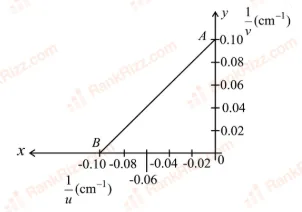
The graph between u1 and v1 for a thin convex lens in order to determine its focal length is plotted as shown in the figure. The refractive index of lens is 1.5 and its both the surfaces have same radius of curvatures R. The value of R will be ______ cm. (Where u = object distance, v = image distance)
JEE MAIN 2022 · 28 JUL S2Thin lenses: lens formula, lens maker's formula and powerTRANSCRIBED
In an experiment with a convex lens, the plot of the image distance (v′) against the object distance (μ′) measured from the focus gives a curve v′μ′=225. If all the distances are measured in cm. The magnitude of the focal length of the lens is _____ cm.
JEE MAIN 2021 · 16 MAR S2Thin lenses: lens formula, lens maker's formula and powerTRANSCRIBED
The refractive index of a converging lens is 1.4. What will be the focal length of this lens if it is placed in a medium of same refractive index? (Assume the radii of curvature of the faces of lens are R1 and R2 respectively)
- A
- B
- C
R1−R2R1R2
- D
JEE MAIN 2021 · 31 AUG S1Thin lenses: lens formula, lens maker's formula and powerTRANSCRIBED
An object is placed at the focus of concave lens having focal length f. What is the magnification and distance of the image from the optical centre of the lens?
- A
41,4f
- B
21,2f
- C
- D
JEE MAIN 2021 · 17 MAR S1Thin lenses: lens formula, lens maker's formula and powerTRANSCRIBED
The thickness at the centre of a plano convex lens is 3 mm and the diameter is 6 cm. If the speed of light in the material of the lens is 2×10⁸ m s−1. The focal length of the lens is:
- A
- B
- C
- D