JEE Main 2021 Physics question — Thin lenses: lens formula, lens maker's formula and power
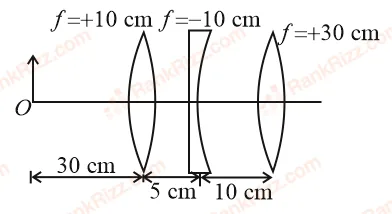
Find the distance of the image from object , formed by the combination of lenses in the figure:
SOLUTION
We need to find the total distance between the object and the final image produced by the combination of three thin lenses.
1. Analyze the First Lens (Convex Lens)
The object is placed to the left of the first convex lens () at a distance of .
- Object distance,
- Focal length,
Applying the standard Lens Formula:
The first lens forms a real image to its right.
2. Analyze the Second Lens (Concave Lens)
The second lens () is placed to the right of the first lens. The image from the first lens acts as a virtual object for this second lens.
- Object distance,
- Focal length,
Applying the Lens Formula for the second stage:
The light rays emerge completely parallel to the principal axis after passing through the second lens.
3. Analyze the Third Lens (Convex Lens)
The third lens () is placed to the right of the second lens. Since the incoming rays are traveling parallel to the principal axis (), they must naturally converge at its focus.
- Object distance,
- Focal length,
Applying the Lens Formula for the final stage:
The final image is formed at a distance of to the right of the third lens.
4. Calculate the Total Distance from Object to Final Image
The total geometric separation distance () across the entire setup is the sum of the initial object distance, all gaps between the lenses, and the final image distance:
Final Answer: 75 cm
Tagged Thin lenses: lens formula, lens maker's formula and power. Machine-assigned, so read it as a strong shortlist rather than a verdict.