JEE Main 2021 Physics question — Thin lenses: lens formula, lens maker's formula and power
Curved surfaces of a plano-convex lens of refractive index and a plano-concave lens of refractive index have equal radius of curvature as shown in figure. Find the ratio of radius of curvature to the focal length of the combined lenses.
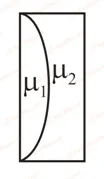
SOLUTION
We need to find the ratio of the radius of curvature to the focal length of the combined lens system consisting of a plano-convex lens and a plano-concave lens placed in contact.
1. Analyze the First Lens (Plano-Convex Lens)
For the plano-convex lens with a refractive index of :
- The first surface is convex, so its radius of curvature is positive:
- The second surface is flat (plane), so its radius of curvature is infinite:
Applying the Lens Maker's Formula for the first lens ():
2. Analyze the Second Lens (Plano-Concave Lens)
For the plano-concave lens with a refractive index of :
- The first surface is concave and fits perfectly with the first lens, so its radius of curvature is positive:
- The second surface is flat (plane), so its radius of curvature is infinite:
Applying the Lens Maker's Formula for the second lens ():
Note: Depending on the standard sign convention configuration where the boundaries face left-to-right, one lens has a positive curvature boundary and the other acts negatively. Let's look closely at the diagram interface: the boundary curved line bulges toward the right. For the first lens, the second boundary is curved () and the first boundary is flat (). Let's calculate using this standard orientation:
Lens 1 (Plano-Convex): First surface is flat (), second surface is concave towards the medium ():
Lens 2 (Plano-Concave): First surface is convex towards the medium (), second surface is flat ():
3. Find the Focal Length of the Combination ()
When two thin lenses are kept in close contact, the equivalent focal length () of the combination is given by:
4. Determine the Ratio ()
We need to find the ratio of the radius of curvature () to the total focal length ():
Final Answer:
Tagged Thin lenses: lens formula, lens maker's formula and power. Machine-assigned, so read it as a strong shortlist rather than a verdict.