Spring-block oscillations — JEE Main Previous Year Questions
Every JEE Main question on Spring-block oscillations, one of the ideas inside Oscillations: 51 questions from 2004–2026, 25 of them in the last five years. Newest first, answer key on every one. Free to read.
Questions on Spring-block oscillations in each year it was asked, the latest 12 of 16.
20267
20252
20241
20237
20228
202112
20202
20191
20181
20172
20151
20141
Every Spring-block oscillations question
1–20 OF 51 · NEWEST FIRST
JEE MAIN 2026 · 28 JAN S2Spring-block oscillationsTRANSCRIBED
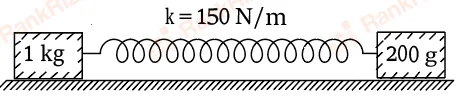
As shown in the figure, a spring is kept in a stretched position with some extension by holding the masses 1 kg and 0.2 kg with a separation more than spring natural length and are released. Assuming the horizontal serface to be frictionless, the angular frequency (in SI unit) of the system is:
JEE MAIN 2026 · 23 JAN S1Spring-block oscillationsTRANSCRIBED
A simple pendulum of string length 30 cm performs 20 oscillations in 10 s. The length of the string required for the pendulum to perfo rm 40 oscillations in the same time duration is _________cm. [Assume that the mass of the pendulum remains same.]
JEE MAIN 2026 · 22 JAN S2Spring-block oscillationsTRANSCRIBED
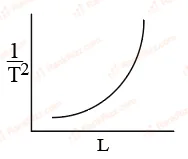
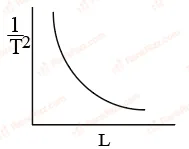
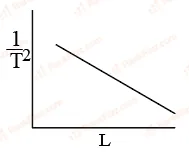
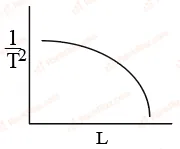
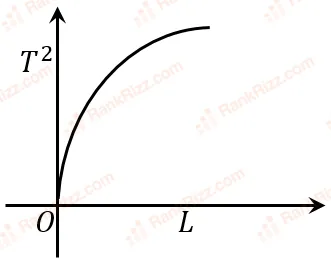
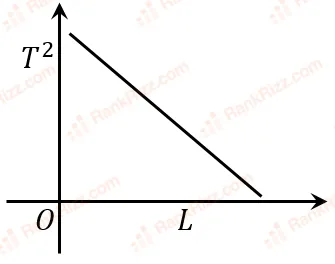
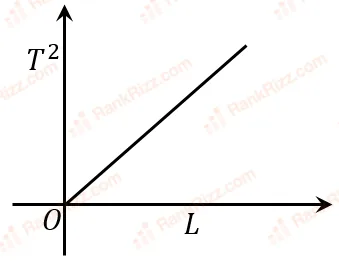
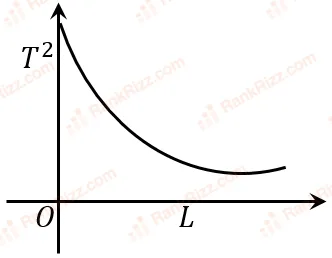
Using a simple pendulum experiment g is determind by measuring its time period T. Which of the following plots represent the correct relation between the pendulum length L and time period T?
JEE MAIN 2026 · 04 APR S2Spring-block oscillationsTRANSCRIBED
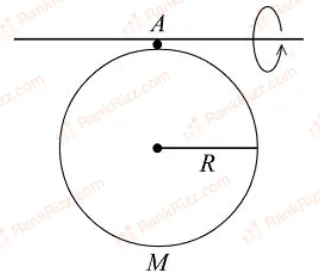
A uniform disc of radius R and mass M is free to oscillate about the axis A as shown in the figure. For small oscillations the time period is ______. ( g is acceleration due to gravity)
JEE MAIN 2026 · 06 APR S2Spring-block oscillationsTRANSCRIBED
A spring stretches by 2 mm when it is loaded with a mass of 200 g. From equilibrium position the mass is further pulled down by 2 mm and released. The frequency associated with the system and maximum energy in the spring are __________ Hz and __________ J, respectively. (Take g=10 m/s2)
JEE MAIN 2026 · 08 APR S2Spring-block oscillationsTRANSCRIBED
The frequency of oscillation of a mass m suspended by a spring is v1. If the length of the spring is cut to half, the same mass oscillates with frequency v2. The value of v1v2 is __________.
JEE MAIN 2025 · 03 APR S1Spring-block oscillationsTRANSCRIBED
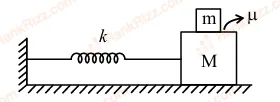
Two blocks of masses m and M, (M>m), are placed on a frictionless table as shown in figure. A massless spring with spring constant k is attached with the lower block. If the system is slightly displaced and released then (μ = coefficient of friction between the two blocks)
(A) The time period of small oscillation of the two blocks is T=2πkm+M (B) The acceleration of the blocks is a=M+mkx (C) The magnitude of the frictional force on upper block is M+mmμ∣x∣ (D) The maximum amplitude of the upper block, if it does not slip, is kμ(M+m)g (E) Maximum frictional force can be μ(M+m)g.
Choose the correct answer from the options given below :
JEE MAIN 2025 · 04 APR S1Spring-block oscillationsTRANSCRIBED
Two simple pendulums having lengths l1 and l2 with negligible string mass undergo angular displacements θ1 and θ2, from their mean positions, respectively. If the angular accelerations of both pendulums are same, then which expression is correct?
JEE MAIN 2023 · 06 APR S1Spring-block oscillationsTRANSCRIBED
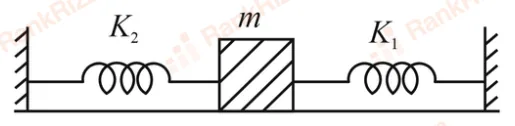
A mass m is attached to two springs as shown in figure. The spring constants of two springs are K1 and K2. For the frictionless surface, the time period of oscillation of mass m is
JEE MAIN 2023 · 30 JAN S2Spring-block oscillationsTRANSCRIBED
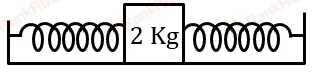
For a simple harmonic motion in a mass spring system shown, the surface is frictionless. When the mass of the block is 1 kg, the angular frequency is ω1. When the mass block is 2 kg the angular frequency is ω2. The ratio ω1ω2 is:
JEE MAIN 2023 · 10 APR S2Spring-block oscillationsTRANSCRIBED
A rectangular block of mass 5 kg attached to a horizontal spiral spring executes simple harmonic motion of amplitude 1 m and time period 3.14 s. The maximum force exerted by spring on block is _______ N.
JEE MAIN 2023 · 24 JAN S1Spring-block oscillationsTRANSCRIBED
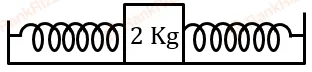
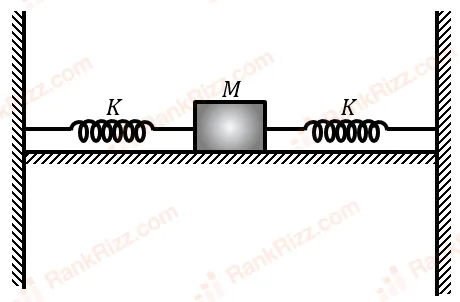
A block of mass 2 kg is attached with two identical springs of spring constant 20 N m−1 each. The block is placed on a frictionless surface and the ends of the springs are attached to rigid supports (see figure). When the mass is displaced from its equilibrium position, it executes a simple harmonic motion. The time period of oscillation is Xπ in SI unit. The value of X is _____.
JEE MAIN 2023 · 31 JAN S1Spring-block oscillationsTRANSCRIBED
In the figure given below, a block of mass M=490 g placed on a frictionless table is connected with two springs having same spring constant (K=2 N m−1). If the block is horizontally displaced through X m then the number of complete oscillations it will make in 14π seconds will be ______.
JEE MAIN 2022 · 24 JUN S2Spring-block oscillationsTRANSCRIBED
Two massless springs with spring constants 2k and 9k, carry 50 g and 100 g masses at their free ends. These two masses oscillate vertically such that their maximum velocities are equal. Then, the ratio of their respective amplitudes will be :
JEE MAIN 2022 · 26 JUN S1Spring-block oscillationsTRANSCRIBED
Time period of a simple pendulum in a stationary lift is T. If the lift accelerates with 6g vertically upwards then the time period will be (Where g = acceleration due to gravity)
JEE MAIN 2022 · 25 JUL S1Spring-block oscillationsTRANSCRIBED
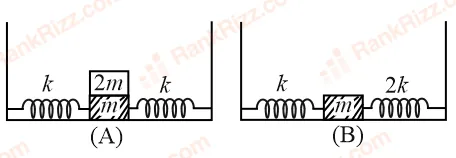
In figure (A), mass 2m is fixed on mass m which is attached to two springs of spring constant k. In figure (B), mass m is attached to two springs of spring constant k and 2k. If mass m in (A) and (B) are displaced by distance x horizontally and then released, then time period T1 and T2 corresponding to (A) and (B) respectively follow the relation.