JEE Main 2025 Physics question — Spring-block oscillations
Two blocks of masses m and M, , are placed on a frictionless table as shown in figure. A massless spring with spring constant k is attached with the lower block. If the system is slightly displaced and released then ( = coefficient of friction between the two blocks)
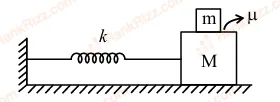
(A) The time period of small oscillation of the two blocks is
(B) The acceleration of the blocks is
(C) The magnitude of the frictional force on upper block is
(D) The maximum amplitude of the upper block, if it does not slip, is
(E) Maximum frictional force can be .
Choose the correct answer from the options given below :
SOLUTION
Treat both blocks as one system (if no slipping occurs).
Total mass
M+m
Restoring force by spring:
F=−kx
So equation of motion is
Thus
So (B) is correct.
For SHM,
Hence
So (A) is correct.
For upper block m, only horizontal force is friction.
It must provide acceleration
Therefore friction needed is
So (C) is wrong
For no slipping,
required friction must not exceed maximum static friction:
Cancel m:
Thus maximum amplitude
So (D) is correct.
Now (E):
Maximum possible friction between blocks is
Normal reaction is only due to upper block’s weight:
N=mg
So
So (E) is false.
Tagged Spring-block oscillations. Machine-assigned, so read it as a strong shortlist rather than a verdict.