JEE Main 2023 Physics question — Spring-block oscillations
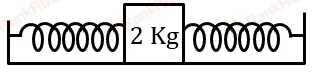
A block of mass 2 kg is attached with two identical springs of spring constant 20 N m each. The block is placed on a frictionless surface and the ends of the springs are attached to rigid supports (see figure). When the mass is displaced from its equilibrium position, it executes a simple harmonic motion. The time period of oscillation is in SI unit. The value of is _____.
SOLUTION
Solution & Explanation
1. Understand the Spring Configuration
A block of mass is connected between two identical horizontal springs, each having a spring constant . The outer ends of the springs are anchored to rigid vertical walls.
When the mass is displaced to one side by a distance :
- One spring is compressed by a distance , exerting a restoring force of directed back toward the equilibrium center.
- The other spring is stretched by the exact same distance , pulling the block with a restoring force of in the same direction.
Because both restoring forces pull the mass in the same direction to restore equilibrium, the total net force is:
This additive restoring behavior means the two springs are structurally operating in a parallel combination.
2. Calculate the Effective Spring Constant ()
For springs connected in parallel, their individual stiffness constants add together directly to create a stiffer system:
3. Determine the Time Period of Oscillation ()
The standard formula for the time period of a spring-mass system executing Simple Harmonic Motion (SHM) is:
Substitute the mass () and the effective spring constant () into the formula:
Simplify the expression under the radical sign:
Canceling out the factor of 2 from both the numerator and denominator yields:
4. Find the Value of
We are given that the time period of oscillation is expressionally equal to in SI units:
Correct Numerical Answer: 5
Tagged Spring-block oscillations. Machine-assigned, so read it as a strong shortlist rather than a verdict.