SHM: equation, phase, velocity and acceleration — JEE Main Previous Year Questions
Every JEE Main question on SHM: equation, phase, velocity and acceleration, one of the ideas inside Oscillations: 78 questions from 2005–2026, 41 of them in the last five years. Newest first, answer key on every one. Free to read.
JEE MAIN 2026 · 06 APR S1SHM: equation, phase, velocity and accelerationTRANSCRIBED
A particle is executing simple harmonic motion. Its amplitude is A and time period is 5 sec. The time required by it to move from x=A to x=2A is _______ sec.
JEE MAIN 2026 · 28 JAN S1SHM: equation, phase, velocity and accelerationTRANSCRIBED
The displacement of a particle, executing simple harmonic motion with time period T, is expressed as x(t)=Asinωt, where A is the amplitude. The maximum value of potential energy of this oscillator is found at t=T/2β. The value of β is_____.
JEE MAIN 2026 · 04 APR S1SHM: equation, phase, velocity and accelerationTRANSCRIBED
The velocity of a particle executing simple harmonic motion along x-axis is described as v2=50−x2, where x represents displacement. If the time period of motion is 7x s, the value of x is _____.
JEE MAIN 2026 · 02 APR S2SHM: equation, phase, velocity and accelerationTRANSCRIBED
The equation of motion of a particle is given by x=asin(50t+3π) cm. The particle will come to rest at time t1 and it will have zero acceleration at time t2. The t1 and t2 respectively are _____.
JEE MAIN 2025 · 29 JAN S2SHM: equation, phase, velocity and accelerationTRANSCRIBED
Two bodies A and B of equal mass are suspended from two massless springs of spring constant k1 and k2, respectively. If the bodies oscillate vertically such that their amplitudes are equal, the ratio of the maximum velocity of A to the maximum velocity of B is
JEE MAIN 2025 · 02 APR S1SHM: equation, phase, velocity and accelerationTRANSCRIBED
A particle is subjected to two simple harmonic motions as: x1=7sin5t cm and x2=27sin(5t+3π) cm where x is displacement and t is time in seconds. The maximum acceleration of the particle is x×10−2 ms−2. The value of x is:
JEE MAIN 2025 · 24 JAN S1SHM: equation, phase, velocity and accelerationTRANSCRIBED
A particle is executing simple harmonic motion with time period 2s and amplitude 1cm. If D and d are the total distance and displacement covered by the particle in 12.5s, then dD is:
JEE MAIN 2025 · 29 JAN S1SHM: equation, phase, velocity and accelerationTRANSCRIBED
Given below are two statements : one is labelled as Assertion (A) and the other is labelled as Reason (R). Assertion (A) : Time period of a simple pendulum is longer at the top of a mountain than that at the base of the mountain. Reason (R): Time period of a simple pendulum decreases with increasing value of acceleration due to gravity and vice-versa. In the light of the above statements, choose the most appropriate answer from the options given below :
A
Both (A) and (R) are true and (R) is the correct explanation of (A)
B
(A) is true but (R) is false
C
(A) is false but (R) is true
D
Both (A) and (R) are true but (R) is not the correct explanation of (A)
JEE MAIN 2024 · 01 FEB S2SHM: equation, phase, velocity and accelerationTRANSCRIBED
A mass m is suspended from a spring of negligible mass and the system oscillates with a frequency f1. The frequency of oscillations if a mass 9m is suspended from the same spring is f2. The value of f2f1 is ______.
JEE MAIN 2024 · 27 JAN S1SHM: equation, phase, velocity and accelerationTRANSCRIBED
A particle executes simple harmonic motion with an amplitude of 4 cm. At the mean position, velocity of the particle is 10 cm s−1. The distance of the particle from the mean position when its speed becomes 5 cm s−1 is α cm, where α= ______.
JEE MAIN 2024 · 29 JAN S2SHM: equation, phase, velocity and accelerationTRANSCRIBED
A simple harmonic oscillator has an amplitude A and time period 6π second. Assuming the oscillation starts from its mean position, the time required by it to travel from x=A to x=23A will be xπ s, where x= ______.
JEE MAIN 2024 · 31 JAN S1SHM: equation, phase, velocity and accelerationTRANSCRIBED
A particle performs simple harmonic motion with amplitude A. Its speed is increased to three times at an instant when its displacement is 32A. The new amplitude of motion is 3nA. The value of n is _____.
JEE MAIN 2024 · 04 APR S2SHM: equation, phase, velocity and accelerationTRANSCRIBED
The displacement of a particle executing SHM is given by x=10sin(ωt+3π) m. The time period of motion is 3.14 s. The velocity of the particle at t=0 is _____ m/s.
JEE MAIN 2024 · 09 APR S1SHM: equation, phase, velocity and accelerationTRANSCRIBED
The position, velocity and acceleration of a particle executing simple harmonic motion are found to have magnitudes of 4 m, 2 ms−1 and 16 ms−2 at a certain instant. The amplitude of the motion is x m, where x is ________
JEE MAIN 2024 · 09 APR S2SHM: equation, phase, velocity and accelerationTRANSCRIBED
A particle of mass 0.50 kg executes simple harmonic motion under force F=−50 (Nm−1)x. The time period of oscillation is xπ s. The value of x is ______ (Given π=722)
JEE MAIN 2023 · 11 APR S1SHM: equation, phase, velocity and accelerationTRANSCRIBED
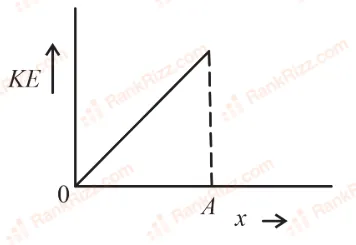
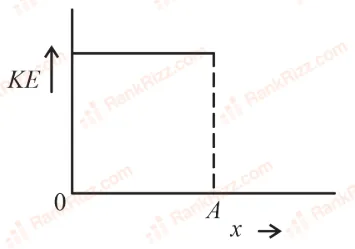
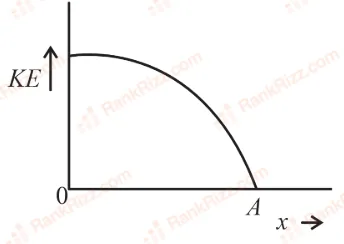
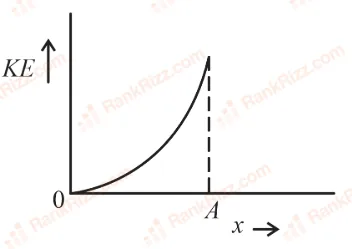
The variation of kinetic energy (KE) of a particle executing simple harmonic motion with the displacement (x) starting from mean position to extreme position (A) is given by
JEE MAIN 2023 · 31 JAN S1SHM: equation, phase, velocity and accelerationTRANSCRIBED
The maximum potential energy of a block executing simple harmonic motion is 25 J. A is amplitude of oscillation. At 2A, the kinetic energy of the block is