RankRizz

Spring-block oscillations — JEE Main Previous Year Questions

Every JEE Main question on Spring-block oscillations, one of the ideas inside Oscillations: 51 questions from 2004–2026, 25 of them in the last five years. Newest first, answer key on every one. Free to read.

Questions

51

Years asked

16

Since

2004

Of the chapter

28%

Every Spring-block oscillations question

41–51 OF 51 · NEWEST FIRST

JEE MAIN 2018 · 16 APR ONLINESpring-block oscillationsTRANSCRIBED

An oscillator of mass M is at rest in its equilibrium position in a potential, V=12k(x−X)2V = \frac{1}{2}k(x - X)^2. A particle of mass m comes from the right with speed u and collides completely inelastic with M and sticks to it. This process repeats every time the oscillator crosses its equilibrium position. The amplitude of oscillations after 13 collisions is: (M = 10, m = 5, u = 1, k = 1)

  1. A

    23\frac{2}{3}

  2. B

    13\frac{1}{\sqrt{3}}

  3. C

    35\sqrt{\frac{3}{5}}

  4. D

    12\frac{1}{2}

JEE MAIN 2017 · 08 APR ONLINESpring-block oscillationsTRANSCRIBED

A 1 kg block attached to a spring vibrates with a frequency of 1 Hz on a frictionless horizontal table. Two springs identical to the original spring are attached in parallel to a 8 kg block placed on the same table. So, the frequency of vibration of the 8 kg block is:

  1. A

    2 Hz

  2. B

    14\frac{1}{4} Hz

  3. C

    122\frac{1}{2\sqrt{2}} Hz

  4. D

    12\frac{1}{2} Hz

JEE MAIN 2017 · 09 APR ONLINESpring-block oscillationsTRANSCRIBED

In an experiment to determine the period of a simple pendulum of length 1 m, it is attached to different spherical bobs of radii r1r_1 and r2r_2. The two spherical bobs have uniform mass distribution. If the relative difference in the periods, is found to be 5×10−45 \times 10^{-4} s, the difference in radii, ∣r1−r2∣|r_1 - r_2| is best-given by

  1. A

    0.01 cm

  2. B

    0.05 cm

  3. C

    0.5 cm

  4. D

    1 cm

JEE MAIN 2015 · 04 APR OFFLINESpring-block oscillationsTRANSCRIBED

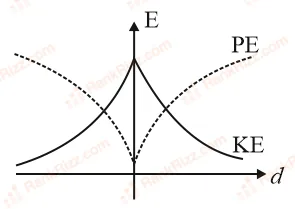
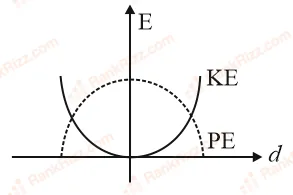
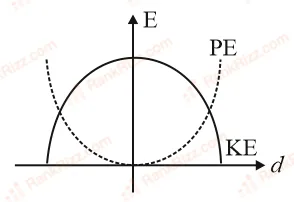
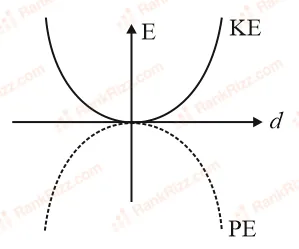
For a simple pendulum, a graph is plotted between its kinetic energy (K.E.) and potential energy (P.E.) against its displacement d. Which one of the following represents these correctly? (graphs are schematic and not drawn to scale)

  1. A
    Figure for JEE Main 2015 Physics question on Spring-block oscillations
  2. B
    Figure for JEE Main 2015 Physics question on Spring-block oscillations
  3. C
    Figure for JEE Main 2015 Physics question on Spring-block oscillations
  4. D
    Figure for JEE Main 2015 Physics question on Spring-block oscillations
JEE MAIN 2014 · 09 APR ONLINESpring-block oscillationsTRANSCRIBED

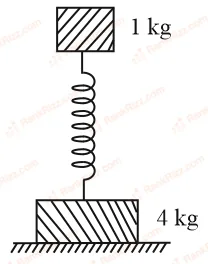
Two bodies of masses 1 kg and 4 kg are connected to a vertical spring, as shown in the figure. The smaller mass executes simple harmonic motion of angular frequency 25 rad s−1^{-1}, and amplitude 1.6 cm while the bigger mass remains stationary on the ground. The maximum force exerted by the system on the floor is (take g=10g = 10 m s−2^{-2}).

Figure for JEE Main 2014 Physics question on Spring-block oscillations
  1. A

    20 N

  2. B

    60 N

  3. C

    40 N

  4. D

    10 N

JEE MAIN 2013 · 25 APR ONLINESpring-block oscillationsTRANSCRIBED

A uniform cylinder of length L and mass M having cross-sectional area A is suspended, with its length vertical, from a fixed point by a massless spring, such that it is half submerged in a liquid of density σ\sigma at equilibrium position. When the cylinder is given a downward push and released, it starts oscillating vertically with a small amplitude. The time period T of the oscillations of the cylinder will be :

  1. A

    Smaller than 2π[M(k+Aσg)]1/22\pi\left[\frac{M}{(k+A\sigma g)}\right]^{1/2}

  2. B

    2πMk2\pi\sqrt{\frac{M}{k}}

  3. C

    Larger than 2π[M(k+Aσg)]1/22\pi\left[\frac{M}{(k+A\sigma g)}\right]^{1/2}

  4. D

    2π[M(k+Aσg)]1/22\pi\left[\frac{M}{(k+A\sigma g)}\right]^{1/2}

JEE MAIN 2013 · 09 APR ONLINESpring-block oscillationsTRANSCRIBED

Two simple pendulums of length 1 m and 4 m respectively are both given small displacement in the same direction at the same instant. They will be again in phase after the shorter pendulum has completed number of oscillations equal to:

  1. A

    2

  2. B

    7

  3. C

    5

  4. D

    3

JEE MAIN 2013 · 22 APR ONLINESpring-block oscillationsTRANSCRIBED

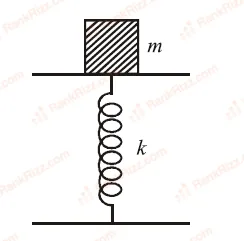
A mass m=1.0m = 1.0 kg is put on a flat pan attached to a vertical spring fixed on the ground. The mass of the spring and the pan is negligible. When pressed slightly and released, the mass executes simple harmonic motion. The spring constant is 500 N/m. What is the amplitude A of the motion, so that the mass m tends to get detached from the pan? (Take g=10g = 10 m/s2^2). The spring is stiff enough so that it does not get distorted during the motion.

Figure for JEE Main 2013 Physics question on Spring-block oscillations
  1. A

    A ≥\geq 2.0 cm

  2. B

    A = 2.0 cm

  3. C

    A < 2.0 cm

  4. D

    A = 1.5 cm

JEE MAIN 2011Spring-block oscillationsTRANSCRIBED

A mass MM, attached to a horizontal spring, executes S.H.M. with amplitude A1A_1. When the mass MM passes through its mean position then a smaller mass mm is placed over it and both of them move together with amplitude A2A_2. The ratio of (A1A2)\left(\dfrac{A_1}{A_2}\right) is:

  1. A

    M+mM\dfrac{M+m}{M}

  2. B

    (MM+m)1/2\left(\dfrac{M}{M+m}\right)^{1/2}

  3. C

    (M+mM)1/2\left(\dfrac{M+m}{M}\right)^{1/2}

  4. D

    MM+m\dfrac{M}{M+m}

JEE MAIN 2007Spring-block oscillationsTRANSCRIBED

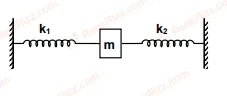
Two springs, of force constants k1k_1 and k2k_2, are connected to a mass mm as shown. The frequency of oscillation of the mass is ff. If both k1k_1 and k2k_2 are made four times their original values, the frequency of oscillation becomes

Figure for JEE Main 2007 Physics question on Spring-block oscillations
  1. A

    f/2f/2

  2. B

    f/4f/4

  3. C

    4f4f

  4. D

    2f2f

JEE MAIN 2004Spring-block oscillationsTRANSCRIBED

A particle at the end of a spring executes simple harmonic motion with a period t1t_1, while the corresponding period for another spring is t2t_2. If the period of oscillation with the two springs in series is tt, then

  1. A

    T=t1+t2T = t_1 + t_2

  2. B

    T2=t12+t22T^2 = t_1^2 + t_2^2

  3. C

    T−1=t1−1+t2−1T^{-1} = t_1^{-1} + t_2^{-1}

  4. D

    T−2=t1−2+t2−2T^{-2} = t_1^{-2} + t_2^{-2}