JEE Main 2026 Physics question — Spring-block oscillations
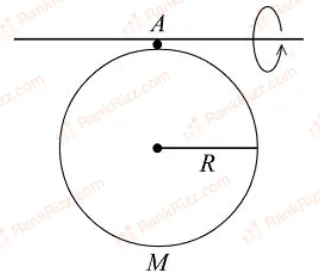
A uniform disc of radius R and mass M is free to oscillate about the axis A as shown in the figure. For small oscillations the time period is ______. ( g is acceleration due to gravity)
SOLUTION
For small-angle oscillations about a fixed horizontal axis, any rigid body behaves as a physical pendulum. Its time period is
where
• is the moment of inertia about the axis of suspension A,
• is the mass of the body,
• is the distance between the axis A and the centre of mass (C.O.M.),
• is the acceleration due to gravity.
Moment of inertia about axis A
The disc is uniform, has radius and mass . The axis A passes through a point on the rim and is perpendicular to the plane of the disc (a tangential axis). Using the parallel-axis theorem,
Here,
• for a disc about its central axis (parallel to the plane) is .
• The distance from the rim to the centre is .
Substitute in
Distance between axis and C.O.M.
The C.O.M. of a uniform disc is at its centre, so .
Time period
Insert from and into the physical-pendulum formula
Thus the time period of oscillation is
Option A which is:
Tagged Spring-block oscillations. Machine-assigned, so read it as a strong shortlist rather than a verdict.