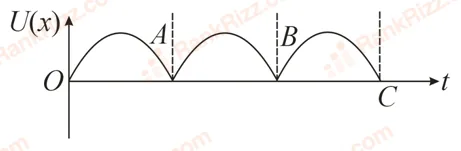
The kinetic energy of a simple harmonic oscillator is oscillating with angular frequency of 176 rad/ s. The frequency of this simple harmonic oscillator is _____Hz. [take ]
- A
28
- B
88
- C
176
- D
14
Every JEE Main question on Energy in simple harmonic motion, one of the ideas inside Oscillations: 17 questions from 2004–2026, 6 of them in the last five years. Newest first, answer key on every one. Free to read.
Questions
17
Years asked
9
Since
2004
Of the chapter
9%
Questions on Energy in simple harmonic motion in each year it was asked.
1–17 OF 17 · NEWEST FIRST
The kinetic energy of a simple harmonic oscillator is oscillating with angular frequency of 176 rad/ s. The frequency of this simple harmonic oscillator is _____Hz. [take ]
28
88
176
14
Given below are two statements. One is labelled as Assertion (A) and the other is labelled as Reason (R). Assertion (A) : Knowing initial position and initial momentum is enough to determine the position and momentum at any time for a simple harmonic motion with a given angular frequency . Reason (R): The amplitude and phase can be expressed in terms of and . In the light of the above statements, choose the correct answer from the options given below :
(A) is false but (R) is true
(A) is true but (R) is false
Both (A) and (R) are true but (R) is NOT the correct explanation of (A)
Both (A) and (R) are true and (R) is the correct explanation of (A)
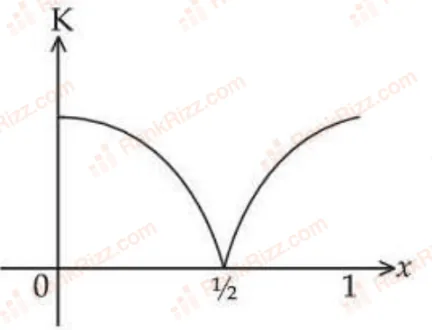
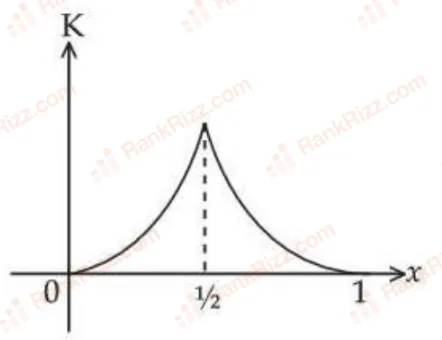
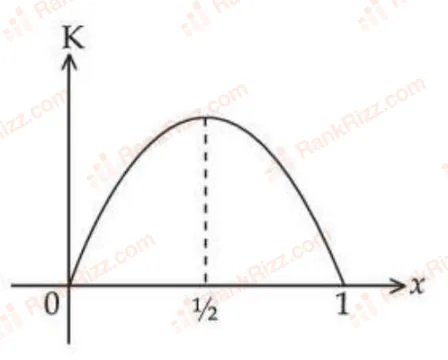
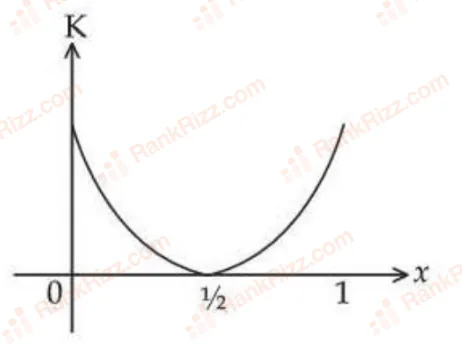
A particle oscillates along the -axis according to the law, where . The kinetic energy of the particle as a function of is correctly represented by the graph


In simple harmonic motion, the total mechanical energy of given system is . If mass of oscillating particle is doubled then the new energy of the system for same amplitude is

When the displacement of a simple harmonic oscillator is one third of its amplitude, the ratio of total energy to the kinetic energy is , where _______.
An object of mass 0.2 kg executes simple harmonic motion along x axis with frequency of Hz. At the position m the object has kinetic energy 0.5 J and potential energy 0.4 J. The amplitude of oscillation is _____ cm.
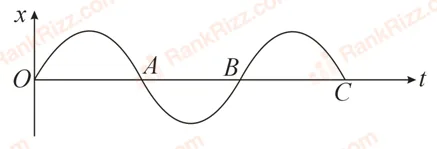
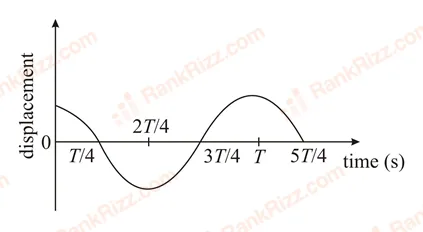
The variation of displacement with time of a particle executing free simple harmonic motion is shown in the figure.
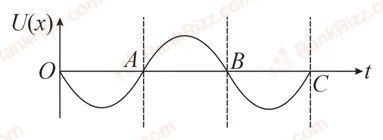
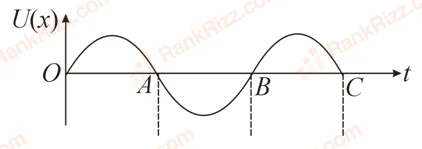
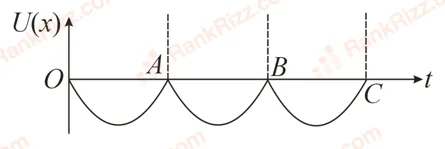
The potential energy versus time plot of the particle is correctly shown in figure:


In a simple harmonic oscillation, what fraction of total mechanical energy is in the form of kinetic energy, when the particle is midway between mean and extreme position.
For what value of displacement the kinetic energy and potential energy of a simple harmonic oscillation become equal?
For a body executing S.H.M.:
(a) Potential energy is always equal to its K.E.
(b) Average potential and kinetic energy over any given time interval are always equal.
(c) Sum of the kinetic and potential energy at any point of time is constant.
(d) Average K.E. in one time period is equal to average potential energy in one time period.
Choose the most appropriate option from the options given below:
(c) and (d)
only (c)
only (b)
(b) and (c)
A particle is making simple harmonic motion along the X-axis. If at distances and from the mean position the velocities of the particle are and , respectively. The time period of its oscillation is given as:
The displacement time graph of a particle executing SHM is given in figure: (sketch is schematic and not to scale)
Which of the following statements is/are true for this motion?
(A) The force is zero at
(B) The magnitude of acceleration is maximum at
(C) The speed is maximum at
(D) The P.E. is equal to K.E. of the oscillation at
(A), (B) and (C)
(B), (C) and (D)
(A), (B) and (D)
(A) and (D)
A particle is executing simple harmonic motion (SHM) of amplitude , along the -axis, about . When its potential Energy (PE) equal kinetic energy (KE), the position of the particle will be:
A particle undergoing simple harmonic motion has time dependent displacement given by . The ratio of kinetic to potential energy of this particle at s will be
1
2
A particle of mass executes simple harmonic motion with amplitude '' and frequency ''. The average kinetic energy during its motion from the position of equilibrium to the end is
Starting from the origin, a body oscillates simple harmonically with a period of . After what time will its kinetic energy be 75% of the total energy?
The total energy of particle, executing simple harmonic motion is
independent of