SHM: equation, phase, velocity and acceleration — JEE Main Previous Year Questions
Every JEE Main question on SHM: equation, phase, velocity and acceleration, one of the ideas inside Oscillations: 78 questions from 2005–2026, 41 of them in the last five years. Newest first, answer key on every one. Free to read.
Every SHM: equation, phase, velocity and acceleration question
41–60 OF 78 · NEWEST FIRST
JEE MAIN 2022 · 27 JUN S2SHM: equation, phase, velocity and accelerationTRANSCRIBED
A particle executes simple harmonic motion. Its amplitude is 8 cm and time period is 6 s. The time it will take to travel from its position of maximum displacement to the point corresponding to half of its amplitude, is ______ s.
JEE MAIN 2021 · 22 JUL S1SHM: equation, phase, velocity and accelerationTRANSCRIBED
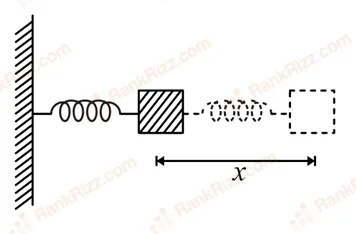
The motion of a mass on a spring, with spring constant K is as shown in figure.
The equation of motion is given by, x(t)=Asinωt+Bcosωt with ω=mK. Suppose that at time t=0, the position of mass is x(0) and velocity v(0), then its displacement can also be represented as x(t)=Ccos(ωt−ϕ), where C and ϕ are:
JEE MAIN 2021 · 25 FEB S2SHM: equation, phase, velocity and accelerationTRANSCRIBED
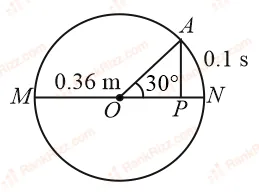
The point A moves with a uniform speed along the circumference of a circle of radius 0.36 m and covers 30° in 0.1 s. The perpendicular projection P from A on the diameter MN represents the simple harmonic motion of P. The restoration force per unit mass when P touches M will be:
JEE MAIN 2021 · 25 FEB S2SHM: equation, phase, velocity and accelerationTRANSCRIBED
Y=Asin(ωt+ϕ0) is the time-displacement equation of a SHM. At t=0 the displacement of the particle is Y=2A and it is moving along negative x-direction. Then the initial phase angle ϕ0 will be:
JEE MAIN 2021 · 27 JUL S1SHM: equation, phase, velocity and accelerationTRANSCRIBED
A particle starts executing simple harmonic motion (SHM) of amplitude a and total energy E. At any instant, its kinetic energy is 43E, then its displacement y is given by:
JEE MAIN 2021 · 27 JUL S2SHM: equation, phase, velocity and accelerationTRANSCRIBED
An object of mass 0.5 kg is executing simple harmonic motion. It amplitude is 5 cm and time period (T) is 0.2 s. What will be the potential energy of the object at an instant t=4T s starting from mean position. Assume that the initial phase of the oscillation is zero.
JEE MAIN 2021 · 26 AUG S2SHM: equation, phase, velocity and accelerationTRANSCRIBED
Two simple harmonic motions are represented by the equations x1=5sin(2πt+4π) and x2=52(sin2πt+cos2πt). The amplitude of the second motion is _________ times the amplitude in the first motion.
JEE MAIN 2021 · 31 AUG S1SHM: equation, phase, velocity and accelerationTRANSCRIBED
A particle of mass 1 kg is hanging from a spring of force constant 100 N m−1. The mass is pulled slightly downward and released so that it executes free simple harmonic motion with time period T. The time when the kinetic energy and potential energy of the system will become equal, is nT. The value of n is _________.
JEE MAIN 2021 · 26 FEB S2SHM: equation, phase, velocity and accelerationTRANSCRIBED
A particle executes S.H.M. with amplitude A and time period T. The displacement of the particle when its speed is half of maximum speed is 2xA. The value of x is
JEE MAIN 2021 · 27 JUL S2SHM: equation, phase, velocity and accelerationTRANSCRIBED
A particle executes simple harmonic motion represented by displacement function as x(t)=Asin(ωt+ϕ). If the position and velocity of the particle at t=0 s are 2 cm and 2ω cm s−1 respectively, then its amplitude is x2 cm where the value of x is _________
JEE MAIN 2019 · 10 JAN S2SHM: equation, phase, velocity and accelerationTRANSCRIBED
A particle executes simple harmonic motion with an amplitude of 5 cm. When the particle is at 4 cm from the mean position, the magnitude of its velocity in SI units is equal to that of its acceleration. Then, its periodic time in seconds is:
JEE MAIN 2018 · 16 APR ONLINESHM: equation, phase, velocity and accelerationTRANSCRIBED
A particle executes simple harmonic motion and it is located at x = a, b and c at time t0, 2t0 and 3t0 respectively. The frequency of the oscillation is:
JEE MAIN 2018 · 08 APR OFFLINESHM: equation, phase, velocity and accelerationTRANSCRIBED
A silver atom in a solid oscillates in simple harmonic motion in some direction with a frequency of 1012 s−1. What is the force constant of the bonds connecting one atom with the other? (Mole wt. of silver = 108 g mol−1 and Avogadro number = 6.02×10²³)
JEE MAIN 2018 · 15 APR S2SHM: equation, phase, velocity and accelerationTRANSCRIBED
Two simple harmonic motions, as shown, are at right angles. They are combined to form Lissajous figures. x(t)=Asin(at+δ), y(t)=Bsin(bt). Identify the correct match below.
JEE MAIN 2017 · 08 APR ONLINESHM: equation, phase, velocity and accelerationTRANSCRIBED
The ratio of maximum acceleration to maximum velocity in a simple harmonic motion is 10 s−1. At, t=0 the displacement is 5 m. What is the maximum acceleration? The initial phase is 4π.
JEE MAIN 2017 · 02 APR OFFLINESHM: equation, phase, velocity and accelerationTRANSCRIBED
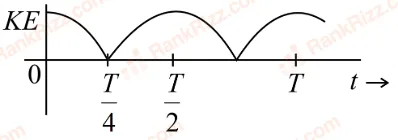
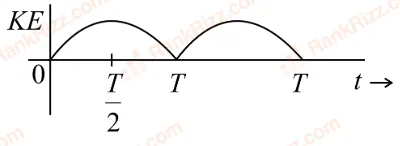
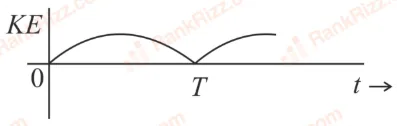
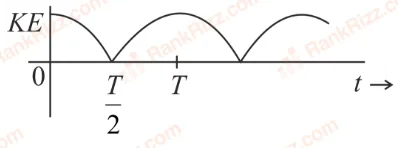
A particle is executing simple harmonic motion with a time period T. At time t=0, it is at its position of equilibrium. The kinetic energy - time graph of the particle will look like: