JEE Main 2021 Physics question — SHM: equation, phase, velocity and acceleration
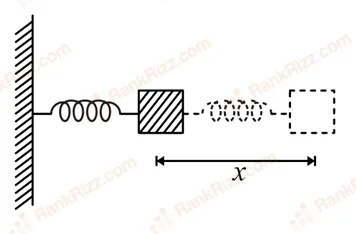
The motion of a mass on a spring, with spring constant K is as shown in figure.
The equation of motion is given by, x(t)=Asinωt+Bcosωt with ω=mK. Suppose that at time t=0, the position of mass is x(0) and velocity v(0), then its displacement can also be represented as x(t)=Ccos(ωt−ϕ), where C and ϕ are:
SOLUTION
We need to find the constants C and ϕ when the equation of motion of a mass on a spring is represented in the cosine form, given its initial position x(0) and initial velocity v(0) at t=0.
1. Understand the Two Representations of the Motion
The displacement of the mass can be written in two equivalent ways:
Form 1: x(t)=Asinωt+Bcosωt— (Equation 1)
Form 2: x(t)=Ccos(ωt−ϕ)— (Equation 2)
2. Expand the Cosine Form
Using the trigonometric identity cos(α−β)=cosαcosβ+sinαsinβ, we can expand Equation 2:
x(t)=C(cosωtcosϕ+sinωtsinϕ)
x(t)=(Csinϕ)sinωt+(Ccosϕ)cosωt— (Equation 3)
Comparing the coefficients of sinωt and cosωt between Equation 1 and Equation 3, we get:
A=Csinϕ— (Equation 4)
B=Ccosϕ— (Equation 5)
3. Relate Constants to Initial Conditions (t=0)
Let's find the values of A and B using the position and velocity at t=0:
For Position (x(0)): Substitute t=0 into Equation 1:
x(0)=Asin(0)+Bcos(0)⟹B=x(0)
For Velocity (v(0)): First, differentiate Equation 1 with respect to time t to find the velocity equation v(t):
v(t)=dtdx=Aωcosωt−Bωsinωt
Now, substitute t=0 into this velocity equation:
v(0)=Aωcos(0)−Bωsin(0)⟹v(0)=Aω⟹A=ωv(0)
4. Solve for Amplitude (C) and Phase Constant (ϕ)
Now substitute the expressions for A and B back into our coefficient relations (Equation 4 and Equation 5):
Csinϕ=ωv(0)
Ccosϕ=x(0)
To find C: Square both equations and add them together (sin2ϕ+cos2ϕ=1):
C2sin2ϕ+C2cos2ϕ=(ωv(0))2+[x(0)]2
C2=ω2v(0)2+x(0)2⟹C=ω2v(0)2+x(0)2
To find ϕ: Divide the sine equation by the cosine equation (cosϕsinϕ=tanϕ):
tanϕ=CcosϕCsinϕ=x(0)ωv(0)=x(0)ωv(0)
ϕ=tan−1(x(0)ωv(0))
Final Answer:Option D: C=ω2v(0)2+x(0)2, ϕ=tan−1(x(0)ωv(0))
Tagged SHM: equation, phase, velocity and acceleration. Machine-assigned, so read it as a strong shortlist rather than a verdict.