SHM: equation, phase, velocity and acceleration — JEE Main Previous Year Questions
Every JEE Main question on SHM: equation, phase, velocity and acceleration, one of the ideas inside Oscillations: 78 questions from 2005–2026, 41 of them in the last five years. Newest first, answer key on every one. Free to read.
Every SHM: equation, phase, velocity and acceleration question
21–40 OF 78 · NEWEST FIRST
JEE MAIN 2023 · 12 APR S1SHM: equation, phase, velocity and accelerationTRANSCRIBED
A particle is executing simple harmonic motion (SHM). The ratio of potential energy and kinetic energy of the particle when its displacement is half of its amplitude will be
JEE MAIN 2023 · 25 JAN S2SHM: equation, phase, velocity and accelerationTRANSCRIBED
A particle executes simple harmonic motion between x=−A and x=+A. If time taken by particle to go from x=0 to 2A is 2 s; then time taken by particle in going from x=2A to A is:
JEE MAIN 2023 · 15 APR S1SHM: equation, phase, velocity and accelerationTRANSCRIBED
In a linear Simple Harmonic Motion (SHM) (A) Restoring force is directly proportional to the displacement. (B) The acceleration and displacement are opposite in direction. (C) The velocity is maximum at mean position. (D) The acceleration is minimum at extreme points. Choose the correct answer from the options given below:
JEE MAIN 2023 · 08 APR S2SHM: equation, phase, velocity and accelerationTRANSCRIBED
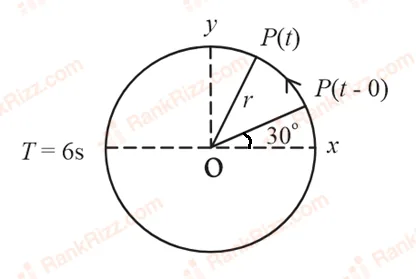
For particle P revolving round the centre O with radius of circular path r and angular velocity ω, as shown in below figure, the projection of OP on the x-axis at time t is
JEE MAIN 2023 · 10 APR S1SHM: equation, phase, velocity and accelerationTRANSCRIBED
A particle executes S.H.M. of amplitude A along x-axis. At t=0, the position of the particle is x=2A and it moves along positive x-axis. The displacement of particle in time t is x=Asin(ωt+δ), then the value δ will be
JEE MAIN 2023 · 13 APR S1SHM: equation, phase, velocity and accelerationTRANSCRIBED
At a given point of time the value of displacement of a simple harmonic oscillator is given as y=Acos(30°). If amplitude is 40 cm and kinetic energy at that time is 200 J, the value of force constant is 1.0×10x N m−1. The value of x is _____.
JEE MAIN 2023 · 30 JAN S1SHM: equation, phase, velocity and accelerationTRANSCRIBED
The general displacement of a simple harmonic oscillator is x=Asinωt. Let T be its time period. The slope of its potential energy (U) - time (t) curve will be maximum when t=βT. The value of β is ______.
JEE MAIN 2023 · 24 JAN S2SHM: equation, phase, velocity and accelerationTRANSCRIBED
A mass m, attached to free end of a spring executes SHM with a period of 1 s. If the mass is increased by 3 kg, the period of oscillation increases by one second. The value of mass m is _____ kg.
JEE MAIN 2023 · 29 JAN S2SHM: equation, phase, velocity and accelerationTRANSCRIBED
A particle of mass 250 g executes a simple harmonic motion under a periodic force F=(−25x) N. The particle attains a maximum speed of 4 m s−1 during its oscillation. The amplitude of the motion is ______ cm.
JEE MAIN 2023 · 06 APR S2SHM: equation, phase, velocity and accelerationTRANSCRIBED
A simple pendulum with length 100 cm and bob of mass 250 g is executing S.H.M of amplitude 10 cm. The maximum tension in the string is found to be 40x N. The value of x is ______.
JEE MAIN 2023 · 01 FEB S1SHM: equation, phase, velocity and accelerationTRANSCRIBED
The amplitude of a particle executing SHM is 3 cm. The displacement at which its kinetic energy will be 25% more than the potential energy is: _____ cm.
JEE MAIN 2023 · 30 JAN S2SHM: equation, phase, velocity and accelerationTRANSCRIBED
The velocity of a particle executing SHM varies with displacement (x) as 4v2=50−x2. The time period of oscillations is 7x s. The value of x is ______. [Take π=722]
JEE MAIN 2022 · 27 JUN S1SHM: equation, phase, velocity and accelerationTRANSCRIBED
The displacement of simple harmonic oscillator after 3 seconds starting from its mean position is equal to half of its amplitude. The time period of harmonic motion is
JEE MAIN 2022 · 29 JUN S2SHM: equation, phase, velocity and accelerationTRANSCRIBED
The motion of a simple pendulum executing S.H.M. is represented by the following equation y=Asin(πt+ϕ), where time is measured in second. The length of pendulum is
JEE MAIN 2022 · 29 JUN S1SHM: equation, phase, velocity and accelerationTRANSCRIBED
A body is performing simple harmonic with an amplitude of 10 cm. The velocity of the body was tripled by air Jet when it is at 5 cm from its mean position. The new amplitude of vibration is x cm. The value of x is ______.