JEE MAIN 2026 · 05 APR S2+4 / −1MEDIUMTRANSCRIBED
JEE Main 2026 Physics question — SHM: equation, phase, velocity and acceleration
Match the List I with List II:
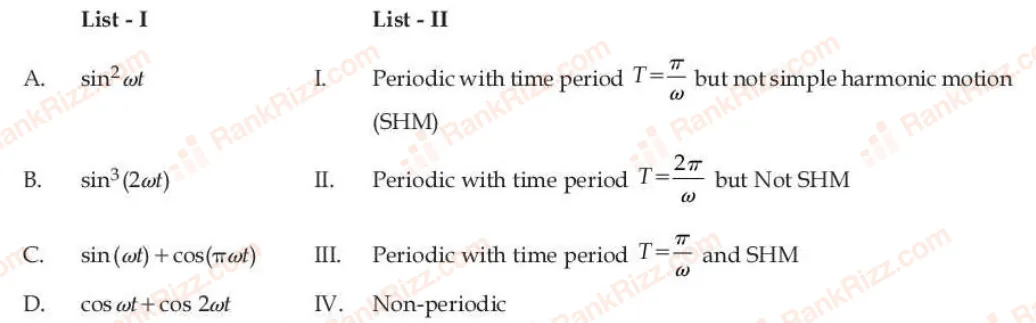
Choose the correct answer from the options given below:
SOLUTION
A. can be rewritten as . Since it consists of a single sinusoidal term, it represents SHM with a time period
B. expands to . The combination of multiple distinct harmonic frequencies means it is not SHM. Its fundamental period is governed by the lowest frequency (), givingC. , the individual periods are and . Their ratio is an irrational number, which makes the combined function non-periodic
D. contains two separate harmonic frequencies ( and ), so it is not SHM. The overall time period is the LCM of their individual periods ( and ), which equals
Tagged SHM: equation, phase, velocity and acceleration. Machine-assigned, so read it as a strong shortlist rather than a verdict.