RankRizz
JEE MAIN 2020 · 04 SEP S1+4 / −1MEDIUMTRANSCRIBED

JEE Main 2020 Physics question — Electric potential and potential energy

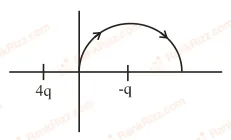
A two point charges 4q4q and −q-q are fixed on the xx-axis at x=−d2x = \frac{-d}{2} and x=d2x = \frac{d}{2}, respectively. If the third point charge 'q' is taken from the origin to x=dx = d along the semicircle as shown in the figure, the energy of the charge will:

Figure for JEE Main 2020 Physics question on Electric potential and potential energy
SOLUTION

For electrostatic forces, the work done in moving a charge depends only on the initial and final positions because the electric field is conservative. Therefore, the change in energy of the moving charge equals its charge multiplied by the change in electric potential experienced during the displacement.

We have two fixed charges on the xx-axis:

4q at x=−d2,−q at x=d2.4q \text{ at } x=-\frac{d}{2},\qquad -q \text{ at } x=\frac{d}{2}.

A third charge qq is moved from the origin (0,0)(0,0) to the point (d,0)(d,0). Since potential is a state function, we only need the potentials at these two points.

The potential VV at a point due to a single point charge QQ located a distance rr away is given by the well-known formula

V=14πε0 Qr.V=\frac{1}{4\pi\varepsilon_0}\,\frac{Q}{r}.

1. Potential at the origin, VinitialV_{\text{initial}}.

Distances from the origin to the two fixed charges:
r1=∣0− ⁣(−d2)∣=d2,r2=∣0− ⁣(d2)∣=d2.r_1=\left|0-\!\Bigl(-\frac{d}{2}\Bigr)\right|=\frac{d}{2},\qquad r_2=\left|0-\!\Bigl(\frac{d}{2}\Bigr)\right|=\frac{d}{2}.

Hence

Vinitial=14πε0 ⁣(4qd/2+−qd/2)=14πε0 ⁣(4q−qd/2)=14πε0 3qd/2=14πε0 6qd.V_{\text{initial}}=\frac{1}{4\pi\varepsilon_0}\!\left( \frac{4q}{d/2}+\frac{-q}{d/2} \right) =\frac{1}{4\pi\varepsilon_0}\!\left( \frac{4q- q}{d/2} \right) =\frac{1}{4\pi\varepsilon_0}\,\frac{3q}{d/2} =\frac{1}{4\pi\varepsilon_0}\,\frac{6q}{d}.$

Thus

Vinitial=6q4πε0d.V_{\text{initial}}=\frac{6q}{4\pi\varepsilon_0 d}.

2. Potential at the final point (d,0)(d,0), VfinalV_{\text{final}}.

Distances from (d,0)(d,0) to the two fixed charges:

R1=∣d− ⁣(−d2)∣=3d2,R2=∣d− ⁣(d2)∣=d2.R_1 = \left|d -\!\Bigl(-\frac{d}{2}\Bigr)\right| = \frac{3d}{2},\qquad R_2 = \left|d -\!\Bigl(\frac{d}{2}\Bigr)\right| = \frac{d}{2}.

Therefore

Vfinal=14πε0 ⁣(4q3d/2+−qd/2)=14πε0 ⁣(8q3d−2qd).V_{\text{final}}=\frac{1}{4\pi\varepsilon_0}\!\left( \frac{4q}{3d/2}+\frac{-q}{d/2} \right) =\frac{1}{4\pi\varepsilon_0}\!\left( \frac{8q}{3d}-\frac{2q}{d} \right).$

We bring both fractions to a common denominator 3d3d:

8q3d−2qd=8q3d−6q3d=2q3d.\frac{8q}{3d}-\frac{2q}{d} =\frac{8q}{3d}-\frac{6q}{3d} =\frac{2q}{3d}.$

Hence

Vfinal=14πε0 2q3d=q6πε0d.V_{\text{final}}=\frac{1}{4\pi\varepsilon_0}\,\frac{2q}{3d} =\frac{q}{6\pi\varepsilon_0 d}.

3. Change in potential experienced by the moving charge.

ΔV=Vfinal−Vinitial=q6πε0d−6q4πε0d.\Delta V = V_{\text{final}}-V_{\text{initial}} =\frac{q}{6\pi\varepsilon_0 d}-\frac{6q}{4\pi\varepsilon_0 d}.

Writing both terms over the common denominator 6πε0d6\pi\varepsilon_0 d:

ΔV=q6πε0d−9q6πε0d=−8q6πε0d=−4q3πε0d.\Delta V =\frac{q}{6\pi\varepsilon_0 d}-\frac{9q}{6\pi\varepsilon_0 d} =-\frac{8q}{6\pi\varepsilon_0 d} =-\frac{4q}{3\pi\varepsilon_0 d}.$

4. Change in potential energy of the charge qq.

The change in energy is simply qq times the change in potential:

ΔU=q ΔV=q(−4q3πε0d)=−4q23πε0d.\Delta U = q\,\Delta V =q\left(-\frac{4q}{3\pi\varepsilon_0 d}\right) =-\frac{4q^{2}}{3\pi\varepsilon_0 d}.$

The negative sign tells us that the energy decreases, and the magnitude of the decrease is 4q23πε0d\dfrac{4q^2}{3\pi\varepsilon_0 d}.

Hence, the correct answer is Option D.

Tagged Electric potential and potential energy. Machine-assigned, so read it as a strong shortlist rather than a verdict.

SubjectPhysics
TopicElectric potential and potential energy
TypeMultiple choice