JEE Main 2020 Physics question — Electric field due to point charges and superposition
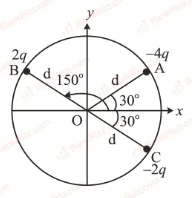
Three charged particles A, B and C with charges −4q, 2q and −2q are present on the circumference of a circle of radius d. The charged particles A, C and centre O of the circle formed an equilateral triangle as shown in the figure. The electric field at the point O is
SOLUTION
First we recall the basic formula for the electric field produced by a point charge.
For a charge Q situated at a distance r from the observation point, the magnitude of the field is
E=4πε01r2∣Q∣
The direction of the field is
• from the charge towards the observation point if the charge is positive, and
• from the observation point towards the charge if the charge is negative.
In the present problem every charge lies on the circumference of the circle, so the distance of each charge from the centre O is the radius d.
Hence for every charge the magnitude of the field at O will be
4πε01d2∣qi∣
where qi is the magnitude of the respective charge.
Let us adopt a convenient coordinate system.
We place the centre O at the origin and take the line OA as the positive x-axis.
Because the triangle AOC is equilateral, the angle ∠AOC equals 60∘, so the radius OC makes an angle 60∘ with the positive x-axis.
The figure supplied in the question shows the charge B diametrically opposite to the charge C.
Therefore the radius OB forms an angle of 60∘+180∘=240∘ with the positive x-axis.
Now we examine each charge one by one.
Charge at A:
Value qA=−4q (negative).
Magnitude of its field at O:
EA=4πε01d24q
Because the charge is negative, the field points from O towards A, i.e. outward along the radius OA or the +x direction.
Hence in vector form
EA=4πε01d24qi^
Charge at C:
Value qC=−2q (negative).
Magnitude:
EC=4πε01d22q
Direction is outward along the radius OC, that is at 60∘.
EC=4πε01d22q(cos60∘i^+sin60∘j^)
Charge at B:
Value qB=+2q (positive).
Magnitude:
EB=4πε01d22q
This time the charge is positive, so the field points from the charge towards the centre, i.e. inward along the radius BO.
Since the outward radius OB is at 240∘, the inward direction is opposite to it, namely 240∘−180∘=60∘.
Thus EB is also directed at 60∘.