JEE Main 2022 Physics question — Electric field due to point charges and superposition
A uniform electric field V m is created between two parallel plates of length 1 m as shown in figure, (where = mass of electron and = charge of electron). An electron enters the field symmetrically between the plates with a speed of 2 m s. The angle of the deviation of the path of the electron as it comes out of the field will be
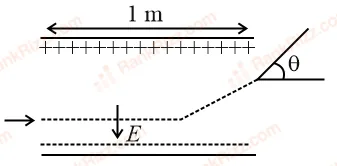
SOLUTION
We need to find the angle of deviation of the path of the electron as it emerges from the electric field between two parallel plates.
The uniform electric field is given as , where is the mass of the electron and is the magnitude of its charge.
The force experienced by the electron due to the electric field is directed perpendicular to its initial motion and is given by: .
According to Newton's second law, the acceleration of the electron in the vertical direction (-axis) is: .
The electron enters symmetrically with an initial horizontal speed . Since there is no force acting in the horizontal direction, this horizontal velocity remains constant throughout the motion: .
The length of the plates is . The time taken by the electron to travel through the plates is determined by its horizontal motion: t = \frac{L}{v_x} = \frac{1}{2} = 0.5\text{ s}$.</p> <p>The vertical velocityv_yv_y = a_y t = 8 \times 0.5 = 4\text{ m s}^{-1}\theta\tan\theta = \frac{v_y}{v_x}v_yv_x\tan\theta = \frac{4}{2} = 2\theta = \tan^{-1}(2)$$.
Therefore, the correct answer is Option B: tan-1(2).
Tagged Electric field due to point charges and superposition. Machine-assigned, so read it as a strong shortlist rather than a verdict.