RankRizz

Electric dipole and dipole in external field — JEE Main Previous Year Questions

Every JEE Main question on Electric dipole and dipole in external field, one of the ideas inside Electrostatics: 39 questions from 2006–2026, 24 of them in the last five years. Newest first, answer key on every one. Free to read.

Questions

39

Years asked

11

Since

2006

Of the chapter

13%

Every Electric dipole and dipole in external field question

21–39 OF 39 · NEWEST FIRST

JEE MAIN 2023 · 13 APR S1Electric dipole and dipole in external fieldTRANSCRIBED

Two charges of each magnitude 0.010.01 C and separated by a distance of 0.40.4 mm constitute an electric dipole. If the dipole is placed in an uniform electric field E⃗\vec{E} of 1010 dyne ⋅\cdot C−1^{-1} making 30°30° angle with E⃗\vec{E}, the magnitude of torque acting on dipole is:

  1. A

    4.0×10−104.0 \times 10^{-10} N m

  2. B

    1.0×10−81.0 \times 10^{-8} N m

  3. C

    1.5×10−91.5 \times 10^{-9} N m

  4. D

    2.0×10−102.0 \times 10^{-10} N m

JEE MAIN 2023 · 08 APR S1Electric dipole and dipole in external fieldTRANSCRIBED

An electric dipole of dipole moment is 6.0×10−66.0 \times 10^{-6} C m placed in a uniform electric field of 1.5×1031.5 \times 10^3 N C−1^{-1} in such a way that dipole moment is along electric field. The work done in rotating dipole by 180° in this field will be ______ mJ.

JEE MAIN 2022 · 26 JUN S1Electric dipole and dipole in external fieldTRANSCRIBED

Given below two statements : One is labelled as Assertion (A) and other is labelled as Reason (R).
Assertion (A): Non-polar materials do not have any permanent dipole moment.
Reason (R): When a non-polar material is placed in an electric field, the centre of the positive charge distribution of it's individual atom or molecule coincides with the centre of the negative charge distribution.
In the light of above statements, choose the most appropriate answer from the options given below.

  1. A

    Both (A) and (R) are correct and (R) is the correct explanation of (A).

  2. B

    Both (A) and (R) are correct and (R) is not the correct explanation of (A).

  3. C

    (A) is correct but (R) is not correct.

  4. D

    (A) is not correct but (R) is correct.

JEE MAIN 2022 · 28 JUL S1Electric dipole and dipole in external fieldTRANSCRIBED

Two electric dipoles of dipole moments 1.2×10−301.2 \times 10^{-30} Cm and 2.4×10−302.4 \times 10^{-30} Cm are placed in two different uniform electric fields of strengths 5×1045 \times 10^4 N C−1^{-1} and 15×10415 \times 10^4 N C−1^{-1} respectively. The ratio of maximum torque experienced by the electric dipoles will be 1x\frac{1}{x}. The value of xx is _____.

JEE MAIN 2021 · 22 JUL S1Electric dipole and dipole in external fieldTRANSCRIBED

An electric dipole is placed on xx-axis in proximity to a line charge of linear charge density 3.0×10−63.0 \times 10^{-6} C m−1^{-1}. Line charge is placed on zz-axis and positive and negative charge of dipole is at a distance of 10 mm and 12 mm from the origin respectively. If total force of 4 N is exerted on the dipole, find out the amount of positive or negative charge of the dipole.

  1. A

    815.1 nC

  2. B

    8.8 μ\muC

  3. C

    0.485 mC

  4. D

    4.44 μ\muC

JEE MAIN 2021 · 25 JUL S2Electric dipole and dipole in external fieldTRANSCRIBED

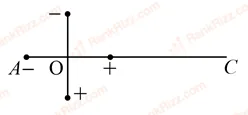
Two ideal electric dipoles AA and BB, having their dipole moment p1p_1 and p2p_2 respectively are placed on a plane with their centres at OO as shown in the figure. At point CC on the axis of dipole AA, the resultant electric field is making an angle of 37° with the axis. The ratio of the dipole moment of AA and BB, p1p2\frac{p_1}{p_2} is: (take sin 37° = 35\frac{3}{5})

Figure for JEE Main 2021 Physics question on Electric dipole and dipole in external field
  1. A

    35\frac{3}{5}

  2. B

    32\frac{3}{2}

  3. C

    23\frac{2}{3}

  4. D

    43\frac{4}{3}

JEE MAIN 2021 · 26 FEB S2Electric dipole and dipole in external fieldTRANSCRIBED

Given below are two statements
Statement I: An electric dipole is placed at the centre of a hollow sphere. The flux of electric field through the sphere is zero, but the electric field is not zero anywhere in the sphere.
Statement II: If RR is the radius of a solid metallic sphere and QQ be the total charge on it. The electric field at any point on the spherical surface of radius r(<R)r (< R) is zero but the electric flux passing through this closed spherical surface of radius rr is not.
In the light of the above statements, choose the correct answer from the options given below:

  1. A

    Both Statement I and Statement II are true

  2. B

    Statement I is false but Statement II is true

  3. C

    Statement I is true but Statement II is false

  4. D

    Both Statement I and Statement II are false

JEE MAIN 2020 · 09 JAN S1Electric dipole and dipole in external fieldTRANSCRIBED

An electric dipole of moment p⃗=(−i^−3j^+2k^)×10−29\vec{p} = (-\hat{i} - 3\hat{j} + 2\hat{k}) \times 10^{-29} C m at the origin (0,0,0)(0,0,0). The electric field due to this dipole at r⃗=+i^+3j^+5k^\vec{r} = +\hat{i} + 3\hat{j} + 5\hat{k} (note that r⃗⋅p⃗=0\vec{r} \cdot \vec{p} = 0) is parallel to:

  1. A

    (+i^−3j^−2k^)(+\hat{i} - 3\hat{j} - 2\hat{k})

  2. B

    (−i^+3j^−2k^)(-\hat{i} + 3\hat{j} - 2\hat{k})

  3. C

    (+i^+3j^−2k^)(+\hat{i} + 3\hat{j} - 2\hat{k})

  4. D

    (−i^−3j^+2k^)(-\hat{i} - 3\hat{j} + 2\hat{k})

JEE MAIN 2020 · 06 SEP S2Electric dipole and dipole in external fieldTRANSCRIBED

Two identical electric point dipoles have dipole moments p⃗1=pi^\vec{p}_1 = p\hat{i} and p⃗2=−pi^\vec{p}_2 = -p\hat{i} and are held on the x-axis at distance 'a' from each other. When released, they move along the x-axis with the direction of their dipole moments remaining unchanged. If the mass of each dipole is 'm', their speed when they are infinitely far apart is:

  1. A

    pa1πε0ma\frac{p}{a}\sqrt{\frac{1}{\pi\varepsilon_0 ma}}

  2. B

    pa12πε0ma\frac{p}{a}\sqrt{\frac{1}{2\pi\varepsilon_0 ma}}

  3. C

    pa2πε0ma\frac{p}{a}\sqrt{\frac{2}{\pi\varepsilon_0 ma}}

  4. D

    pa32πε0ma\frac{p}{a}\sqrt{\frac{3}{2\pi\varepsilon_0 ma}}

JEE MAIN 2019 · 12 JAN S1Electric dipole and dipole in external fieldTRANSCRIBED

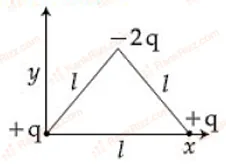
Determine the electric dipole moment of the system of three charges, placed on the vertices of an equilateral triangle, as shown in the figure:

Figure for JEE Main 2019 Physics question on Electric dipole and dipole in external field
  1. A

    3qli^−j^2\sqrt{3}ql\frac{\hat{i}-\hat{j}}{\sqrt{2}}

  2. B

    −3qlj^-\sqrt{3}ql\hat{j}

  3. C

    2qlj^2ql\hat{j}

  4. D

    (ql)i^+j^2(ql)\frac{\hat{i}+\hat{j}}{\sqrt{2}}

JEE MAIN 2019 · 10 JAN S1Electric dipole and dipole in external fieldTRANSCRIBED

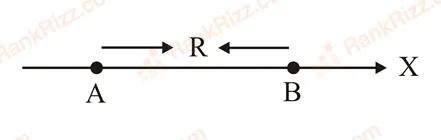
Two electric dipoles, A, B with respective dipole moments dA⃗=−4qai^\vec{d_A} = -4qa\hat{i} and dB⃗=−2qai^\vec{d_B} = -2qa\hat{i} are placed on the xx-axis with a separation RR, as shown in the figure.

Figure for JEE Main 2019 Physics question on Electric dipole and dipole in external field


The distance from A at which both of them produce the same potential is:

  1. A

    R2−1\frac{R}{\sqrt{2}-1}

  2. B

    2R2−1\frac{\sqrt{2}R}{\sqrt{2}-1}

  3. C

    2R2+1\frac{\sqrt{2}R}{\sqrt{2}+1}

  4. D

    R2+1\frac{R}{\sqrt{2}+1}

JEE MAIN 2019 · 12 APR S1Electric dipole and dipole in external fieldTRANSCRIBED

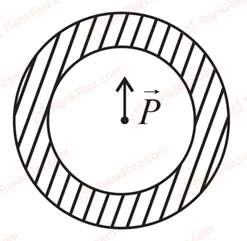
Shown in the figure is a shell made of a conductor. It has inner radius a and outer radius b, and carries charge Q. At its centre a dipole p⃗\vec{p} is placed as shown then:

Figure for JEE Main 2019 Physics question on Electric dipole and dipole in external field
  1. A

    Surface charge density on the inner surface of the shell is zero everywhere.

  2. B

    Electric field outside the shell is the same as that of a point charge at the centre of the shell.

  3. C

    Surface charge density on the inner surface is uniform and equal to (Q/2)4πa2\frac{(Q/2)}{4\pi a^2}.

  4. D

    Surface charge density on the outer surface depends on p⃗\vec{p}.

JEE MAIN 2019 · 11 JAN S2Electric dipole and dipole in external fieldTRANSCRIBED

An electric field of 1000 V/m is applied to an electric dipole at angle of 45°45°. The value of electric dipole moment is 10−2910^{-29} C.m. What is the potential energy of the electric dipole?

  1. A

    −20×10−18-20 \times 10^{-18} J

  2. B

    −7×10⁻²⁷-7 \times 10^{-27} J

  3. C

    −10×10−29-10 \times 10^{-29} J

  4. D

    −9×10⁻²⁰-9 \times 10^{-20} J

JEE MAIN 2019 · 08 APR S2Electric dipole and dipole in external fieldTRANSCRIBED

An electric dipole is formed by two equal and opposite charges q with separation d. The charges have same mass m. It is kept in a uniform electric field E. If it is slightly rotated from its equilibrium orientation, then its angular frequency ω\omega is:

  1. A

    2qEmd2\sqrt{\frac{qE}{md}}

  2. B

    2qEmd\sqrt{\frac{2qE}{md}}

  3. C

    qE2md\sqrt{\frac{qE}{2md}}

  4. D

    qEmd\sqrt{\frac{qE}{md}}

JEE MAIN 2019 · 12 APR S1Electric dipole and dipole in external fieldTRANSCRIBED

A Point dipole p⃗=−p0x^\vec{p} = -p_0\hat{x} is kept at the origin. The potential and electric field due to this dipole on the y-axis at a distance d are, respectively: (Taken V = 0 at infinity)

  1. A

    ∣p⃗∣4πε0d2\frac{|\vec{p}|}{4\pi\varepsilon_0 d^2}, −p⃗4πε0d3\frac{-\vec{p}}{4\pi\varepsilon_0 d^3}

  2. B

    00, ∣p⃗∣4πε0d3\frac{|\vec{p}|}{4\pi\varepsilon_0 d^3}

  3. C

    ∣p⃗∣4πε0d3\frac{|\vec{p}|}{4\pi\varepsilon_0 d^3}, p⃗4πε0d3\frac{\vec{p}}{4\pi\varepsilon_0 d^3}

  4. D

    00, −p⃗4πε0d3\frac{-\vec{p}}{4\pi\varepsilon_0 d^3}

JEE MAIN 2019 · 10 JAN S2Electric dipole and dipole in external fieldTRANSCRIBED

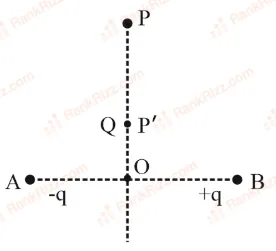
Charges −q-q and +q+q, located at A and B, respectively, constitute an electric dipole. Distance AB=2aAB = 2a, OO is the mid point of the dipole and OPOP is perpendicular to ABAB. A charge QQ is placed at P where OP=yOP = y and y≫2ay \gg 2a. The charge QQ experiences an electrostatic force FF. If QQ is now moved along the equatorial line to P' such that OP′=y3OP' = \frac{y}{3}, the force on QQ will be close to (y3≪2a\frac{y}{3} \ll 2a):

Figure for JEE Main 2019 Physics question on Electric dipole and dipole in external field
  1. A

    27F

  2. B

    F3\frac{F}{3}

  3. C

    3F

  4. D

    9F

JEE MAIN 2017 · 02 APR OFFLINEElectric dipole and dipole in external fieldTRANSCRIBED

An electric dipole has fixed dipole moment p⃗\vec{p}, which makes angle θ\theta with respect to xx-axis. When subjected to an electric field E⃗1=Ei^\vec{E}_{1} = E\hat{i}, it experiences a torque T⃗1=τk^\vec{T}_{1} = \tau\hat{k}. When subjected to another electric field E⃗2=3E1j^\vec{E}_{2} = \sqrt{3}E_{1}\hat{j}, it experiences a torque T⃗2=−T⃗1\vec{T}_{2} = -\vec{T}_{1}. The angle θ\theta is:

  1. A

    90°

  2. B

    30°

  3. C

    45°

  4. D

    60°

JEE MAIN 2013 · 09 APR ONLINEElectric dipole and dipole in external fieldTRANSCRIBED

Two point dipoles of dipole moment p1⃗\vec{p_1} and p2⃗\vec{p_2} are at a distance x from each other and p1⃗∥p2⃗\vec{p_1} \| \vec{p_2}. The force between the dipoles is :

  1. A

    14πϵ04p1p2x4\frac{1}{4\pi\epsilon_0}\frac{4p_1p_2}{x^4}

  2. B

    14πϵ03p1p2x3\frac{1}{4\pi\epsilon_0}\frac{3p_1p_2}{x^3}

  3. C

    14πϵ06p1p2x4\frac{1}{4\pi\epsilon_0}\frac{6p_1p_2}{x^4}

  4. D

    14πϵ08p1p2x4\frac{1}{4\pi\epsilon_0}\frac{8p_1p_2}{x^4}

JEE MAIN 2006Electric dipole and dipole in external fieldTRANSCRIBED

A electric dipole is placed at an angle of 30∘30^\circ to a non-uniform electric field. The dipole will experience

  1. A

    a torque only

  2. B

    a translational force only in the direction of the field

  3. C

    a translational force only in a direction normal to the direction of the field

  4. D

    a torque as well as a translational force