JEE Main 2019 Physics question — Electric dipole and dipole in external field
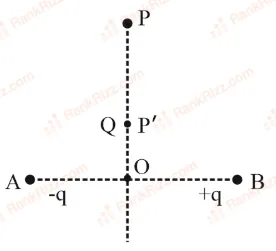
Charges and , located at A and B, respectively, constitute an electric dipole. Distance , is the mid point of the dipole and is perpendicular to . A charge is placed at P where and . The charge experiences an electrostatic force . If is now moved along the equatorial line to P' such that , the force on will be close to ():
SOLUTION
The electric field () at a distance on the equatorial plane of a dipole where is given by:
Since the electrostatic force on a charge is , the force is inversely proportional to the cube of the distance ():
When the charge is moved to position at a distance (given that it still satisfies far-field approximations relative to the small dipole separation), the new force becomes:
Tagged Electric dipole and dipole in external field. Machine-assigned, so read it as a strong shortlist rather than a verdict.