RankRizz

Photoelectric effect and Einstein's equation — JEE Main Previous Year Questions

Every JEE Main question on Photoelectric effect and Einstein's equation, one of the ideas inside Dual Nature of Radiation & Matter: 98 questions from 2004–2026, 52 of them in the last five years. Newest first, answer key on every one. Free to read.

Questions

98

Years asked

19

Since

2004

Of the chapter

45%

Every Photoelectric effect and Einstein's equation question

61–80 OF 98 · NEWEST FIRST

JEE MAIN 2021 · 25 JUL S2Photoelectric effect and Einstein's equationTRANSCRIBED

When radiation of wavelength λ\lambda is incident on a metallic surface, the stopping potential of ejected photoelectrons is 4.8 V. If the same surface is illuminated by radiation of double the previous wavelength, then the stopping potential becomes 1.6 V. The threshold wavelength of the metal is:

  1. A

    2λ2\lambda

  2. B

    4λ4\lambda

  3. C

    8λ8\lambda

  4. D

    6λ6\lambda

JEE MAIN 2021 · 25 JUL S2Photoelectric effect and Einstein's equationTRANSCRIBED

A light beam of wavelength 500 nm is incident on a metal having work function of 1.25 eV, placed in a magnetic field of intensity BB. The electrons emitted perpendicular to the magnetic field BB, with maximum kinetic energy are bent into a circular arc of radius 30 cm. The value of BB is _________ ×10−7\times 10^{-7} T.
Given hc=20×10−26hc = 20 \times 10^{-26} J m, the mass of the electron = 9×10−319 \times 10^{-31} kg.

JEE MAIN 2021 · 20 JUL S2Photoelectric effect and Einstein's equationTRANSCRIBED

A certain metallic surface is illuminated by monochromatic radiation of wavelength λ\lambda. The stopping potential for photoelectric current for this radiation is 3V03V_0. If the same surface is illuminated with a radiation of wavelength 2λ2\lambda, the stopping potential is V0V_0. The threshold wavelength of this surface for photoelectric effect is ___ λ\lambda.

JEE MAIN 2021 · 26 FEB S2Photoelectric effect and Einstein's equationTRANSCRIBED

Two stream of photons, possessing energies equal to twice and ten times the work function of metal are incident on the metal surface successively. The value of ratio of maximum velocities of the photoelectrons emitted in the two respective cases is x:3x : 3. The value of xx is

JEE MAIN 2020 · 09 JAN S1Photoelectric effect and Einstein's equationTRANSCRIBED

Radiation, with wavelength 65616561 Å falls on a metal surface to produce photoelectrons. The electrons are made to enter a uniform magnetic field of 3×10−43 \times 10^{-4} T. If the radius of the largest circular path followed by the electrons is 1010 mm, the work function of the metal is close to:

  1. A

    1.6 eV

  2. B

    0.8 eV

  3. C

    1.1 eV

  4. D

    1.8 eV

JEE MAIN 2020 · 03 SEP S1Photoelectric effect and Einstein's equationTRANSCRIBED

When the wavelength of radiation falling on a metal is changed from 500 nm to 200 nm, the maximum kinetic energy of the photoelectrons becomes three times larger. The work function of the metal is close to:

  1. A

    0.81 eV

  2. B

    1.02 eV

  3. C

    0.52 eV

  4. D

    0.61 eV

JEE MAIN 2020 · 08 JAN S1Photoelectric effect and Einstein's equationTRANSCRIBED

When photon of energy 4.0 eV strikes the surface of a metal A, the ejected photoelectrons have maximum kinetic energy TAT_A eV and de-Broglie wavelength λA\lambda_A. The maximum kinetic energy of photoelectrons liberated from another metal B by photon of energy 4.50 eV is TB=(TA−1.5)T_B = (T_A - 1.5) eV. If the de-Broglie wavelength of these photoelectrons λB=2λA\lambda_B = 2\lambda_A, then the work function of metal B is:

  1. A

    4 eV

  2. B

    2 eV

  3. C

    1.5 eV

  4. D

    3 eV

JEE MAIN 2020 · 04 SEP S2Photoelectric effect and Einstein's equationTRANSCRIBED

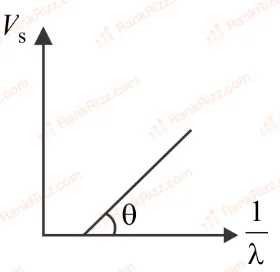
In a photoelectric effect experiment, the graph of stopping potential VV versus reciprocal of wavelength obtained is shown in the figure. As the intensity of incident radiation is increased:

Figure for JEE Main 2020 Physics question on Photoelectric effect and Einstein's equation
  1. A

    Straight line shifts to right

  2. B

    Slope of the straight line get more steep

  3. C

    Straight line shifts to left

  4. D

    Graph does not change

JEE MAIN 2020 · 04 SEP S1Photoelectric effect and Einstein's equationTRANSCRIBED

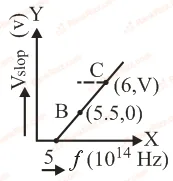
Given figure shows few data points in a photo-electric effect experiment for a certain metal. The minimum energy for ejection of electrons from its surface is: (Planck's constant h = 6.62 ×\times 10−34^{-34} J.s)

Figure for JEE Main 2020 Physics question on Photoelectric effect and Einstein's equation
  1. A

    2.27 eV

  2. B

    2.59 eV

  3. C

    1.93 eV

  4. D

    2.10 eV

JEE MAIN 2020 · 05 SEP S2Photoelectric effect and Einstein's equationTRANSCRIBED

The surface of a metal is illuminated alternately with photons of energies E1=4 eVE_1 = 4\,\text{eV} and E2=2.5 eVE_2 = 2.5\,\text{eV} respectively. The ratio of maximum speeds of the photoelectrons emitted in the two cases is 2. The work function of the metal in (eV) is..........

JEE MAIN 2020 · 02 SEP S1Photoelectric effect and Einstein's equationTRANSCRIBED

When radiation of wavelength A is used to illuminate a metallic surface, the stopping potential is V. When the same surface is illuminated with radiation of wavelength 3A, the stopping potential is V4\frac{V}{4}. If the threshold wavelength for the metallic surface is nλn\lambda then value of n will be ___________.

JEE MAIN 2019 · 12 JAN S2Photoelectric effect and Einstein's equationTRANSCRIBED

When a certain photosensitive surface is illuminated with monochromatic light of frequency ν\nu, the stopping potential of the photo current is −V02-\frac{V_0}{2}. When the surface is illuminated by monochromatic light of frequency ν2\frac{\nu}{2}, the stopping potential is −V0-V_0. The threshold frequency for photoelectric emission is

  1. A

    5ν3\frac{5\nu}{3}

  2. B

    3ν2\frac{3\nu}{2}

  3. C

    43ν\frac{4}{3}\nu

  4. D

    2ν2\nu

JEE MAIN 2019 · 10 APR S1Photoelectric effect and Einstein's equationTRANSCRIBED

In a photoelectric effect experiment, the threshold wavelength of light is 380 nm. If the wavelength of incident light is 260 nm, the maximum kinetic energy of emitted electrons will be
Given E (in eV) = 1237λ(in nm)\frac{1237}{\lambda(\text{in nm})}

  1. A

    4.5 eV

  2. B

    3.0 eV

  3. C

    1.5 eV

  4. D

    15.1 eV

JEE MAIN 2019 · 09 JAN S2Photoelectric effect and Einstein's equationTRANSCRIBED

The magnetic field associated with a light wave is given, at the origin, by B=B0[sin⁡(3.14×10⁷)ct+sin⁡(6.28×10⁷)ct]B = B_0 [\sin(3.14 \times 10^7)ct + \sin(6.28 \times 10^7)ct]. If this light falls on a silver plate having a work function of 4.7 eV, what will be the maximum kinetic energy of the photoelectrons? (c=3×10⁸c = 3 \times 10^8 m s−1^{-1}, h=6.6×10⁻³⁴h = 6.6 \times 10^{-34} J s)

  1. A

    6.82 eV

  2. B

    7.72 eV

  3. C

    12.5 eV

  4. D

    8.52 eV

JEE MAIN 2019 · 11 JAN S2Photoelectric effect and Einstein's equationTRANSCRIBED

In a photoelectric experiment, the wavelength of the light incident on a metal is changed from 300 nm to 400 nm. The decrease in the stopping potential is close to: (hce=1240 nm⋅V)\left(\frac{hc}{e} = 1240 \text{ nm} \cdot V\right)

  1. A

    0.5 V

  2. B

    1.5 V

  3. C

    1.0 V

  4. D

    2.0 V

JEE MAIN 2019 · 09 APR S1Photoelectric effect and Einstein's equationTRANSCRIBED

The electric field of light wave is given as E⃗=10−3cos⁡(2πx5×10−7−2π×6×1014t)x^NC\vec{E} = 10^{-3} \cos\left(\frac{2\pi x}{5 \times 10^{-7}} - 2\pi \times 6 \times 10^{14}t\right) \hat{x} \frac{N}{C}. This light falls on a metal plate of work function 2 eV. The stopping potential of the photo-electrons is: Given, E (in eV) = 12375λ(in A˚)\frac{12375}{\lambda(\text{in } \mathring{A})}

  1. A

    0.72 V

  2. B

    2.0 V

  3. C

    2.48 V

  4. D

    0.48 V

JEE MAIN 2019 · 12 APR S1Photoelectric effect and Einstein's equationTRANSCRIBED

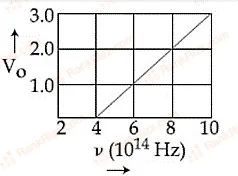
The stopping potential V0_0 (in volt) as a function of frequency (ν\nu) for a sodium emitter, is shown in the figure. The work function of sodium, from the data plotted in the figure, will be:
(Given: Planck's constant h = 6.63×10−346.63 \times 10^{-34} J s, electron charge (e) = 1.6×10−191.6 \times 10^{-19} C)

Figure for JEE Main 2019 Physics question on Photoelectric effect and Einstein's equation
  1. A

    2.12 eV

  2. B

    1.82 eV

  3. C

    1.95 eV

  4. D

    1.66 eV

JEE MAIN 2019 · 10 JAN S2Photoelectric effect and Einstein's equationTRANSCRIBED

A metal plate of area 1×10−41 \times 10^{-4} m2^2 is illuminated by a radiation of intensity 16 m W/m2^2. The work function of the metal is 5 eV. The energy of the incident photons is 10 eV and only 10% of it produces photo electrons. The number of emitted photo electrons per second and their maximum energy, respectively, will be: [1eV=1.6×10−191eV = 1.6 \times 10^{-19} J]

  1. A

    101410^{14} and 10 eV

  2. B

    101210^{12} and 5 eV

  3. C

    101110^{11} and 5 eV

  4. D

    101010^{10} and 5 eV

JEE MAIN 2019 · 09 JAN S1Photoelectric effect and Einstein's equationTRANSCRIBED

The surface of certain metal is first illuminated with light of wavelength λ1=350\lambda_1 = 350 nm and then, by a light of wavelength λ2=540\lambda_2 = 540 nm. It is found that the maximum speed of the photoelectrons in the two cases differ by a factor of 2. The work function of the metal (in eV) is close to (Energy of photon =1240λ  in  nm= \frac{1240}{\lambda \; in \; nm} eV)

  1. A

    2.5

  2. B

    1.8

  3. C

    5.6

  4. D

    1.4

JEE MAIN 2017 · 08 APR ONLINEPhotoelectric effect and Einstein's equationTRANSCRIBED

The maximum velocity of the photoelectrons emitted from the surface is vv when light of frequency nn falls on a metal surface. If the incident frequency is increased to 3n3n, the maximum velocity of the ejected photoelectrons will be:

  1. A

    more than 3v\sqrt{3}v

  2. B

    equal to 3v\sqrt{3}v

  3. C

    vv

  4. D

    less than 3v\sqrt{3}v