JEE MAIN 2020 · 04 SEP S2+4 / −1EASYTRANSCRIBED
JEE Main 2020 Physics question — Photoelectric effect and Einstein's equation
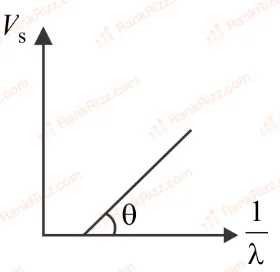
In a photoelectric effect experiment, the graph of stopping potential versus reciprocal of wavelength obtained is shown in the figure. As the intensity of incident radiation is increased:
SOLUTION
, and the work function are constants for a given photosensitive material, the graph is entirely independent of intensity.
Increasing the intensity only increases the number of photons and the saturation current, leaving the stopping potential and the graph unaltered
Tagged Photoelectric effect and Einstein's equation. Machine-assigned, so read it as a strong shortlist rather than a verdict.