JEE MAIN 2024 · 27 JAN S2Photoelectric effect and Einstein's equationTRANSCRIBED
The threshold frequency of a metal with work function 6.63 eV is :
- A
Hz
- B
Hz
- C
Hz
- D
Hz
Every JEE Main question on Photoelectric effect and Einstein's equation, one of the ideas inside Dual Nature of Radiation & Matter: 98 questions from 2004–2026, 52 of them in the last five years. Newest first, answer key on every one. Free to read.
Questions
98
Years asked
19
Since
2004
Of the chapter
45%
21–40 OF 98 · NEWEST FIRST
The threshold frequency of a metal with work function 6.63 eV is :
Hz
Hz
Hz
Hz
In a photoelectric effect experiment a light of frequency 1.5 times the threshold frequency is made to fall on the surface of photosensitive material. Now if the frequency is halved and intensity is doubled, the number of photo electrons emitted will be:
Doubled
Quadrupled
Zero
Halved
Given below are two statements: one is labelled as Assertion A and the other is labelled as Reason R. Assertion A: Number of photons increases with increase in frequency of light. Reason R: Maximum kinetic energy of emitted electrons increases with the frequency of incident radiation. In the light of the above statements, choose the most appropriate answer from the options given below:
Both A and R are correct and R is the correct explanation of A.
Both A and R are correct and R is NOT the correct explanation of A.
A is not correct but R is correct.
A is correct but R is not correct.
Which of the following statement is not true about stopping potential ?
It is times the maximum kinetic energy of electrons emitted.
It increases with increase in intensity of the incident light.
It depends on the nature of emitter material.
It depends upon frequency of the incident light.
When UV light of wavelength is incident on the metal surface having work function , electron emission takes place. The stopping potential is: (Given )
Which figure shows the correct variation of applied potential difference (V) with photoelectric current (I) at two different intensities of light of same wavelengths:
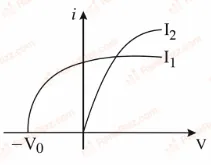
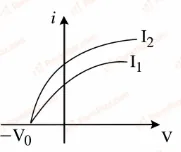
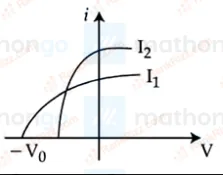
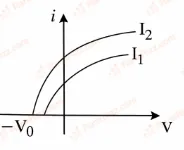
The work function of a substance is . The longest wavelength of light that can cause the emission of photoelectrons from this substance is approximately:
When a metal surface is illuminated by light of wavelength , the stopping potential is V. When the same surface is illuminated by light of wavelength , stopping potential is V. The threshold wavelength for this surface is :
Given below are two statements :
Statement I :
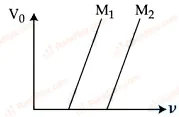
Figure shows the variation of stopping potential with frequency for the two photosensitive materials and . The slope gives value of , where is Planck's constant, is the charge of electron.
Statement II : will emit photoelectrons of greater kinetic energy for the incident radiation having same frequency.
In the light of the above statements, choose the most appropriate answer from the options given below.
Both Statement I and Statement II are correct
Statement I is incorrect but Statement II is correct
Both Statement I and Statement II are incorrect
Statement I is correct and Statement II is incorrect
Given below are two statements:
Statement I : Out of microwaves, infrared rays and ultraviolet rays, ultraviolet rays are the most effective for the emission of electrons from a metallic surface
Statement II : Above the threshold frequency, the maximum kinetic energy of photoelectrons is inversely proportional to the frequency of the incident light
In the light of above statements, choose the correct answer from the options given below
Statement I is false but Statement II is true
Statement I is true but Statement II is false
Both Statement I and Statement II are true
Both Statement I and Statement II are false
The threshold wavelength for photoelectric emission from a material is . Photoelectrons will be emitted, when this material is illuminated with monochromatic radiation from a
A. 75 W infra-red lamp
B. 10 W infra-red lamp
C. 75 W ultra-violet lamp
D. 10 W ultra-violet lamp
Choose the correct answer from the options given below:
B and C only
A and D only
C only
C and D only
The variation of stopping potential as a function of the frequency of the incident light for a metal is shown in figure. The work function of the surface is
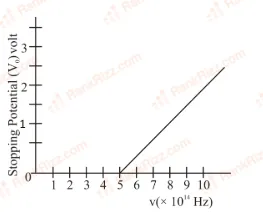
2.98 eV
2.07 eV
1.36 eV
18.6 eV
From the photoelectric effect experiment, following observations are made. Identify which of these are correct
A. The stopping potential depends only on the work function of the metal.
B. The saturation current increases as the intensity of incident light increases.
C. The maximum kinetic energy of a photo electron depends on the intensity of the incident light.
D. Photoelectric effect can be explained using wave theory of light.
Choose the correct answer from the options given below:
B, C only
A, C, D only
B only
A, B, D only
From the photoelectric effect experiment, following observations are made. Identify which of these are correct:
A. The stopping potential depends only on the work function of the metal.
B. The saturation current increases as the intensity of incident light increases.
C. The maximum kinetic energy of a photo electron depends on the intensity of the incident light.
D. Photoelectric effect can be explained using wave theory of light.
Choose the correct answer from the options given below:
B, C only
A, C, D only
B only
A, B, D only
The threshold frequency of metal is . When the light of frequency is incident on the metal plate, the maximum velocity of photoelectron is . When the frequency of incident radiation is increased to , the maximum velocity of photoelectrons emitted is . The ratio of to is:
The difference between threshold wavelengths for two metal surfaces and having work function eV and eV in nm is:
{Given, eV nm}
If the two metals and are exposed to radiation of wavelength 350 nm. The work functions of metals and are 4.8 eV and 2.2 eV. Then choose the correct option
Metal B will not emit photo-electrons
Both metals A and B will emit photo-electrons
Both metals A and B will not emit photoelectrons
Metal A will not emit photo-electrons
In photoelectric effect
A. The photocurrent is proportional to the intensity of the incident radiation.
B. Maximum kinetic energy with which photoelectrons are emitted depends on the intensity of incident light.
C. Max K.E. with which photoelectrons are emitted depends on the frequency of incident light.
D. The emission of photoelectrons require a minimum threshold intensity of incident radiation.
E. Max K.E. of the photoelectrons is independent of the frequency of the incident light.
Choose the correct option from the options given below:
A and B only
A and E only
A and C only
B and C only
A metallic surface is illuminated with radiation of wavelength , the stopping potential is . If the same surface is illuminated with radiation of wavelength , the stopping potential becomes . The threshold wavelength for this metallic surface will be
Given below are two statements:
Statement I: Stopping potential in photoelectric effect does not depend on the power of the light source.
Statement II: For a given metal, the maximum kinetic energy of the photoelectron depends on the wavelength of the incident light.
In the light of above statements, choose the most appropriate answer from the options given below.
Statement I is incorrect but statement II is correct
Both Statement I and Statement II are incorrect
Statement I is correct but statement II is incorrect
Both statement I and statement II are correct
RELATED DUAL NATURE OF RADIATION & MATTER TOPICS