Radiation of wavelength is incident on a photocell. The fastest emitted photoelectron has a speed v. If the wavelength is changed to , the speed of the fastest emitted photoelectron will be:
- A
- B
- C
- D
Every JEE Main question on Photoelectric effect and Einstein's equation, one of the ideas inside Dual Nature of Radiation & Matter: 98 questions from 2004–2026, 52 of them in the last five years. Newest first, answer key on every one. Free to read.
Questions
98
Years asked
19
Since
2004
Of the chapter
45%
81–98 OF 98 · NEWEST FIRST
Radiation of wavelength is incident on a photocell. The fastest emitted photoelectron has a speed v. If the wavelength is changed to , the speed of the fastest emitted photoelectron will be:
When photons of wavelength are incident on an isolated sphere, the corresponding stopping potential is found to be . When photons of wavelength are used, the corresponding stopping potential was thrice that of the above value. If light of wavelength is used then find the stopping potential for this case:
A photoelectric surface is illuminated successively by monochromatic light of wavelengths and . If the maximum kinetic energy of the emitted photoelectrons in the second case is 3 times that in the first case, the work function of the surface is:
A beam of light has two wavelengths of 4972 and 6216 with a total intensity of Wm equally distributed among the two wavelengths. The beam falls normally on an area of 1 cm of a clean metallic surface of work function 2.3 eV. Assume that there is no loss of light by reflection and that each capable photon ejects one electron. The number of photoelectrons liberated in 2 s is approximately:
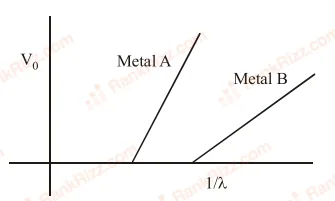
In an experiment on photoelectric effect, a student plots stopping potential against reciprocal of the wavelength of the incident light for two different metals A and B. These are shown in the figure.

Looking at the graphs, you can most appropriately say that:
Work function of metal B is greater than that of metal A
For light of certain wavelength falling on both metal, maximum kinetic energy of electrons emitted from A will be greater than those emitted from B.
Work function of metal A is greater than that of metal B
Students data is not correct
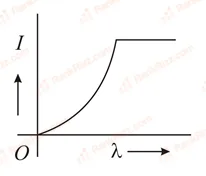
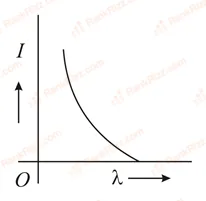
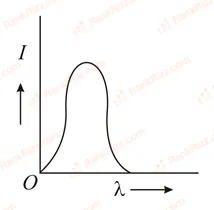
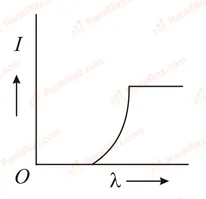
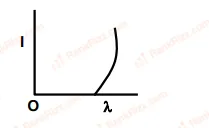
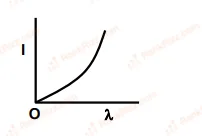
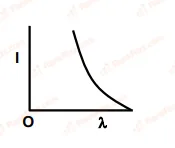
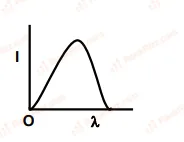
The anode voltage of a photocell is kept fixed. The wavelength of the light falling on the cathode is gradually changed. The plate current I of the photocell varies as follows :


A copper ball of radius 1 cm and work function 4.47 eV is irradiated with ultraviolet radiation of wavelength 2500 . The effect of irradiation results in the emission of electrons from the ball. Further the ball will acquire charge and due to this there will be a finite value of the potential on the ball. The charge acquired by the ball is :
C
C
C
C
Photoelectrons are ejected from a metal when light of frequency falls on it. Pick out the wrong statement from the following.
No electrons are emitted if is less than , where is the work function of the metal
The ejection of the photoelectrons is instantaneous.
The maximum energy of the photoelectrons is .
The maximum energy of the photoelectrons is independent of the intensity of the light.
This question has Statement 1 and Statement 2. Of the four choices given after the Statements, choose the one that best describes the two Statements. Statement 1: A metallic surface is irradiated by a monochromatic light of frequency (the threshold frequency). If the incident frequency is now doubled, the photocurrent and the maximum kinetic energy are also doubled. Statement 2: The maximum kinetic energy of photoelectrons emitted from a surface is linearly dependent on the frequency of the incident light. The photocurrent depends only on the intensity of the incident light.
Statement 1 is true, Statement 2 is true, Statement 2 is the correct explanation of Statement 1.
Statement 1 is false, Statement 2 is true.
Statement 1 is true, Statement 2 is false.
Statement 1 is true, Statement 2 is true, Statement 2 is not the correct explanation of Statement 1.
This question has Statement-1 and Statement-2. Of the four choices given after the statements, choose the one that best describes the two statements. Statement-1: A metallic surface is irradiated by a monochromatic light of frequency (the threshold frequency). The maximum kinetic energy and the stopping potential are and respectively. If the frequency incident on the surface doubled, both the and are also doubled. Statement-2: The maximum kinetic energy and the stopping potential of photoelectrons emitted from a surface are linearly dependent on the frequency of incident light.
Statement-1 is true, Statement-2 is true; Statement-2 is the correct explanation of Statement-1.
Statement-1 is true, Statement-2 is true; Statement-2 is not the correct explanation of Statement-1.
Statement-1 is false, Statement-2 is true.
Statement-1 is true, Statement-2 is false.
Statement-1 : When ultraviolet light is incident on a photocell, its stopping potential is and the maximum kinetic energy of the photoelectrons is . When the ultraviolet light is replaced by X-rays, both and increase. Statement-2 : Photoelectrons are emitted with speeds ranging from zero to a maximum value because of the range of frequencies present in the incident light. Of the four choices given after the statements, choose the one that best describes the two statements.
Statement-1 is true, Statement-2 is true; Statement-2 is the correct explanation of Statement-1.
Statement-1 is true, Statement-2 is true; Statement-2 is not the correct explanation of Statement-1.
Statement-1 is false, Statement-2 is true.
Statement-1 is true, Statement-2 is false.
The surface of a metal is illuminated with the light of nm. The kinetic energy of the ejected photoelectrons was found to be eV. The work function of the metal is (hc eVnm)
eV
eV
eV
eV
The time by a photoelectron to come out after the photon strikes is approximately
The threshold frequency for a metallic surface corresponds to an energy of , and the stopping potential for a radiation incident on this surface . The incident radiation lies in
X-ray region
ultra-violet region
infra-red region
visible region
The anode voltage of a photocell is kept fixed. The wavelength of the light falling on the cathode is gradually changed. The plate current of the photocell varies as follows :


A photocell is illuminated by a small bright source placed m away. When the same source of light is placed m away, the number of electrons emitted by photo cathode would
decrease by a factor of 4
increase by a factor of 4
decrease by a factor of 2
increase by a factor of 2
According to Einstein's photoelectric equation, the plot of the kinetic energy of the emitted photo electrons from a metal the frequency, of the incident radiation gives straight line whose slope
depends on the nature of the metal used
depends on the intensity of the radiation
depends both on the intensity of the radiation and the metal used
is the same for all metals and independent of the intensity of the radiation.
The work function of a substance is eV. Then longest wavelength of light that can cause photoelectron emission from this substance approximately
nm
nm
nm
nm
RELATED DUAL NATURE OF RADIATION & MATTER TOPICS