JEE MAIN 2020 · 09 JAN S2Solubility product and common ion effectTRANSCRIBED
The solubility product of at 298K is . The concentration of hydroxide ions in a saturated solution of will be:
- A
- B
- C
- D
Every Chemical and Ionic Equilibrium question JEE Main has set, grouped by the idea it tests rather than the order of the syllabus. 274 questions across 10 distinct ideas. Free to read, answer key on every one.
Questions
274
Distinct ideas
10
Share of marks
5.7%
Difficulty
MEDIUM
A chapter is not one subject — it is a handful of procedures the examiner reuses. These are the ones Chemical and Ionic Equilibrium questions actually test.
161–180 OF 274 · NEWEST FIRST
The solubility product of at 298K is . The concentration of hydroxide ions in a saturated solution of will be:
For the following Assertion and Reason, the correct option is:
Assertion (A): When Cu (II) and sulphide ions are mixed, they react together extremely quickly to give a solid.
Reason (R): The equilibrium constant of is high because the solubility product is low.
(A) is false and (R) is true.
Both (A) and (R) are false.
Both (A) and (R) are true but (R) is not the explanation for (A).
Both (A) and (R) are true and (R) is the explanation for (A).
The stoichiometry and solubility product of a salt with the solubility curve given below is, respectively:
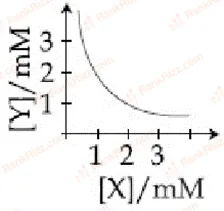
XY, M
XY, M
XY, M
XY, M
For the following Assertion and Reason, the correct option is:
Assertion: The pH of water increases with increase in temperature.
Reason: The dissociation of water into H and OH is an exothermic reaction.
Both assertion and reason are true, and the reason is the correct explanation for the assertion.
Both assertion and reason are false.
Both assertion and reason are true, but the reason is not the correct explanation for the assertion.
Assertion is not true, but reason is true.
The for the following dissociation is
Which of the following choices is correct for a mixture of 300 mL 0.134 M and 100 mL 0.4 M NaCl?
Not enough data provided
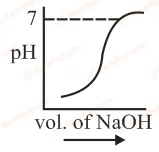
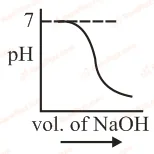
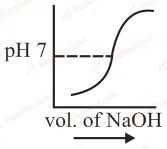
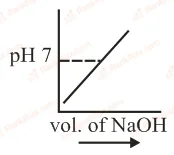
100 mL of 0.1 M HCl is taken in a beaker and to it 100 mL 0.1 M NaOH of is added in steps of 2 mL and the pH is continuously measured. Which of the following graphs correctly depicts the change in pH?
The strength of an aqueous NaOH solution is most accurately determined by titrating: (Note: consider that an appropriate indicator is used)
Aq. NaOH in a pipette and aqueous oxalic acid in a burette
Aq. NaOH in a burette and aqueous oxalic acid in a conical flask
Aq. NaOH in a burette and concentrate HSO in a conical flask
Aq. NaOH in a volumetric flask and concentrated HSO in a conical flask
If the equilibrium constant for is and that of is , the equilibrium constant for is:
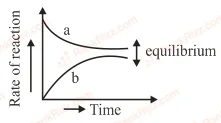
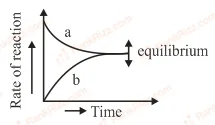
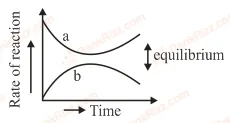
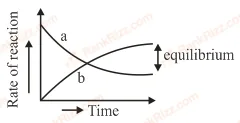
For the equilibrium , the variation of the rate of the forward (a) and reverse (b) reaction with time is given by:
A soft drink was bottled with a partial pressure of of over the liquid at room temperature. The partial pressure of over the solution approaches a value of when of is dissolved in of water at room temperature. The approximate pH of the soft drink is __________ . (First dissociation constant of ; ; density of the soft drink )
Two solutions, A and B, each of 100L was made by dissolving 4g of NaOH and 9.8g of HSO in water, respectively. The pH of the resultant solution obtained from mixing 40L of solution A and 10L of solution B is (log 2 = 0.3)
For a reaction , of X, of Y and of Z were taken in a 1L vessel and allowed to react. At equilibrium, the concentration of Z was . The equilibrium constant of the reaction is . The value of x is.......
3 g of acetic acid is added to 250 mL of 0.1 M HCl and the solution made up to 500 mL. To 20 mL of this solution mL of 5M NaOH is added. The pH of the solution is
[Given: pKa of acetic acid = 4.75, molar mass of acetic acid 60 g/mol, log 3 = 0.4771, Neglect any changes in volume]
If the solubility product of is , then the solubility of in pure water is ______ [Assuming that neither kind of ion reacts with water]
The incorrect match in the following is:
\Delta G^0 < 0, K > 1
\Delta G^0 > 0, K < 1
\Delta G^0 < 0, K < 1
If solubility product of Zr(PO) is denoted by K and its molar solubility is denoted by S, then which of the following relation between S and K is correct?
What are the values of for the following reactions at 300 K respectively?
(At 300 K, RT = 24.62 dm atm mol)
24.63 dm atm mol, 606.0 dm atm mol, dm atm mol
1, 24.62 dm atm mol, 606.0 dm atm mol
1, 24.62 dm atm mol, dm atm mol
1, dm atm mol, 606 dm atm mol
5.1 g is introduced in 3.0 L evacuated flask at 327C. 30% of the solid is decomposed to and as gases. The of the reaction at 327C is: ( L atm mol K, Molar mass of S = 32 g mol, Molar mass of N = 14 g mol)
0.242 atm
atm
atm
atm
In which one of the following equilibria, K ≠ K?
2HI(g) H(g) + I(g)
2C(s) + O(g) 2CO(g)
2NO(g) N(g) + O(g)
NO(g) + SO(g) NO(g) + SO(g)
Consider the reaction . The equilibrium constant of the above reaction is . If pure ammonia is left to dissociate, the partial pressure of ammonia at equilibrium is given by (Assume that at equilibrium)
OTHER CHEMISTRY CHAPTERS