JEE MAIN 2021 · 27 JUL S2Law of mass action and equilibrium constants Kc and KpTRANSCRIBED
The equilibrium constant for the reaction is . At equilibrium, the partial pressure of O is _________ atm. (Round off to the nearest integer)
Every Chemical and Ionic Equilibrium question JEE Main has set, grouped by the idea it tests rather than the order of the syllabus. 274 questions across 10 distinct ideas. Free to read, answer key on every one.
Questions
274
Distinct ideas
10
Share of marks
5.7%
Difficulty
MEDIUM
A chapter is not one subject — it is a handful of procedures the examiner reuses. These are the ones Chemical and Ionic Equilibrium questions actually test.
141–160 OF 274 · NEWEST FIRST
The equilibrium constant for the reaction is . At equilibrium, the partial pressure of O is _________ atm. (Round off to the nearest integer)
The OH concentration in a mixture of 5.0 mL of 0.0504 M NHCl and 2 mL of 0.0210 M NH solution is M. The value of is _________ (Nearest integer) [Given and ]
Value of K for the equilibrium reaction NO(g) 2NO(g) at 288 K is 47.9. The K for this reaction at same temperature is (Nearest integer)
(R = 0.083 L bar K mol)
The pH of ammonium phosphate solution, if of phosphoric acid and of ammonium hydroxide are 5.23 and 4.75 respectively, is ______
Assuming that Ba(OH) is completely ionised in aqueous solution under the given conditions the concentration of HO ions in 0.005M aqueous solution of Ba(OH) at 298 K is _________ mol L. (Nearest integer)
At 1990 K and 1 atm pressure, there are equal number of molecules and Cl atoms in the reaction mixture. The value of for the reaction under the above conditions is . The value of is ______ (Rounded off to the nearest integer)
Two salts and MX have the same value of solubility product of . The ratio of their molar solubilities i.e. = ________. (Round off to the Nearest Integer).
The solubility product of is . The solubility of lead iodide in 0.1 molar solution of lead nitrate is mol/L. The value of x is ______ (Rounded off to the nearest integer)
[Given ]
3.0 moles of PCl is introduced in a 1L closed reaction vessel at 380 K. The number of moles of PCl at equilibrium is _________ (Round off to the Nearest Integer)
For the reaction
A + B 2C
the value of equilibrium constant is 100 at 298 K. If the initial concentration of all the three species is 1 M each, then the equilibrium concentration of C is M. The value of x is ___. (Nearest integer)
When 5.1 g of solid NHHS is introduced into a two litre evacuated flask at 27°C, 20% of the solid decomposes into gaseous ammonia and hydrogen sulphide. The K for the reaction at 27°C is . The value of x is _________. (Integer answer)
[Given 1R = 0.082 L atm K mol]
0.01 moles of a weak acid HA () is dissolved in 1.0 L of 0.1M HCl solution. The degree of dissociation of HA is ________ . (Round off to the Nearest Integer). [Neglect volume change on adding HA and assume degree of dissociation << 1]
The molar solubility of Zn(OH) in 0.1M NaOH solution is M. The value of x is _________. (Nearest integer)
Given: The solubility product of Zn(OH) is
The variation of equilibrium constant with temperature is given below:
Temperature: , Equilibrium Constant:
,
The values of , at and at (in ) respectively, are close to [use ]
28.4, and
0.64, and
28.4, and
0.64, and
For the reaction
The value of is 64 at 800 K for the reaction
The value of for the following reaction is:
1/64
8
1/4
1/8
Consider the following reaction:
For each of the following cases (a, b), the direction in which the equilibrium shifts is:
(a) Temperature is decreased.
(b) Pressure is increased by adding at constant T.
(a) towards product, (b) towards reactant
(a) towards reactant, (b) towards product
(a) towards reactant, (b) no change
(a) towards product, (b) no change
An acidic buffer is obtained on mixing:
100 mL of 0.1 M CHCOOH and 100 mL of 0.1 M NaOH
100 mL of 0.1 M HCl and 200 mL of 0.1 M NaCl
100 mL of 0.1 M CHCOOH and 200 mL of 0.1 M NaOH
100 mL of 0.1 M HCl and 200 mL of 0.1 M CHCOONa
In the figure shown below reactant A (represented by square) is in equilibrium with product B (represented by circle). The equilibrium constant is (approx):
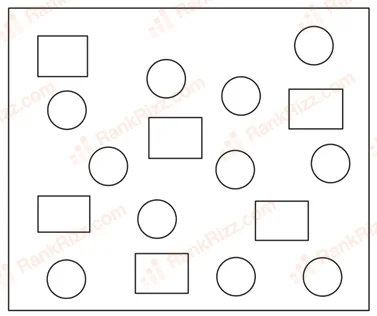
4
8
1
2
Arrange the following solutions in the decreasing order of pOH:
(A) 0.01 M HCl
(B) 0.01 M NaOH
(C) 0.01 M
(D) 0.01 M NaCl
OTHER CHEMISTRY CHAPTERS