RankRizz

Arrhenius equation and activation energy — JEE Main Previous Year Questions

Every JEE Main question on Arrhenius equation and activation energy, one of the ideas inside Chemical Kinetics: 62 questions from 2005–2026, 32 of them in the last five years. Newest first, answer key on every one. Free to read.

Questions

62

Years asked

16

Since

2005

Of the chapter

27%

Every Arrhenius equation and activation energy question

41–60 OF 62 · NEWEST FIRST

JEE MAIN 2020 · 09 JAN S1Arrhenius equation and activation energyTRANSCRIBED

For the following reactions:
A→700KProductA \xrightarrow{700K} Product
A→catalyst500KProductA \xrightarrow[catalyst]{500K} Product
It was found that the EaE_a is decreased by 30 KJ/mol in the presence of catalyst. If the rate remains unchanged, the activation energy for catalysed reaction is (Assume pre-exponential factor is same):

  1. A

    75 KJ/mol

  2. B

    105 KJ/mol

  3. C

    135 KJ/mol

  4. D

    198 KJ/mol

JEE MAIN 2020 · 08 JAN S1Arrhenius equation and activation energyTRANSCRIBED

The rate of a certain biochemical reaction at physiological temperature (T) occurs 10610^6 times faster with enzyme than without. The change in the activation energy upon adding enzyme is:

  1. A

    −6(2.303)RT-6(2.303)RT

  2. B

    −6RT-6RT

  3. C

    +6(2.303)RT+6(2.303)RT

  4. D

    +6RT+6RT

JEE MAIN 2020 · 05 SEP S2Arrhenius equation and activation energyTRANSCRIBED

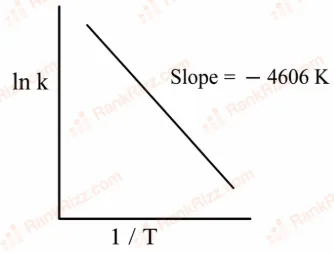
The rate constant (k)(k) of a reaction is measured at different temperature (T)(T), and the data are plotted in the given figure. The activation energy of the reaction in kJ mol−1\text{kJ mol}^{-1} is: (R is gas constant)

Figure for JEE Main 2020 Chemistry question on Arrhenius equation and activation energy
  1. A

    2/R2/R

  2. B

    1/R1/R

  3. C

    RR

  4. D

    2R2R

JEE MAIN 2020 · 09 JAN S2Arrhenius equation and activation energyTRANSCRIBED

A sample of milk splits after 60 min at 300K and after 40 min at 400K when the population of lactobacillus acidophilus in it doubles. The activation energy (in kJ/mol) for this process is closest to ___________.
(Given, R=8.3R = 8.3 J mol−1^{-1} K−1^{-1}, ln⁡(23)=0.4\ln\left(\frac{2}{3}\right) = 0.4, e−3=4.0e^{-3} = 4.0)

JEE MAIN 2020 · 06 SEP S2Arrhenius equation and activation energyTRANSCRIBED

The rate of a reaction decreased by 3.555 times when the temperature was changed from 40 ∘C40\,^\circ\text{C} to 30 ∘C30\,^\circ\text{C}. The activation energy (in kJ mol−1\text{kJ mol}^{-1}) of the reaction is______.

JEE MAIN 2020 · 04 SEP S2Arrhenius equation and activation energyTRANSCRIBED

The number of molecules with energy greater than the threshold energy for a reaction increases five fold by a rise of temperature from 27°C to 42°C. Its energy of activation in J/mol is __________ (Take ln 5 = 1.6094; R = 8.314 J mol−1^{-1})

JEE MAIN 2019 · 09 APR S2Arrhenius equation and activation energyTRANSCRIBED

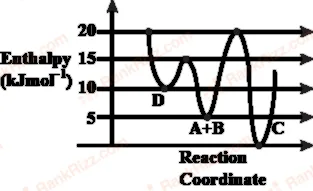
Consider the given plot of enthalpy of the following reaction between A and B.
A + B →\rightarrow C + D. Identify the incorrect statement.

Figure for JEE Main 2019 Chemistry question on Arrhenius equation and activation energy
  1. A

    Formation of A and B from C has highest enthalpy of activation.

  2. B

    D is kinetically stable product.

  3. C

    C is the thermodynamically stable product.

  4. D

    Activation enthalpy to form C is 5 kJ mol−1^{-1} less than that to form D.

JEE MAIN 2019 · 12 JAN S2Arrhenius equation and activation energyTRANSCRIBED

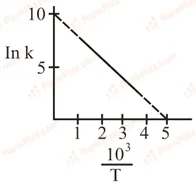
For a reaction, consider the plot of ln k versus 1/T given in the figure. If the rate constant of this reaction at 400 K is 10−5s−110^{-5} s^{-1}, then the rate constant at 500 K is:

Figure for JEE Main 2019 Chemistry question on Arrhenius equation and activation energy
  1. A

    10−4s−110^{-4} s^{-1}

  2. B

    10−6s−110^{-6} s^{-1}

  3. C

    2×10⁻⁴s−12 \times 10^{-4} s^{-1}

  4. D

    4×10⁻⁴s−14 \times 10^{-4} s^{-1}

JEE MAIN 2019 · 11 JAN S1Arrhenius equation and activation energyTRANSCRIBED

If a reaction follows the Arrhenius equation, the plot ln⁡k\ln k vs 1(RT)\frac{1}{(RT)} gives straight line with a gradient (−y)(-y) unit. The energy required to activate the reactant is:

  1. A

    y/Ry/R unit

  2. B

    yy unit

  3. C

    yRyR unit

  4. D

    −y-y unit

JEE MAIN 2019 · 10 APR S2Arrhenius equation and activation energyTRANSCRIBED

For the reaction of H2_2 with I2_2, the rate constant is 2.5×10−42.5 \times 10^{-4} dm3^3 mol−1^{-1} s−1^{-1} at 327°C and 1.0 dm3^3 mol−1^{-1} s−1^{-1} at 527°C. The activation energy for the reaction, in kJ mol−1^{-1} is:
R = 8.314 JK−1^{-1} mol−1^{-1}

  1. A

    166

  2. B

    59

  3. C

    72

  4. D

    150

JEE MAIN 2019 · 10 JAN S1Arrhenius equation and activation energyTRANSCRIBED

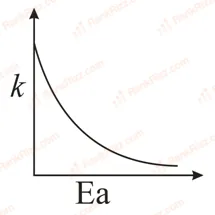
Consider the given plots for a reaction obeying Arrhenius equation (0∘0^{\circ}C < T < 300∘^{\circ}C): (K and EaE_a are rate constant and activation energy, respectively)

Figure for JEE Main 2019 Chemistry question on Arrhenius equation and activation energy Figure for JEE Main 2019 Chemistry question on Arrhenius equation and activation energy
  1. A

    I is wrong but II is right

  2. B

    Both I and II are wrong

  3. C

    I is right but II is wrong

  4. D

    Both I and II are correct

JEE MAIN 2017 · 02 APR OFFLINEArrhenius equation and activation energyTRANSCRIBED

Two reactions A1_{1} and A2_{2} have identical pre-exponential factors. The activation energy of A1_{1} is more than A2_{2} by 10 kJ mol−1^{-1}. If k1_{1} and k2_{2} are the rate constants for reactions A1_{1} and A2_{2}, respectively at 300 K, then ln⁡k2k1\ln\frac{k_{2}}{k_{1}} is equal to
(R = 8.314 J mol−1^{-1} K−1^{-1})

  1. A

    12

  2. B

    6

  3. C

    4

  4. D

    8

JEE MAIN 2017 · 08 APR ONLINEArrhenius equation and activation energyTRANSCRIBED

The rate of a reaction A doubles on increasing the temperature from 300 to 310 K. By how much, the temperature of reaction B should be increased from 300 K so that rate doubles if activation energy of the reaction B is twice to that of reaction A.

  1. A

    4.92 K

  2. B

    9.84 K

  3. C

    19.67 K

  4. D

    2.45 K

JEE MAIN 2017 · 09 APR ONLINEArrhenius equation and activation energyTRANSCRIBED

The rate of a reaction quadruples when the temperature changes from 300 to 310 K. The activation energy of this reaction is:
(Assume Activation energy and pre-exponential factor are independent of temperature;
ln(2) = 0.693; R = 8.314 J mol−1^{-1} K−1^{-1})

  1. A

    53.6 kJ mol−1^{-1}

  2. B

    214.4 kJ mol−1^{-1}

  3. C

    107.2 kJ mol−1^{-1}

  4. D

    53.7 kJ mol−1^{-1}

JEE MAIN 2015 · 11 APR ONLINEArrhenius equation and activation energyTRANSCRIBED

For the equilibrium, A(g)⇌B(g)A(g) \rightleftharpoons B(g), ΔH\Delta H is −40-40 kJ/mol. If the ratio of the activation energies of the forward (Ef)(E_f) and reverse (Eb)(E_b) reactions is 23\frac{2}{3} then:

  1. A

    Ef=30E_f = 30 kJ/mol, Eb=70E_b = 70 kJ/mol

  2. B

    Ef=70E_f = 70 kJ/mol, Eb=30E_b = 30 kJ/mol

  3. C

    Ef=80E_f = 80 kJ/mol, Eb=120E_b = 120 kJ/mol

  4. D

    Ef=60E_f = 60 kJ/mol, Eb=100E_b = 100 kJ/mol

JEE MAIN 2014 · 12 APR ONLINEArrhenius equation and activation energyTRANSCRIBED

The rate coefficient (k) for a particular reactions is 1.3×10−41.3 \times 10^{-4} M−1^{-1} s−1^{-1} at 100°C, and 1.3×10−31.3 \times 10^{-3} M−1^{-1} s−1^{-1} at 150°C. What is the energy of activation (EA_A) (in kJ) for this reaction? (R = molar gas constant = 8.314 JK−1^{-1} mol−1^{-1})

  1. A

    16

  2. B

    60

  3. C

    99

  4. D

    132

JEE MAIN 2013 · 22 APR ONLINEArrhenius equation and activation energyTRANSCRIBED

The reaction X →\rightarrow Y is an exothermic reaction. Activation energy of the reaction for X into Y is 150 kJ mol−1^{-1}. Enthalpy of reaction is 135 kJ mol−1^{-1}. The activation energy for the reverse reaction, Y →\rightarrow X will be :

  1. A

    280 kJ mol−1^{-1}

  2. B

    285 kJ mol−1^{-1}

  3. C

    270 kJ mol−1^{-1}

  4. D

    15 kJ mol−1^{-1}

JEE MAIN 2013 · 07 APR ONLINEArrhenius equation and activation energyTRANSCRIBED

The rate of a reaction doubles when its temperature changes from 300K to 310K. Activation energy of such a reaction will be:
(R=8.314(R = 8.314 JK−1^{-1} mol−1^{-1} and log 2 = 0.301))

  1. A

    58.5 kJ mol−1^{-1}

  2. B

    60.5 kJ mol−1^{-1}

  3. C

    53.6 kJ mol−1^{-1}

  4. D

    48.6 kJ mol−1^{-1}

JEE MAIN 2012Arrhenius equation and activation energyTRANSCRIBED

The activation energy for a reaction which doubles the rate when the temperature is raised from 298 K to 308 K is

  1. A

    59.2 kJ mol−1^{-1}

  2. B

    39.2 kJ mol−1^{-1}

  3. C

    52.9 kJ mol−1^{-1}

  4. D

    29.5 kJ mol−1^{-1}

JEE MAIN 2011Arrhenius equation and activation energyTRANSCRIBED

The rate of a chemical reaction doubles for every 10∘C10^\circ \text{C} rise of temperature. If the temperature is raised by 50∘C50^\circ \text{C}, the rate of the reaction increases by about:

  1. A

    2424 times

  2. B

    3232 times

  3. C

    6464 times

  4. D

    1010 times