RankRizz

Arrhenius equation and activation energy — JEE Main Previous Year Questions

Every JEE Main question on Arrhenius equation and activation energy, one of the ideas inside Chemical Kinetics: 62 questions from 2005–2026, 32 of them in the last five years. Newest first, answer key on every one. Free to read.

Questions

62

Years asked

16

Since

2005

Of the chapter

27%

Every Arrhenius equation and activation energy question

21–40 OF 62 · NEWEST FIRST

JEE MAIN 2023 · 24 JAN S1Arrhenius equation and activation energyTRANSCRIBED

The number of correct statement/s from the following is _____.
A. Larger the activation energy, smaller is the value of the rate constant.
B. The higher is the activation energy, higher is the value of the temperature coefficient.
C. At lower temperatures, increase in temperature causes more change in the value of k than at higher temperature.
D. A plot of ln⁡k\ln k vs 1T\frac{1}{T} is a straight line with slope equal to −EaR-\frac{E_a}{R}
JEE MAIN 2023 · 24 JAN S1Arrhenius equation and activation energyTRANSCRIBED

The number of correct statement/s from the following is _____.
A. Larger the activation energy, smaller is the value of the rate constant.
B. The higher is the activation energy, higher is the value of the temperature coefficient.
C. At lower temperatures, increase in temperature causes more change in the value of k than at higher temperature.
D. A plot of ln k vs 1T\frac{1}{T} is a straight line with slope equal to −EaR\frac{-E_a}{R}
JEE MAIN 2023 · 31 JAN S1Arrhenius equation and activation energyTRANSCRIBED

A→BA \rightarrow B
The rate constants of the above reaction at 200 K and 300 K are 0.03 min−1^{-1} and 0.05 min−1^{-1} respectively. The activation energy for the reaction is J (Nearest integer)
(Given: ln 10 = 2.3, R = 8.3 J K−1^{-1} mol−1^{-1}, log 5 = 0.70, log 3 = 0.48, log 2 = 0.30)

JEE MAIN 2023 · 06 APR S1Arrhenius equation and activation energyTRANSCRIBED

For the adsorption of hydrogen on platinum, the activation energy is 30 kJ mol−1^{-1} and for the adsorption of hydrogen on nickel, the activation energy is 41.4 kJ mol−1^{-1}. The logarithm of the ratio of the rates of chemisorption on equal areas of the metals at 300 K is ______ (Nearest integer)
Given: ln10 = 2.3, R = 8.3 J K−1^{-1} mol−1^{-1}

JEE MAIN 2023 · 08 APR S1Arrhenius equation and activation energyTRANSCRIBED

The number of given statement/s which is/are correct is______
(A) The stronger the temperature dependence of the rate constant, the higher is the activation energy.
(B) If a reaction has zero activation energy, its rate is independent of temperature.
(C) The stronger the temperature dependence of the rate constant, the smaller is the activation energy.
(D) If there is no correlation between the temperature and the rate constant then it means that the reaction has negative activation energy.

JEE MAIN 2022 · 29 JUN S1Arrhenius equation and activation energyTRANSCRIBED

The activation energy of one of the reactions in a biochemical process is 532611 J mol−1^{-1}. When the temperature falls from 310 K to 300 K, the change in rate constant observed is k300_{300} = x ×\times 10−3^{-3}k310_{310}. The value of x is ______.
[Given: ln 10 = 2.3 R = 8.3 J K−1^{-1} mol−1^{-1}]

JEE MAIN 2022 · 29 JUN S2Arrhenius equation and activation energyTRANSCRIBED

The equation k=(6.5×10¹²s−1)e−26000K/Tk = (6.5 \times 10^{12} s^{-1})e^{-26000 K/T} is followed for the decomposition of compound A. The activation energy for the reaction is ______ KJ mol−1^{-1}. [nearest integer]
(Given: R = 8.314 J K−1^{-1} mol−1^{-1})

JEE MAIN 2022 · 24 JUN S1Arrhenius equation and activation energyTRANSCRIBED

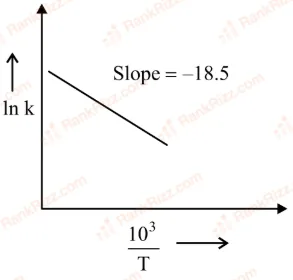
The rate constants for decomposition of acetaldehyde have been measured over the temperature range 700−1000700 - 1000 K. The data has been analysed by plotting ln⁡k\ln k vs 103T\frac{10^3}{T} graph. The value of activation energy for the reaction is ______ kJ mol−1^{-1}. (Nearest integer) (Given : R=8.31R = 8.31 J K−1^{-1} mol−1^{-1})

Figure for JEE Main 2022 Chemistry question on Arrhenius equation and activation energy
JEE MAIN 2022 · 27 JUN S1Arrhenius equation and activation energyTRANSCRIBED

The rate constant for a first order reaction is given by the following equation :
ln⁡k=33.24−2.0×10⁴KT\ln k = 33.24 - \frac{2.0 \times 10^4 K}{T}
The Activation energy for the reaction is given by ______ kJ mol−1^{-1}. (In Nearest integer) (Given : R=8.3R = 8.3 J K−1^{-1} mol−1^{-1})

JEE MAIN 2022 · 26 JUN S2Arrhenius equation and activation energyTRANSCRIBED

Catalyst A reduces the activation energy for a reaction by 1010 kJ mol−1^{-1} at 300300 K. The ratio of rate constants, kT CatalysedkT Uncatalysed\frac{k_T \text{ Catalysed}}{k_T \text{ Uncatalysed}} is exe^x. The value of xx is ______ [nearest integer] [Assume that the pre-exponential factor is same in both the cases. Given R=8.31R = 8.31 J K−1^{-1} mol−1^{-1}]

JEE MAIN 2022 · 27 JUN S2Arrhenius equation and activation energyTRANSCRIBED

It has been found that for a chemical reaction with rise in temperature by 99 K the rate constant gets doubled. Assuming a reaction to be occurring at 300300 K, the value of activation energy is found to be ______ kJ mol−1^{-1}. [nearest integer] (Given ln⁡10=2.3,R=8.3\ln 10 = 2.3, R = 8.3 J K−1^{-1} mol−1^{-1}, log⁡2=0.30\log 2 = 0.30)

JEE MAIN 2022 · 28 JUL S2Arrhenius equation and activation energyTRANSCRIBED

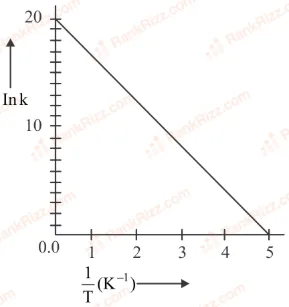
For a reaction, given below is the graph of ln⁡k\ln k vs 1T\frac{1}{T}. The activation energy for the reaction is equal to _____ cal mol−1^{-1}. (Given: R=2R = 2 cal K−1^{-1} mol−1^{-1})

Figure for JEE Main 2022 Chemistry question on Arrhenius equation and activation energy
JEE MAIN 2021 · 01 SEP S2Arrhenius equation and activation energyTRANSCRIBED

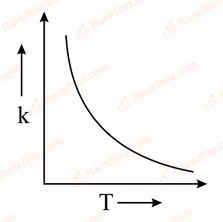
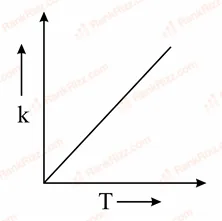
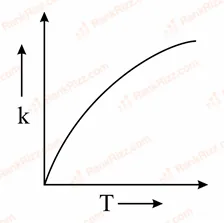
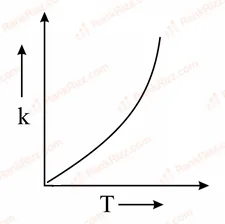
Which one of the following given graphs represents the variation of rate constant (k) with temperature (T) for an endothermic reaction?

  1. A
    Figure for JEE Main 2021 Chemistry question on Arrhenius equation and activation energy
  2. B
    Figure for JEE Main 2021 Chemistry question on Arrhenius equation and activation energy
  3. C
    Figure for JEE Main 2021 Chemistry question on Arrhenius equation and activation energy
  4. D
    Figure for JEE Main 2021 Chemistry question on Arrhenius equation and activation energy
JEE MAIN 2021 · 25 FEB S2Arrhenius equation and activation energyTRANSCRIBED

The rate constant of a reaction increases by five times on increase in temperature from 27°C to 52°C. The value of activation energy in kJ mol−1^{-1} is ______. (Rounded-off to the nearest integer) [R=8.314R = 8.314 J K−1^{-1} mol−1^{-1}]

JEE MAIN 2021 · 31 AUG S2Arrhenius equation and activation energyTRANSCRIBED

For the reaction A →\rightarrow B, the rate constant k (in s−1^{-1}) is given by
log⁡10k=20.35−2.47×10³T\log_{10} k = 20.35 - \frac{2.47 \times 10^3}{T}
The energy of activation in kJ mol−1^{-1} is _________. (Nearest integer)
[Given : R = 8.314 J K−1^{-1} mol−1^{-1}]

JEE MAIN 2021 · 16 MAR S1Arrhenius equation and activation energyTRANSCRIBED

The decomposition of formic acid on gold surface follows first order kinetics. If the rate constant at 300 K is 1.0×10−31.0 \times 10^{-3} s−1^{-1} and the activation energy Ea=11.488E_a = 11.488 kJ mol−1^{-1}, the rate constant at 200 K is ________ ×10−5\times 10^{-5} s−1^{-1}. (Round off to the Nearest Integer).
[Given R=8.314R = 8.314 J mol−1^{-1} K−1^{-1}]

JEE MAIN 2021 · 27 AUG S2Arrhenius equation and activation energyTRANSCRIBED

The first order rate constant for the decomposition of CaCO3_3 at 700 K is 6.36×10−36.36 \times 10^{-3} s−1^{-1} and activation energy is 209 kJ mol−1^{-1}. Its rate constant (in s−1^{-1}) at 600 K is x×10−6x \times 10^{-6}. The value of x is _________. (Nearest integer)
[Given R = 8.31 J K−1^{-1} mol−1^{-1}; log 6.36×10−36.36 \times 10^{-3} = -2.19, 10−4.7910^{-4.79} = 1.62×10−51.62 \times 10^{-5}]

JEE MAIN 2021 · 25 FEB S1Arrhenius equation and activation energyTRANSCRIBED

For the reaction, aA+bB→cC+dDaA + bB \to cC + dD, the plot of log k v/s 1T\frac{1}{T} is given below:

Figure for JEE Main 2021 Chemistry question on Arrhenius equation and activation energy


The temperature at which the rate constant of the reaction is 10−410^{-4} s−1^{-1} is ______ K.
(Rounded-off to the nearest integer) [Given: The rate constant of the reaction is 10−510^{-5} s−1^{-1} at 500 K.]

JEE MAIN 2021 · 26 FEB S2Arrhenius equation and activation energyTRANSCRIBED

If the activation energy of a reaction is 80.9 kJ mol−1^{-1}, the fraction of molecules at 700 K, having enough energy to react to form products is e−xe^{-x}. The value of xx is (Rounded off to the nearest integer) [Use R = 8.31 J K−1^{-1} mol−1^{-1}]

JEE MAIN 2020 · 08 JAN S2Arrhenius equation and activation energyTRANSCRIBED

Consider the following plots of rate constant versus 1T\frac{1}{T} for four different reactions. Which of the following orders is correct for the activation energies of these reactions?

Figure for JEE Main 2020 Chemistry question on Arrhenius equation and activation energy
  1. A

    Eb>Ea>Ed>EcE_b > E_a > E_d > E_c

  2. B

    Ea>Ec>Ed>EbE_a > E_c > E_d > E_b

  3. C

    Ec>Ea>Ed>EbE_c > E_a > E_d > E_b

  4. D

    Eb>Ed>Ec>EaE_b > E_d > E_c > E_a