RankRizz
JEE MAIN 2019 · 12 JAN S2+4 / −1MEDIUMTRANSCRIBED

JEE Main 2019 Chemistry question — Arrhenius equation and activation energy

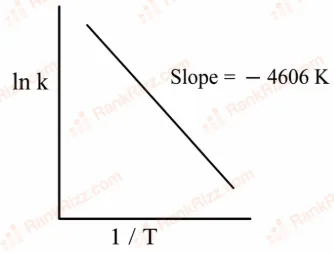
For a reaction, consider the plot of ln k versus 1/T given in the figure. If the rate constant of this reaction at 400 K is 10−5s−110^{-5} s^{-1}, then the rate constant at 500 K is:

Figure for JEE Main 2019 Chemistry question on Arrhenius equation and activation energy
SOLUTION

We have a straight-line plot of ln⁡k\ln k versus 1/T1/T for the reaction. For any Arrhenius plot, the governing relation is first written as

k  =  A e−EaRT.k \;=\; A\,e^{-\dfrac{E_a}{RT}}.

Taking natural logarithms on both sides gives the linear form

ln⁡k  =  ln⁡A  −  EaR  (1T).\ln k \;=\; \ln A \;-\;\dfrac{E_a}{R}\;\left(\dfrac1T\right).

In the form y=mx+cy = mx + c, the ordinate is y=ln⁡ky = \ln k, the abscissa is x=1/Tx = 1/T, and the slope is

m=−EaR.m = -\dfrac{E_a}{R}.

From the figure (reading two well-separated points and calculating), the slope of the straight line is found to be approximately

m  =  −4.6×10³  K.m \;=\; -4.6 \times 10^{3}\;{\rm K}.

Stating this numerically,

−EaR=−4.6×10³  K,soEaR=4.6×10³  K.-\dfrac{E_a}{R} = -4.6 \times 10^{3}\;{\rm K}, \qquad\text{so}\qquad \dfrac{E_a}{R} = 4.6 \times 10^{3}\;{\rm K}.

Now we wish to compare rate constants at two temperatures. Using the Arrhenius form for two temperatures T1T_1 and T2T_2, the standard manipulation is

ln⁡ ⁣(k2k1)  =  −EaR  (1T2−1T1).\ln\!\left(\dfrac{k_2}{k_1}\right) \;=\; -\dfrac{E_a}{R}\;\Bigl(\dfrac1{T_2} - \dfrac1{T_1}\Bigr).

First, list the known data:

T1=400  K,k1=10−5  s−1,T_1 = 400\;{\rm K},\qquad k_1 = 10^{-5}\;{\rm s^{-1}},

T2=500  K,k2=?T_2 = 500\;{\rm K},\qquad k_2 = \text{?}

Calculate the difference in reciprocal temperatures:

1T2−1T1  =  1500  −  1400.\dfrac1{T_2} - \dfrac1{T_1} \;=\; \dfrac1{500} \;-\; \dfrac1{400}.

Writing both denominators explicitly,

1500=2.0×10⁻³  K−1,1400=2.5×10⁻³  K−1.\dfrac1{500} = 2.0 \times 10^{-3}\;{\rm K^{-1}},\qquad \dfrac1{400} = 2.5 \times 10^{-3}\;{\rm K^{-1}}.

So,

1T2−1T1=(2.0−2.5)×10−3=−0.5×10−3  =  −5.0×10⁻⁴  K−1.\dfrac1{T_2} - \dfrac1{T_1} = (2.0 - 2.5)\times10^{-3} = -0.5 \times 10^{-3} \;=\; -5.0 \times 10^{-4}\;{\rm K^{-1}}.

Substituting slope information Ea/R=4.6×103  KE_a / R = 4.6 \times 10^{3}\;{\rm K} into the two-temperature equation gives

ln⁡ ⁣(k2k1)=−(4.6×10³)  (−5.0×10⁻⁴).\ln\!\left(\dfrac{k_2}{k_1}\right) = -\bigl(4.6 \times 10^{3}\bigr)\;\Bigl(-5.0 \times 10^{-4}\Bigr).

Multiplying the two negatives yields a positive result:

ln⁡ ⁣(k2k1)=(4.6×10³) (5.0×10⁻⁴)=2.3.\ln\!\left(\dfrac{k_2}{k_1}\right) = (4.6 \times 10^{3})\,(5.0 \times 10^{-4}) = 2.3.

Recognising that ln⁡10≈2.303\ln 10 \approx 2.303, we can rewrite

ln⁡ ⁣(k2k1)  ≈  ln⁡10.\ln\!\left(\dfrac{k_2}{k_1}\right) \;\approx\; \ln 10.

Therefore,

k2k1  ≈  10.\dfrac{k_2}{k_1} \;\approx\; 10.

Finally, multiplying by the known k1k_1 value,

k2  =  10 k1  =  10×10−5  s−1  =  10−4  s−1.k_2 \;=\; 10\,k_1 \;=\; 10 \times 10^{-5}\;{\rm s^{-1}} \;=\; 10^{-4}\;{\rm s^{-1}}.

Hence, the correct answer is Option A.
Tagged Arrhenius equation and activation energy. Machine-assigned, so read it as a strong shortlist rather than a verdict.

SubjectChemistry
TopicArrhenius equation and activation energy
TypeMultiple choice