JEE MAIN 2026 · 28 JAN S1+4 / −1MEDIUMTRANSCRIBED
JEE Main 2026 Chemistry question — Reactions of phenols
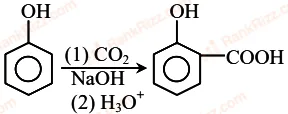
Consider the following reaction sequence

Compound (y) develops characterstic colour with neutral solution.
Identify the INCORRECT statement from the following for the above sequence.
SOLUTION
To find the molecular formula of x, we use the percentage composition and vapor density:
- Molecular Mass: .
- Empirical Calculation: * C: of (which is 6 atoms of Carbon).
- H: of (which is 6 atoms of Hydrogen).
- O: Remaining mass is (which is 1 atom of Oxygen).
- Result: The formula is . Compound (x) is Phenol.
Phenol undergoes the Kolbe-Schmitt Reaction when treated with and under high pressure, followed by acidification.
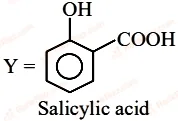
- Product (y): Salicylic acid (-hydroxybenzoic acid).
- Identification Test: Salicylic acid contains a phenolic group, which is why it develops a characteristic violet color with neutral .
Based on the properties of Phenol (x) and Salicylic acid (y):
- Solubility in : Correct. Salicylic acid contains a carboxylic acid group (), which is strong enough to react with sodium bicarbonate and evolve gas. Phenol does not react with .
- Relative Acidity: Option B is INCORRECT. Compound (x) (Phenol) is less acidic than compound (y) (Salicylic acid). The presence of the electron-withdrawing group significantly increases the acidity of the molecule.
- Combustion: Correct. Both are aromatic compounds (high carbon-to-hydrogen ratio) and typically burn with a sooty flame.
- Solubility in : Correct. Both are acidic (phenol is weakly acidic; salicylic acid is more acidic) and will dissolve in a strong base like .
Tagged Reactions of phenols. Machine-assigned, so read it as a strong shortlist rather than a verdict.