RankRizz

Matrices and Determinants — JEE Advanced Previous Year Questions

Every Matrices and Determinants question JEE Advanced has set from 2007–2026, grouped by the idea it tests rather than the order of the syllabus. 57 questions across 8 distinct ideas. Free to read, answer key on every one.

Questions

57

Distinct ideas

8

Share of marks

7.7%

Difficulty

MEDIUM

The ideas inside Matrices and Determinants

A chapter is not one subject — it is a handful of procedures the examiner reuses. These are the ones Matrices and Determinants questions actually test.

01Types of matrices and matrix algebraset 5×
02Matrix multiplication, powers and matrix equationsset 3×
03Transpose, symmetric and skew-symmetric matricesset 8×
04Trace and special matricesset 3×
05Counting matrices with given propertiesNot set in Advanced
06Evaluation of determinantsset 4×
07Properties of determinantsset 9×
08Adjoint and inverse of a matrixset 10×
09Systems of linear equationsset 15×

Every Matrices and Determinants question

41–57 OF 57 · NEWEST FIRST

JEE ADVANCED 2011 · PAPER 1Transpose, symmetric and skew-symmetric matricesTRANSCRIBED

Let M and N be two 3×33 \times 3 non-singular skew-symmetric matrices such that MN=NMMN = NM. If PTP^T denotes the transpose of P, then M2N2(MTN)−1(MN−1)TM^2N^2(M^TN)^{-1}(MN^{-1})^T is equal to

  1. A

    M2M^2

  2. B

    −N2-N^2

  3. C

    −M2-M^2

  4. D

    MNMN

JEE ADVANCED 2011 · PAPER 2Trace and special matricesTRANSCRIBED

Let M be a 3×33 \times 3 matrix satisfying
M[010]=[−123],M[1−10]=[11−1]M\begin{bmatrix}0\\1\\0 \end{bmatrix} = \begin{bmatrix}-1\\2\\3 \end{bmatrix}, M\begin{bmatrix}1\\-1\\0 \end{bmatrix} = \begin{bmatrix}1\\1\\-1 \end{bmatrix}, and M[111]=[0012]M\begin{bmatrix}1\\1\\1 \end{bmatrix} = \begin{bmatrix}0\\0\\12 \end{bmatrix}. Then the sum of the diagonal entries of M is

JEE ADVANCED 2011 · PAPER 1Systems of linear equationsTRANSCRIBED

If the point P(a, b, c), with reference to (E), lies on the plane 2x + y + z = 1, then the value of 7a + b + c is

  1. A

    0

  2. B

    12

  3. C

    7

  4. D

    6

JEE ADVANCED 2011 · PAPER 1Systems of linear equationsTRANSCRIBED

Let ω\omega be a solution of x3−1=0x^3 - 1 = 0 with Im(ω)>0Im(\omega) > 0. If a = 2 with b and c satisfying (E), then the value of 3ωa+1ωb+3ωc\frac{3}{\omega^a} + \frac{1}{\omega^b} + \frac{3}{\omega^c} is equal to

  1. A

    -2

  2. B

    2

  3. C

    3

  4. D

    -3

JEE ADVANCED 2011 · PAPER 1Systems of linear equationsTRANSCRIBED

Let b = 6, with a and c satisfying (E). If α\alpha and β\beta are the roots of the quadratic equation ax2+bx+c=0ax^2 + bx + c = 0, then ∑n=0∞(1α+1β)n\sum_{n=0}^{\infty}\left(\frac{1}{\alpha} + \frac{1}{\beta}\right)^n is

  1. A

    6

  2. B

    7

  3. C

    67\frac{6}{7}

  4. D

    ∞\infty

JEE ADVANCED 2010 · PAPER 2Adjoint and inverse of a matrixTRANSCRIBED

Let k be a positive real number and let
A=[2k−12k2k2k1−2k−2k2k−1]A = \begin{bmatrix}2k-1 & 2\sqrt{k} & 2\sqrt{k} \\2\sqrt{k} & 1 & -2k \\-2\sqrt{k} & 2k & -1 \end{bmatrix} and B=[02k−1k1−2k02k−k−2k0]B = \begin{bmatrix}0 & 2k-1 & \sqrt{k} \\1-2k & 0 & 2\sqrt{k} \\-\sqrt{k} & -2\sqrt{k} & 0 \end{bmatrix}.If det(adjA)+det(adjB)=106det(adj A) + det(adj B) = 10^6, then [k] is equal to
[Note : adj M denotes the adjoint of a square matrix M and [k] denotes the largest integer less than or equal to k].

JEE ADVANCED 2010 · PAPER 1Systems of linear equationsTRANSCRIBED

The number of 3×33\times3 matrices A whose entries are either O or 1 and for which the system A[xyz]=[100]A\begin{bmatrix}x\\y\\z\end{bmatrix}=\begin{bmatrix}1\\0\\0\end{bmatrix} has exactly two distinct solutions, is

  1. A

    00

  2. B

    29−12^{9}-1

  3. C

    168168

  4. D

    22

JEE ADVANCED 2010 · PAPER 1Properties of determinantsTRANSCRIBED

The number of A in TpT_p, such that A is either symmetric or skew-symmetric or both, and det (A) divisible by p is

  1. A

    (p−1)2(p-1)^2

  2. B

    2(p−1)2(p-1)

  3. C

    (p−1)2+1(p-1)^2 + 1

  4. D

    2p−12p-1

JEE ADVANCED 2010 · PAPER 1Properties of determinantsTRANSCRIBED

The number of A in TpT_p, suchthat the trace of A is not divisible by p but det (A) is divisible by p is
[Note : The trace of a matrix is the sumofits diagonal entries.]

  1. A

    (p−1)(p2−p+1)(p-1)(p^2 - p + 1)

  2. B

    p3−(p−1)2p^3 - (p - 1)^2

  3. C

    (p−1)2(p-1)^2

  4. D

    (p−1)(p2−2)(p-1)(p^2 - 2)

JEE ADVANCED 2010 · PAPER 1Properties of determinantsTRANSCRIBED

The number of A in TpT_p, such that det (A) is not divisible byp is

  1. A

    2p22p^2

  2. B

    p3−5pp^3 - 5p

  3. C

    p3−3pp^3 - 3p

  4. D

    p3−p2p^3 - p^2

JEE ADVANCED 2010 · PAPER 1Properties of determinantsTRANSCRIBED

Let ω\omega be the complex number cos⁡2π3+isin⁡2π3\cos \frac{2 \pi}{3} + i \sin \frac{2 \pi}{3}. Then the number of distinct complex numbers z satisfying
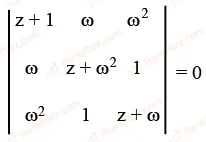
Figure for JEE Advanced 2010 Mathematics question on Properties of determinants
JEE ADVANCED 2009 · PAPER 2Systems of linear equationsTRANSCRIBED

Let (x, y, z) be points with integer coordinates satisfying the system of homogeneous equations:
3x−y−z=03x - y - z = 0
−3x+z=0-3x + z = 0
−3x+2y+z=0-3x + 2y + z = 0.
Then the number of such points for which x2+y2+z2≤100x^2 + y^2 + z^2 \leq 100 is

JEE ADVANCED 2009 · PAPER 1Transpose, symmetric and skew-symmetric matricesTRANSCRIBED

The number of matrices in A is

  1. A

    12

  2. B

    6

  3. C

    9

  4. D

    3

JEE ADVANCED 2009 · PAPER 1Systems of linear equationsTRANSCRIBED

The number of matrices A in A for which the system of linear equations
A[xyz]=[100]A\begin{bmatrix}x\\y\\z \end{bmatrix} = \begin{bmatrix}1\\0\\0 \end{bmatrix}
has a unique solution, is

  1. A

    less than 4

  2. B

    at least 4 but less than 7

  3. C

    at least 7 but less than 10

  4. D

    at least 10

JEE ADVANCED 2009 · PAPER 1Systems of linear equationsTRANSCRIBED

The number of matrices A in A for which the system of linear equations
A[xyz]=[100]A\begin{bmatrix}x\\y\\z \end{bmatrix} = \begin{bmatrix}1\\0\\0 \end{bmatrix}
is inconsistent, is

  1. A

    0

  2. B

    More than 2

  3. C

    2

  4. D

    1

JEE ADVANCED 2008 · PAPER 1Systems of linear equationsTRANSCRIBED

Consider the system of equations
x−2y+3z=−1x - 2y + 3z = -1
−x+y−2z=k-x + y - 2z = k
x−3y+4z=1x - 3y + 4z = 1.
STATEMENT-1: The system of equations has no solution for k≠3k \neq 3.
and
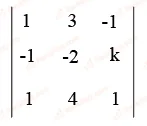
STATEMENT-2: The determinant

Figure for JEE Advanced 2008 Mathematics question on Systems of linear equations

≠0\neq 0, for k≠3k \neq 3.

  1. A

    STATEMENT-1 is True, STATEMENT-2 is True; STATEMENT-2 is a correct explanation for STATEMENT-1

  2. B

    STATEMENT-1 is True, STATEMENT-2 is True; STATEMENT-2 is NOT a correct explanation for STATEMENT-1

  3. C

    STATEMENT-1 is True, STATEMENT-2 is False

  4. D

    STATEMENT-1 is False, STATEMENT-2 is True

JEE ADVANCED 2007 · PAPER 1Systems of linear equationsTRANSCRIBED

Consider the following linear equations
ax+by+cz=0ax + by + cz = 0
bx+cy+az=0bx + cy + az = 0
cx+ay+bz=0cx + ay + bz = 0
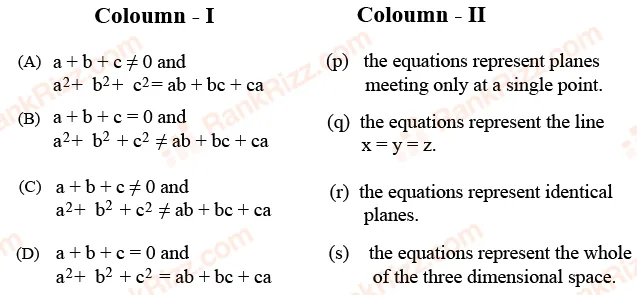
Match the conditions/expressions in Column I with statements in Column II and indicate your answer by darkening the appropriate bubbles in the 4×44 \times 4 matrix given in the ORS.

Figure for JEE Advanced 2007 Mathematics question on Systems of linear equations