RankRizz

Quadratic Equations and Inequalities — JEE Advanced Previous Year Questions

Every Quadratic Equations and Inequalities question JEE Advanced has set from 2007–2026, grouped by the idea it tests rather than the order of the syllabus. 23 questions across 7 distinct ideas. Free to read, answer key on every one.

Questions

23

Distinct ideas

7

Share of marks

2.8%

Difficulty

MEDIUM

The ideas inside Quadratic Equations and Inequalities

A chapter is not one subject — it is a handful of procedures the examiner reuses. These are the ones Quadratic Equations and Inequalities questions actually test.

01Relation between roots and coefficientsset 12×
02Forming equations and power sums of rootsNot set in Advanced
03Nature of roots and discriminantset 3×
04Common roots of equationsset 2×
05Location of rootsset 1×
06Sign and range of quadratic expressionsNot set in Advanced
07Equations with modulus and greatest integerset 1×
08Cubic and higher degree polynomial equationsset 3×
09Rational and polynomial inequalitiesset 1×

Quadratic Equations and Inequalities weightage, year by year

The share of each year’s Maths questions that came from Quadratic Equations and Inequalities, counted from the 19 papers we hold for the last 10 years, and paper by paper inside a year.

Rising: 4.0% of Maths questions in 2024–2026, up from 2.6% in 2017–2023. Its heaviest year was 2026, at 5.9%. Not asked at all in 2018, 2023.

20262 / 345.9%PAPER 1 6.3%PAPER 2 5.6%
20251 / 323.1%PAPER 1 6.3%PAPER 2 0.0%
20241 / 342.9%PAPER 1 5.9%PAPER 2 0.0%
20230 / 340.0%PAPER 1 0.0%PAPER 2 0.0%
20221 / 362.8%PAPER 1 0.0%PAPER 2 5.6%
20211 / 382.6%PAPER 1 5.3%PAPER 2 0.0%
20201 / 362.8%PAPER 1 5.6%PAPER 2 0.0%
20191 / 362.8%PAPER 1 5.6%PAPER 2 0.0%
20180 / 180.0%1 PAPER
20172 / 365.6%PAPER 1 0.0%PAPER 2 11.1%

“QS” is Quadratic Equations and Inequalities questions out of all Maths questions that year. A year with more sittings asks more questions, which is why the share, not the count, is the number to compare.

Quadratic Equations and Inequalities: quick answers

How many Quadratic Equations and Inequalities questions has JEE Advanced asked?

23 questions from 2007–2026. Over the last 20 papers, Quadratic Equations and Inequalities carried about 2.8% of Maths marks.

Which Quadratic Equations and Inequalities topics come up most?

Relation between roots and coefficients (12 questions), Nature of roots and discriminant (3 questions), Cubic and higher degree polynomial equations (3 questions). Start with these, they are what the examiner keeps coming back to.

Is Quadratic Equations and Inequalities important for JEE Advanced?

Rising: 4.0% of Maths questions in 2024–2026, up from 2.6% in 2017–2023. Its heaviest year was 2026, at 5.9%. Not asked at all in 2018, 2023. It has carried about 2.8% of Maths marks in recent papers, rated medium on our difficulty scale. The year-by-year table above shows how that has moved.

Do these Quadratic Equations and Inequalities PYQs have answers and solutions?

Yes. Every question shows its official answer key, and a worked solution opens on the question’s own page wherever we have one. Reading and checking answers is free, no sign-up needed.

What’s the fastest way to revise Quadratic Equations and Inequalities?

Do one past question per idea first: Quadratic Equations and Inequalities has 7 distinct ideas, listed above. Then practise the topics you get wrong, or build a timed test from this chapter.

Every Quadratic Equations and Inequalities question

1–20 OF 23 · NEWEST FIRST

JEE ADVANCED 2026 · PAPER 2Relation between roots and coefficientsTRANSCRIBED

Let a, b, ca,\,b,\,c be positive integers in arithmetic progression such that the equation

ax2+bx+c=0ax^2+bx+c=0

has only integer solutions.

Then which of the following statements is (are) TRUE?

  1. A

    c−bc-b is an integer multiple of aa

  2. B

    Both the roots of the equation ax2+bx+c=0ax^2+bx+c=0 are odd integers

  3. C

    If c=15c=15, then ab=8ab=8

  4. D

    If b=8b=8, then x=3x=3 is a root of the equation ax2+bx+c=0ax^2+bx+c=0

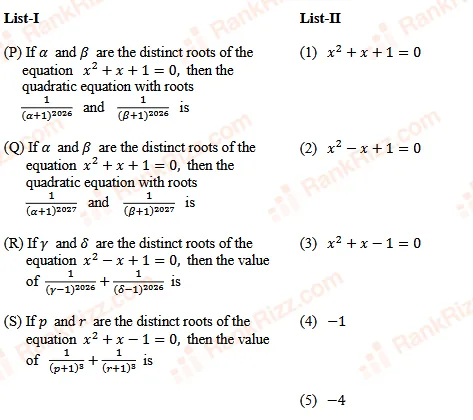
JEE ADVANCED 2026 · PAPER 1Relation between roots and coefficientsTRANSCRIBED

Match each entry in List-I to the correct entry in List-II and choose the correct option.

Figure for JEE Advanced 2026 Mathematics question on Relation between roots and coefficients
  1. A

    (P)→\to(1), (Q)→\to(2), (R)→\to(5), (S)→\to(4)

  2. B

    (P)→\to(3), (Q)→\to(1), (R)→\to(4), (S)→\to(5)

  3. C

    (P)→\to(1), (Q)→\to(2), (R)→\to(4), (S)→\to(5)

  4. D

    (P)→\to(2), (Q)→\to(3), (R)→\to(5), (S)→\to(4)

JEE ADVANCED 2025 · PAPER 1Cubic and higher degree polynomial equationsTRANSCRIBED

Let R\mathbb{R} denote the set of all real numbers. Let ai,bi∈Ra_i, b_i \in \mathbb{R} for i∈{1,2,3}i \in \{1, 2, 3\}. Define the functions f:R→Rf: \mathbb{R} \to \mathbb{R}, g:R→Rg: \mathbb{R} \to \mathbb{R}, and h:R→Rh: \mathbb{R} \to \mathbb{R} by

f(x)=a1+10x+a2x2+a3x3+x4,f(x) = a_1 + 10x + a_2 x^2 + a_3 x^3 + x^4,

g(x)=b1+3x+b2x2+b3x3+x4,g(x) = b_1 + 3x + b_2 x^2 + b_3 x^3 + x^4,

h(x)=f(x+1)−g(x+2).h(x) = f(x+1) - g(x+2).

If f(x)≠g(x)f(x) \neq g(x) for every x∈Rx \in \mathbb{R}, then the coefficient of x3x^3 in h(x)h(x) is

  1. A

    88

  2. B

    22

  3. C

    −4-4

  4. D

    −6-6

JEE ADVANCED 2024 · PAPER 1Cubic and higher degree polynomial equationsTRANSCRIBED

Let a=32a = 3\sqrt{2} and b=151/66b = \frac{1}{5^{1/6}\sqrt{6}}. If x,y∈Rx, y \in \mathbb{R} are such that 3x+2y=log⁡a(18)5/43x + 2y = \log_a (18)^{5/4} and 2x−y=log⁡b(1080)2x - y = \log_b (\sqrt{1080}), then 4x+5y4x + 5y is equal to ________.

JEE ADVANCED 2022 · PAPER 2Cubic and higher degree polynomial equationsTRANSCRIBED

The product of all positive real values of xx satisfying the equation x(16(log⁡5x)3−68log⁡5x)=5−16x^{(16(\log_5 x)^3 - 68\log_5 x)} = 5^{-16} is _______.

JEE ADVANCED 2021 · PAPER 1Equations with modulus and greatest integerTRANSCRIBED

For x∈Rx \in R, the number of real roots of the equation
3x2−4∣x2−1∣+x−1=03x^2 - 4 \mid x^2 - 1 \mid + x - 1 = 0 is .........

JEE ADVANCED 2020 · PAPER 1Relation between roots and coefficientsTRANSCRIBED

Suppose a, b denote the distinct real roots of the quadratic polynomial x2+20x−2020x^{2} + 20x − 2020 and
suppose c, d denote the distinct complex roots of the quadratic polynomial x2−20x+2020x^{2} − 20x + 2020. Then the value of
ac(a - c) + ad(a - d) + bc(b - c) + bd(b + d)
is

  1. A

    0

  2. B

    800

  3. C

    8080

  4. D

    1600

JEE ADVANCED 2019 · PAPER 1Relation between roots and coefficientsTRANSCRIBED

Let αandβ\alpha and \beta be the roots of x2—x—1=0,x^2 — x — 1 = 0, with \alpha > \beta.Forallpositiveintegersn,define<br/>. For all positive integers n, define<br />a_n = \frac{\alpha^n - \beta^n}{\alpha - \beta},n \geq 1,<br/><br />b_1 = 1andandb_n = a_{n - 1} + a_{n + 1},n \geq 2.$$
Then which of the following options is/are correct?

  1. A

    a1+a2+a3+...+an=an+2−1a_1 + a_2 + a_3 + ... + a_n = a_{n + 2} - 1 for all n≥1n \geq 1

  2. B

    ∑n=1∞an10n=1089\sum_{n = 1}^\infty \frac{a_n}{10^n} = \frac{10}{89}

  3. C

    bn=αn+βnb_n = \alpha^n + \beta^n for all n≥1n \geq 1

  4. D

    ∑n=1∞bn10n=889\sum_{n = 1}^\infty \frac{b_n}{10^n} = \frac{8}{89}

JEE ADVANCED 2017 · PAPER 2Relation between roots and coefficientsTRANSCRIBED

a12=a_{12}=

  1. A

    a11−a10a_{11}-a_{10}

  2. B

    a11+a10a_{11}+a_{10}

  3. C

    2a11+a102a_{11}+a_{10}

  4. D

    a11+2a10a_{11}+2a_{10}

JEE ADVANCED 2017 · PAPER 2Relation between roots and coefficientsTRANSCRIBED

If a4=28a_{4}=28, then p+2q=p+2q=

  1. A

    21

  2. B

    14

  3. C

    7

  4. D

    12

JEE ADVANCED 2016 · PAPER 1Relation between roots and coefficientsTRANSCRIBED

Let −π6<θ<π12-\frac{\pi}{6} < \theta < \frac{\pi}{12} Suppose α1\alpha_1 and β1\beta_1 are the roots of the equation x2−2xsec⁡θ+1x^2 - 2x \sec \theta + 1 and α2\alpha_2 and β2\beta_2 are the roots of the equation x2+2xtan⁡θ−1=0x^2 + 2x \tan \theta - 1 = 0. If α1>β1\alpha_1 > \beta_1 and α2>β2\alpha_2 > \beta_2 then α1+β2\alpha_1 + \beta_2 equals

  1. A

    2(sec⁡θ−tan⁡θ)2(\sec \theta - \tan \theta)

  2. B

    2sec⁡θ2 \sec \theta

  3. C

    −2tan⁡θ-2 \tan \theta

  4. D

    00

JEE ADVANCED 2015 · PAPER 2Nature of roots and discriminantTRANSCRIBED

Let S be the set of all non-zero real numbers α\alpha such that the quadratic equation ax2−x+a=0ax^2 - x + a = 0 has two distinct real roots x1x_1 and x2x_2 satisfying the inequality ∣x1−x2∣<1.|x_1 - x_2| < 1. Which of the following intervals is(are) a subset(s) of S?

  1. A

    (−12,−15)\left(-\frac {1}{2}, -\frac{1}{\sqrt 5}\right)

  2. B

    (−15,0)\left(-\frac{1}{\sqrt 5}, 0\right)

  3. C

    (0,15)\left(0, \frac{1}{\sqrt 5}\right)

  4. D

    (15,12)\left(\frac{1}{\sqrt 5}, \frac {1}{2}\right)

JEE ADVANCED 2014 · PAPER 2Nature of roots and discriminantTRANSCRIBED

The quadratic equation p(x) = 0 with real coefficients has purely imaginary roots. Then the equation p(p(x)) = 0 has

  1. A

    only purely imaginary roots

  2. B

    all real roots

  3. C

    two real and two purely imaginary roots

  4. D

    neither real nor purely imaginary roots

JEE ADVANCED 2012 · PAPER 2Relation between roots and coefficientsTRANSCRIBED

Let α(a)\alpha(a) and β(a)\beta(a) be the roots of the equation (1+a3−1)x2+(1+a−1)x+(1+a6−1)=0\left(\sqrt[3]{1 + a} - 1\right)x^2 + \left(\sqrt{1 + a} - 1\right)x + \left(\sqrt[6]{1 + a} - 1\right) = 0 where a > -1. Then lim⁡a→0+α(a)\lim_{a \rightarrow 0^+}\alpha(a) and lim⁡a→0+β(a)\lim_{a \rightarrow 0^+}\beta(a) are

  1. A

    −52-\frac{5}{2} and 1

  2. B

    −12-\frac{1}{2} and -1

  3. C

    −72-\frac{7}{2} and 2

  4. D

    −92-\frac{9}{2} and 3

JEE ADVANCED 2011 · PAPER 2Common roots of equationsTRANSCRIBED

A value of b for which the equations
x2+bx−1=0x^2 + bx - 1 = 0
x2+x+b=0x^2 + x + b = 0,
have one root in common is

  1. A

    −2-\sqrt{2}

  2. B

    −i3-i\sqrt{3}

  3. C

    i5i\sqrt{5}

  4. D

    2\sqrt{2}

JEE ADVANCED 2011 · PAPER 1Common roots of equationsTRANSCRIBED

Let (x0,y0)(x_0, y_0) be the solution of the following equations
(2x)ln⁡2=(3y)ln⁡3(2x)^{\ln 2} = (3y)^{\ln 3}
3ln⁡x=2ln⁡y3^{\ln x} = 2^{\ln y}
Then x0x_0 is

  1. A

    16\frac{1}{6}

  2. B

    13\frac{1}{3}

  3. C

    12\frac{1}{2}

  4. D

    66

JEE ADVANCED 2011 · PAPER 1Relation between roots and coefficientsTRANSCRIBED

Let α\alpha and β\beta be the roots of x2−6x−2=0x^2 - 6x - 2 = 0, with α>β\alpha > \beta. If an=αn−βna_n = \alpha^n - \beta^n for n≥1n \geq 1, then the value of a10−2a82a9\frac{a_{10} - 2a_8}{2a_9} is

  1. A

    1

  2. B

    2

  3. C

    3

  4. D

    4

JEE ADVANCED 2011 · PAPER 2Nature of roots and discriminantTRANSCRIBED

The number of distinct real roots of x4−4x3+12x2+x−1=0x^4 - 4x^3 + 12 x^2 + x - 1 = 0 is

JEE ADVANCED 2010 · PAPER 1Relation between roots and coefficientsTRANSCRIBED

Let p and q be real numbers such that p≠0,p3≠qp\neq 0,p^{3}\neq q and p3≠−qp^{3}\neq -q. If α\alpha and β\beta are nonzero complex numbers satisfying α+β=−p\alpha+\beta=-p and α3+β3=q\alpha^{3}+\beta^{3}=q, then a quadratic equation having αβ\frac{\alpha}{\beta} and βα\frac{\beta}{\alpha} as its roots is

  1. A

    (p3+q)x2−(p3+2q)x+(p3+q)=0(p^{3}+q)x^{2}-(p^{3}+2q)x+(p^{3}+q)=0

  2. B

    (p3+q)x2−(p3−2q)x+(p3+q)=0(p^{3}+q)x^{2}-(p^{3}-2q)x+(p^{3}+q)=0

  3. C

    (p3−q)x2−(5p3−2q)x+(p3−q)=0(p^{3}-q)x^{2}-(5p^{3}-2q)x+(p^{3}-q)=0

  4. D

    (p3−q)x2−(5p3+2q)x+(p3−q)=0(p^{3}-q)x^{2}-(5p^{3}+2q)x+(p^{3}-q)=0

JEE ADVANCED 2009 · PAPER 2Location of rootsTRANSCRIBED

The smallest value of k, for which both the roots of the equation
x2−8kx+16(k2−k+1)=0x^2 - 8kx + 16(k^2 - k + 1) = 0
are real, distinct and have values at least 4, is