RankRizz

Matrices and Determinants — JEE Advanced Previous Year Questions

Every Matrices and Determinants question JEE Advanced has set from 2007–2026, grouped by the idea it tests rather than the order of the syllabus. 57 questions across 8 distinct ideas. Free to read, answer key on every one.

Questions

57

Distinct ideas

8

Share of marks

7.7%

Difficulty

MEDIUM

The ideas inside Matrices and Determinants

A chapter is not one subject — it is a handful of procedures the examiner reuses. These are the ones Matrices and Determinants questions actually test.

01Types of matrices and matrix algebraset 5×
02Matrix multiplication, powers and matrix equationsset 3×
03Transpose, symmetric and skew-symmetric matricesset 8×
04Trace and special matricesset 3×
05Counting matrices with given propertiesNot set in Advanced
06Evaluation of determinantsset 4×
07Properties of determinantsset 9×
08Adjoint and inverse of a matrixset 10×
09Systems of linear equationsset 15×

Every Matrices and Determinants question

21–40 OF 57 · NEWEST FIRST

JEE ADVANCED 2019 · PAPER 1Adjoint and inverse of a matrixTRANSCRIBED

Let
M=[01a1233b1]M = \begin{bmatrix}0 & 1 & a \\1 & 2 & 3 \\3 & b & 1 \end{bmatrix} and adjM=[−11−18−62−53−1]adj M = \begin{bmatrix}-1 & 1 & -1 \\8 & -6 & 2 \\-5 & 3 & -1 \end{bmatrix}
where a and b are real numbers. Which of the following options is/are correct?

  1. A

    a + b = 3

  2. B

    (adjM)−1+adjM−1=−M(adj M)^{-1} + adj M^{-1} = -M

  3. C

    det(adjM2)=81det(adj M^2) = 81

  4. D

    If M [αβγ]=[123],\begin{bmatrix}\alpha \\ \beta \\ \gamma \end{bmatrix} = \begin{bmatrix}1 \\2 \\3 \end{bmatrix}, then α−β+γ=3\alpha - \beta + \gamma = 3

JEE ADVANCED 2019 · PAPER 2Evaluation of determinantsTRANSCRIBED

Suppose
det[∑k=0nk∑k=0nnCkk2∑k=0nnCkk∑k=0nnCk3k]=0det\begin{bmatrix} \sum_{k = 0}^nk & \sum_{k = 0}^n {^nC_k k^2} \\\sum_{k = 0}^n {^n C_k k} & \sum_{k = 0}^n {^n C_k 3^k} \end{bmatrix} = 0
holds for somepositive integer n. Then ∑k=0nnCkk+1\sum_{k = 0}^n \frac {^nC_k}{k + 1} Equals __________

JEE ADVANCED 2017 · PAPER 1Matrix multiplication, powers and matrix equationsTRANSCRIBED

Which of the following is(are) NOT the square of a 3×3 matrix with real entries?

  1. A

    [100010001]\begin{bmatrix}1 & 0 & 0\\0 & 1 & 0\\ 0 & 0 & 1\end{bmatrix}

  2. B

    [10001000−1]\begin{bmatrix}1 & 0 & 0\\0 & 1 & 0\\ 0 & 0 & -1\end{bmatrix}

  3. C

    [1000−1000−1]\begin{bmatrix}1 & 0 & 0\\0 & -1 & 0\\ 0 & 0 & -1\end{bmatrix}

  4. D

    [−1000−1000−1]\begin{bmatrix}-1 & 0 & 0\\0 & -1 & 0\\ 0 & 0 & -1\end{bmatrix}

JEE ADVANCED 2017 · PAPER 2Trace and special matricesTRANSCRIBED

How many 3×33\times3 matrices M with entries from {0,1,2} are there, for which the sum of the diagonal entries of MTMM^{T}M is 5?

  1. A

    126

  2. B

    198

  3. C

    162

  4. D

    135

JEE ADVANCED 2017 · PAPER 1Systems of linear equationsTRANSCRIBED

For a real number α\alpha, if the system [1αα2α1αα2α1][xyz]=[1−11]\begin{bmatrix}1 & \alpha & \alpha^2 \\\alpha & 1 & \alpha\\\alpha^2 & \alpha & 1 \end{bmatrix}\begin{bmatrix}x\\y\\z \end{bmatrix} = \begin{bmatrix}1\\-1\\1 \end{bmatrix} of linear equations, has infinitely many solutions, then 1+α+α2=1+ \alpha + \alpha^2 =

JEE ADVANCED 2016 · PAPER 2Types of matrices and matrix algebraTRANSCRIBED

Let [1004101641]\begin{bmatrix}1 & 0 & 0 \\4 & 1 & 0 \\16 & 4 & 1 \end{bmatrix} and I be the identity matrix of order 3. If Q=[qij]Q = [q_{ij}] is a matrix such that P50−Q=IP^{50} - Q = I, then q31+q32q21\frac{q_{31} + q_{32}}{q_{21}} equals

  1. A

    52

  2. B

    103

  3. C

    201

  4. D

    205

JEE ADVANCED 2016 · PAPER 1Adjoint and inverse of a matrixTRANSCRIBED

Let P=[3−1−220α3−50]P = \begin{bmatrix}3 & -1 & -2 \\2 & 0 & \alpha \\3 & -5 & 0 \end{bmatrix} where α∈R\alpha \in R. Suppose Q=[qij]Q = [q_{ij}] is a matrix such that PQ=kIPQ = kI, where k∈R,k≠0k \in R, k \neq 0 and II is the identity matrix of order 3. If q23=−k8q_{23} = -\frac{k}{8} and det(Q)=k22det(Q) = \frac{k^2}{2}, then

  1. A

    α=0,k=8\alpha = 0, k = 8

  2. B

    4α−k+8=04 \alpha - k + 8 = 0

  3. C

    det(Padj(Q))=29det(P adj(Q)) = 2^9

  4. D

    det(Qadj(P))=213det(Q adj(P)) = 2^{13}

JEE ADVANCED 2016 · PAPER 2Systems of linear equationsTRANSCRIBED

Let a,λ,μϵRa, \lambda, \mu \epsilon R. Consider the system of linear equations
ax+2y=λax + 2y = \lambda
3x−2y=μ3x - 2y = \mu
Which of the following statement(s) is(are) correct?

  1. A

    If a = -3, then the system has infinitely many solutionsforall values of λ\lambda and μ\mu

  2. B

    If a≠−3a \neq -3, then the system has a unique solution for all values of λ\lambda and μ\mu

  3. C

    If λ+μ=0\lambda + \mu = 0, then the systemhasinfinitely many solutions for a = -3

  4. D

    If λ+μ≠0\lambda + \mu \neq 0, then the systemhasinfinitely many solutions for a = -3

JEE ADVANCED 2016 · PAPER 1Evaluation of determinantsTRANSCRIBED

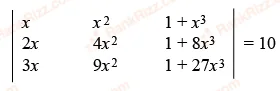
The total number of distinct x∈Rx \in R for which

Figure for JEE Advanced 2016 Mathematics question on Evaluation of determinants
JEE ADVANCED 2016 · PAPER 1Types of matrices and matrix algebraTRANSCRIBED

Let z=−1+3i2z = \frac{-1 + \sqrt{3}i}{2}, where i=−1i = \sqrt{-1}, and r,s∈{1,2,3}r, s \in \left\{1, 2, 3\right\}. Let P=[(−z)rz2sz2szr]P = \begin{bmatrix}(-z)^r & z^{2s} \\z^{2s} & z^r \end{bmatrix} and I be the identity matrix of order 2. Then the total number of ordered pairs (r,s)(r, s) for which P2=−IP^2 = -I is

JEE ADVANCED 2015 · PAPER 1Transpose, symmetric and skew-symmetric matricesTRANSCRIBED

Let X and Y be two arbitrary, 3×33 \times 3, non-zero, skew-symmetric matrices and Z be an arbitrary 3×33 \times 3, non-zero, symmetric matrix. Then which of the following matrices is (are) skew symmetric?

  1. A

    Y3Z4−Z4Y3Y^3 Z^4 - Z^4 Y^3

  2. B

    X44+Y44X^{44} + Y^{44}

  3. C

    X4Z3−Z3X4X^4 Z^3 - Z^3 X^4

  4. D

    X23+Y23X^{23} + Y^{23}

JEE ADVANCED 2015 · PAPER 1Evaluation of determinantsTRANSCRIBED

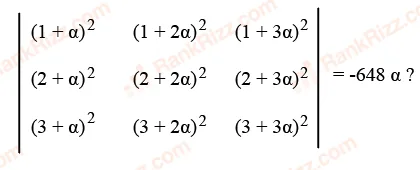
Which of the following values of α\alpha satisfy the equation

Figure for JEE Advanced 2015 Mathematics question on Evaluation of determinants
  1. A

    -4

  2. B

    9

  3. C

    -9

  4. D

    4

JEE ADVANCED 2014 · PAPER 1Properties of determinantsTRANSCRIBED

Let M and N be two 3×33 \times 3 matrices such that MN = NM. Further, if M≠N2M \neq N^2 and M2=N4M^2 = N^4, then

  1. A

    determinant of (M2+MN2)(M^2 + MN^2) is 0

  2. B

    there is a 3×33 \times 3 non-zero matrix UU such that (M2+MN2)(M^2 + MN^2) U is the zero matrix

  3. C

    determinant of (M2+MN2)≥1(M^2 + MN^2) \geq 1

  4. D

    for a 3×33 \times 3 matrix UU, if (M2+MN2)(M^2 + MN^2)U equals the zero matrix then U is the zero matrix

JEE ADVANCED 2014 · PAPER 1Transpose, symmetric and skew-symmetric matricesTRANSCRIBED

Let M be a 2×22 \times 2 symmetric matrix with integer entries. Then M is invertible if

  1. A

    the first column of M is the transpose of the second row of M

  2. B

    the second row of M is the transpose of the first column of M

  3. C

    M is a diagonal matrix with nonzero entries in the main diagonal

  4. D

    the product of entries in the main diagonal of M is not the square of an integer

JEE ADVANCED 2013 · PAPER 2Matrix multiplication, powers and matrix equationsTRANSCRIBED

Let ω\omega be a complex cuberoot of unity with ω≠1\omega \neq 1 and P=[pij]P = [p_{ij}] be a n×nn \times n matrix with pij=ωi+jp_{ij} = \omega^{i+j}. Then P2≠0P^2 \neq 0, when n =

  1. A

    57

  2. B

    55

  3. C

    58

  4. D

    56

JEE ADVANCED 2013 · PAPER 1Transpose, symmetric and skew-symmetric matricesTRANSCRIBED

For 3×33 \times 3 matrices M and N, whichof the following statement(s) is (are) NOT correct ?

  1. A

    NTMNN^T M N is symmetric or skew symmetric, according as M is symmetric or skew symmetric

  2. B

    M N - N M is skew symmetric for all symmetric matrices M and N

  3. C

    M N is symmetric for all symmetric matrices M and N

  4. D

    (adj M) (adj N) = adj (M N) for all invertible matrices and N

JEE ADVANCED 2012 · PAPER 2Transpose, symmetric and skew-symmetric matricesTRANSCRIBED

If P is a 3×33 \times 3 matrix such that PT=2P+IP^T = 2P + I, where PTP^T is the transpose of P and I is the 3×33 \times 3 identity matrix, then there exists a column matrix X=[xyz]≠[000]X = \begin{bmatrix}x \\y \\z\end{bmatrix} \neq \begin{bmatrix}0 \\0 \\0\end{bmatrix} such that

  1. A

    PX=[000]PX =\begin{bmatrix}0 \\0 \\0\end{bmatrix}

  2. B

    PX=XPX = X

  3. C

    PX=2XPX = 2X

  4. D

    PX=−XPX = -X

JEE ADVANCED 2012 · PAPER 1Properties of determinantsTRANSCRIBED

Let P=[aij]P = [a_{ij}] be a 3×33 \times 3 matrix and let Q=[bij]Q = [b_{ij}], where bij=2i+jaijb_{ij} = 2^{i + j}a_{ij} for 1≤i,j≤31 \leq i, j \leq 3. If the determinant of P, is 2, then the determinant of the matrix Q is

  1. A

    2102^{10}

  2. B

    2112^{11}

  3. C

    2122^{12}

  4. D

    2132^{13}

JEE ADVANCED 2012 · PAPER 2Adjoint and inverse of a matrixTRANSCRIBED

If the adjoint of a 3×33 \times 3 matrix P is [144217113]\begin{bmatrix}1 & 4 & 4 \\2 & 1 & 7\\1 & 1 & 3 \end{bmatrix}, then the possible value(s) of the determinant of P is (are)

  1. A

    -2

  2. B

    -1

  3. C

    1

  4. D

    2

JEE ADVANCED 2011 · PAPER 2Properties of determinantsTRANSCRIBED

Let ω≠1\omega \neq 1 be a cube root of unity and S bethe set of all non-singular matrices of the form
[1abω1cω2ω1]\begin{bmatrix}1 & a & b\\\omega & 1 & c\\\omega^2 & \omega & 1\end{bmatrix},
where each of a, b, and c is either ω\omega or ω2\omega^2. Then the number of distinct matrices in the set S is

  1. A

    2

  2. B

    6

  3. C

    4

  4. D

    8