RankRizz

Continuity and Differentiability — JEE Advanced Previous Year Questions

Every Continuity and Differentiability question JEE Advanced has set from 2007–2026, grouped by the idea it tests rather than the order of the syllabus. 30 questions across 3 distinct ideas. Free to read, answer key on every one.

Questions

30

Distinct ideas

3

Share of marks

5.1%

Difficulty

HARD

The ideas inside Continuity and Differentiability

A chapter is not one subject — it is a handful of procedures the examiner reuses. These are the ones Continuity and Differentiability questions actually test.

01Continuity at a pointset 9×
02Types of discontinuity, composite functions and IVTNot set in Advanced
03Differentiability at a pointset 20×
04Points of non-differentiabilityNot set in Advanced
05Differentiability via functional equationsset 1×

Continuity and Differentiability weightage, year by year

The share of each year’s Maths questions that came from Continuity and Differentiability, counted from the 19 papers we hold for the last 10 years, and paper by paper inside a year.

Rising: 8.0% of Maths questions in 2024–2026, up from 3.4% in 2017–2023. Its heaviest year was 2025, at 12.5%. Not asked at all in 2018, 2021, 2022.

20263 / 348.8%PAPER 1 12.5%PAPER 2 5.6%
20254 / 3212.5%PAPER 1 18.8%PAPER 2 6.3%
20241 / 342.9%PAPER 1 5.9%PAPER 2 0.0%
20231 / 342.9%PAPER 1 0.0%PAPER 2 5.9%
20220 / 360.0%PAPER 1 0.0%PAPER 2 0.0%
20210 / 380.0%PAPER 1 0.0%PAPER 2 0.0%
20203 / 368.3%PAPER 1 5.6%PAPER 2 11.1%
20192 / 365.6%PAPER 1 5.6%PAPER 2 5.6%
20180 / 180.0%1 PAPER
20172 / 365.6%PAPER 1 11.1%PAPER 2 0.0%

“QS” is Continuity and Differentiability questions out of all Maths questions that year. A year with more sittings asks more questions, which is why the share, not the count, is the number to compare.

Continuity and Differentiability: quick answers

How many Continuity and Differentiability questions has JEE Advanced asked?

30 questions from 2007–2026. Over the last 20 papers, Continuity and Differentiability carried about 5.1% of Maths marks.

Which Continuity and Differentiability topics come up most?

Differentiability at a point (20 questions), Continuity at a point (9 questions), Differentiability via functional equations (1 questions). Start with these, they are what the examiner keeps coming back to.

Is Continuity and Differentiability important for JEE Advanced?

Rising: 8.0% of Maths questions in 2024–2026, up from 3.4% in 2017–2023. Its heaviest year was 2025, at 12.5%. Not asked at all in 2018, 2021, 2022. It has carried about 5.1% of Maths marks in recent papers, rated hard on our difficulty scale. The year-by-year table above shows how that has moved.

Do these Continuity and Differentiability PYQs have answers and solutions?

Yes. Every question shows its official answer key, and a worked solution opens on the question’s own page wherever we have one. Reading and checking answers is free, no sign-up needed.

What’s the fastest way to revise Continuity and Differentiability?

Do one past question per idea first: Continuity and Differentiability has 3 distinct ideas, listed above. Then practise the topics you get wrong, or build a timed test from this chapter.

Every Continuity and Differentiability question

1–20 OF 30 · NEWEST FIRST

JEE ADVANCED 2026 · PAPER 1Differentiability at a pointTRANSCRIBED

Let R\mathbb{R} denote the set of all real numbers. Let f:R→Rf:\mathbb{R}\to\mathbb{R} be an arbitrary function and let g:R→Rg:\mathbb{R}\to\mathbb{R} be the function defined by

g(x)=x f(x),for all x∈R.g(x)=x\,f(x),\quad\text{for all }x\in\mathbb{R}.

Then which of the following statements is (are) TRUE?

  1. A

    The function gg is always continuous at x=0x=0

  2. B

    If ff is continuous at x=0x=0, then gg is differentiable at x=0x=0

  3. C

    If gg is differentiable at x=0x=0, then ff is continuous at x=0x=0

  4. D

    If gg is differentiable at x=0x=0, then lim⁡x→0f(x)\lim_{x\to 0}f(x) exists

JEE ADVANCED 2026 · PAPER 1Differentiability at a pointTRANSCRIBED

Consider the function f:(−π2,π2)→(−∞,∞)f:\left(-\tfrac{\pi}{2},\tfrac{\pi}{2}\right)\to(-\infty,\infty) defined by

f(x)=(∣x∣+∣x−1∣)sin⁡x+[xsin⁡x],f(x)=(|x|+|x-1|)\sin x+[x\sin x],

where [xsin⁡x][x\sin x] is the greatest integer less than or equal to xsin⁡xx\sin x.

Let α\alpha be the total number of points in the interval (−π2,π2)\left(-\tfrac{\pi}{2},\tfrac{\pi}{2}\right) at which ff is NOT continuous, and let β\beta be the total number of points in the interval (−π2,π2)\left(-\tfrac{\pi}{2},\tfrac{\pi}{2}\right) at which ff is NOT differentiable. Then the value of α+β\alpha+\beta is ___.

JEE ADVANCED 2026 · PAPER 2Continuity at a pointTRANSCRIBED

For a real number α\alpha, let [α][\alpha] denote the greatest integer less than or equal to α\alpha. For a finite set SS, let ∣S∣|S| denote the number of elements in the set SS.

Consider the functions f:(−3,3)→(−∞, ∞)f:(-3,3)\to(-\infty,\,\infty) and g:(−3,3)→(−∞, ∞)g:(-3,3)\to(-\infty,\,\infty) defined by

f(x)=[x3]log⁡e(1+sin⁡2(π(x−[x]))))f(x)=[x^3]\log_e\big(1+\sin^2(\pi(x-[x])))\big)

and

g(x)=x3sin⁡2(πlog⁡e(1+x−[x])).g(x)=x^3\sin^2(\pi\log_e(1+x-[x])).

Let

A={x∈(−3,3):f is discontinuous at x}A=\{x\in(-3,3):f\text{ is discontinuous at }x\}

and

B={x∈(−3,3):g is discontinuous at x}.B=\{x\in(-3,3):g\text{ is discontinuous at }x\}.

Then the value of ∣A∣+2∣B∣−∣A∩B∣|A|+2|B|-|A\cap B| is ___.

JEE ADVANCED 2025 · PAPER 2Differentiability at a pointTRANSCRIBED

Let x0x_0 be the real number such that ex0+x0=0e^{x_0} + x_0 = 0. For a given real number α\alpha, define

g(x)=3xex+3x−aex−ax3(ex+1)g(x) = \frac{3xe^x + 3x - ae^x - ax}{3(e^x + 1)}

for all real numbers xx.

Then which one of the following statements is TRUE?

  1. A

    For α=2\alpha = 2, lim⁡x→x0∣g(x)+ex0x−x0∣=0\displaystyle\lim_{x \to x_0} \left| \frac{g(x) + e^{x_0}}{x - x_0} \right| = 0

  2. B

    For α=2\alpha = 2, lim⁡x→x0∣g(x)+ex0x−x0∣=1\displaystyle\lim_{x \to x_0} \left| \frac{g(x) + e^{x_0}}{x - x_0} \right| = 1

  3. C

    For α=3\alpha = 3, lim⁡x→x0∣g(x)+ex0x−x0∣=0\displaystyle\lim_{x \to x_0} \left| \frac{g(x) + e^{x_0}}{x - x_0} \right| = 0

  4. D

    For α=3\alpha = 3, lim⁡x→x0∣g(x)+ex0x−x0∣=23\displaystyle\lim_{x \to x_0} \left| \frac{g(x) + e^{x_0}}{x - x_0} \right| = \frac{2}{3}

JEE ADVANCED 2025 · PAPER 1Differentiability at a pointTRANSCRIBED

Let R\mathbb{R} denote the set of all real numbers. Define the function f:R→Rf: \mathbb{R} \to \mathbb{R} by

f(x)={2−2x2−x2sin⁡1xif x≠0,2if x=0.f(x) = \begin{cases} 2 - 2x^2 - x^2 \sin \frac{1}{x} & \text{if } x \neq 0, \\ 2 & \text{if } x = 0. \end{cases}

Then which one of the following statements is TRUE?

  1. A

    The function ff is NOT differentiable at x=0x = 0

  2. B

    There is a positive real number δ\delta, such that ff is a decreasing function on the interval (0,δ)(0, \delta)

  3. C

    For any positive real number δ\delta, the function ff is NOT an increasing function on the interval (−δ,0)(-\delta, 0)

  4. D

    x=0x = 0 is a point of local minima of ff

JEE ADVANCED 2025 · PAPER 1Differentiability via functional equationsTRANSCRIBED

Let R\mathbb{R} denote the set of all real numbers. Let f:R→Rf: \mathbb{R} \to \mathbb{R} be a function such that f(x)>0f(x) > 0 for all x∈Rx \in \mathbb{R}, and f(x+y)=f(x)f(y)f(x + y) = f(x)f(y) for all x,y∈Rx, y \in \mathbb{R}.

Let the real numbers a1,a2,…,a50a_1, a_2, \ldots, a_{50} be in an arithmetic progression. If f(a31)=64f(a25)f(a_{31}) = 64f(a_{25}), and

∑i=150f(ai)=3(225+1),\sum_{i=1}^{50} f(a_i) = 3(2^{25} + 1),

then the value of

∑i=630f(ai)\sum_{i=6}^{30} f(a_i)

is ________.

JEE ADVANCED 2025 · PAPER 1Differentiability at a pointTRANSCRIBED

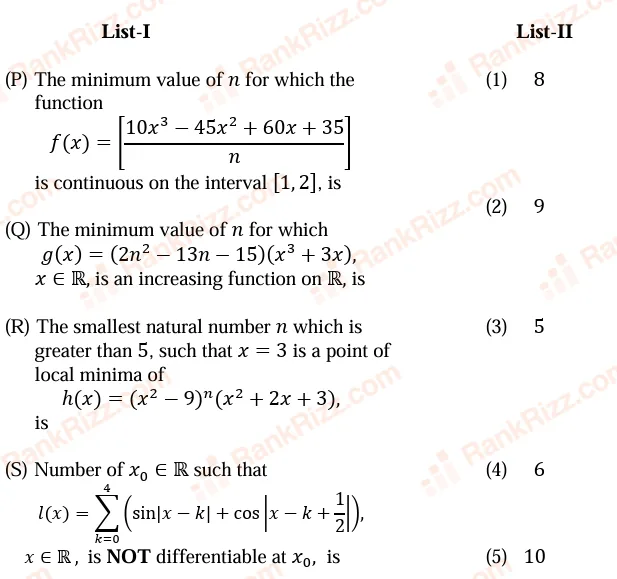
Let R\mathbb{R} denote the set of all real numbers. For a real number xx, let [x][x] denote the greatest integer less than or equal to xx. Let nn denote a natural number.

Match each entry in List-I to the correct entry in List-II and choose the correct option.

Figure for JEE Advanced 2025 Mathematics question on Differentiability at a point
  1. A

    (P)→\to(1), (Q)→\to(3), (R)→\to(2), (S)→\to(5)

  2. B

    (P)→\to(2), (Q)→\to(1), (R)→\to(4), (S)→\to(3)

  3. C

    (P)→\to(5), (Q)→\to(1), (R)→\to(4), (S)→\to(3)

  4. D

    (P)→\to(2), (Q)→\to(3), (R)→\to(1), (S)→\to(5)

JEE ADVANCED 2024 · PAPER 1Continuity at a pointTRANSCRIBED

Let f:R→Rf : \mathbb{R} \to \mathbb{R} and g:R→Rg : \mathbb{R} \to \mathbb{R} be functions defined by f(x)={x∣x∣sin⁡(1x),x≠0,0,x=0,f(x) = \begin{cases} x|x|\sin\left(\frac{1}{x}\right), & x \neq 0, \\ 0, & x = 0, \end{cases} and g(x)={1−2x,0≤x≤12,0,otherwise.g(x) = \begin{cases} 1 - 2x, & 0 \leq x \leq \frac{1}{2}, \\ 0, & \text{otherwise}. \end{cases}

Let a,b,c,d∈Ra, b, c, d \in \mathbb{R}. Define the function h:R→Rh : \mathbb{R} \to \mathbb{R} by h(x)=af(x)+b(g(x)+g(12−x))+c(x−g(x))+d⋅g(x)h(x) = af(x) + b\left(g(x) + g\left(\frac{1}{2} - x\right)\right) + c(x - g(x)) + d \cdot g(x), x∈Rx \in \mathbb{R}.

Match each entry in List-I to the correct entry in List-II.

List-IList-II
(P)If a=0,b=1,c=0a = 0, b = 1, c = 0 and d=0d = 0, then(1)hh is one-one
(Q)If a=1,b=0,c=0a = 1, b = 0, c = 0 and d=0d = 0, then(2)hh is onto
(R)If a=0,b=0,c=1a = 0, b = 0, c = 1 and d=0d = 0, then(3)hh is differentiable on R\mathbb{R}
(S)If a=0,b=0,c=0a = 0, b = 0, c = 0 and d=1d = 1, then(4)the range of hh is [0,1][0, 1]
(5)the range of hh is {0,1}\{0, 1\}
  1. A

    (P) →\to (4), (Q) →\to (3), (R) →\to (1), (S) →\to (2)

  2. B

    (P) →\to (5), (Q) →\to (2), (R) →\to (4), (S) →\to (3)

  3. C

    (P) →\to (5), (Q) →\to (3), (R) →\to (2), (S) →\to (4)

  4. D

    (P) →\to (4), (Q) →\to (2), (R) →\to (1), (S) →\to (3)

JEE ADVANCED 2023 · PAPER 2Differentiability at a pointTRANSCRIBED

Let f:(0,1)→Rf : (0,1) \to \mathbb{R} be the function defined as f(x)=[4x](x−14)2(x−12)f(x) = [4x]\left(x - \frac{1}{4}\right)^2\left(x - \frac{1}{2}\right), where [x][x] denotes the greatest integer less than or equal to xx. Then which of the following statements is(are) true?

  1. A

    The function ff is discontinuous exactly at one point in (0,1)(0,1)

  2. B

    There is exactly one point in (0,1)(0,1) at which the function ff is continuous but NOT differentiable

  3. C

    The function ff is NOT differentiable at more than three points in (0,1)(0,1)

  4. D

    The minimum value of the function ff is −1512-\frac{1}{512}

JEE ADVANCED 2020 · PAPER 2Continuity at a pointTRANSCRIBED

Let the functions f:(−1,1)→Rf:(-1, 1) \rightarrow R and g:(−1,1)→(−1,1)g:(-1, 1) \rightarrow (-1, 1) be defined by
f(x)=∣2x−1∣+∣2x+1∣f(x) = \mid 2x - 1 \mid + \mid 2x + 1 \mid and g(x)=x−[x]g(x) = x - [x],
where [x][x] denotes the greatest integer less than or equal to 𝑥. Let f∘g:(−1,1)→Rf \circ g :(−1, 1) \rightarrow R be the composite function defined by (f∘g)(x)=f(g(x))(f \circ g)(x) = f(g(x)). Suppose c is the number of points in the interval (-1, 1) at which f∘gf \circ g is NOT continuous, and suppose d is the number of points in the interval(-1, 1) at which f∘gf \circ g is NOT differenciable. Then the value of c + d is ____________

JEE ADVANCED 2020 · PAPER 1Differentiability at a pointTRANSCRIBED

Let the function f:R→Rf: R \rightarrow R be defined by f(x)=x3−x2+(x−1)sin⁡xf(x) = x^{3} − x^{2} + (x − 1) \sin x and let g:R→Rg: R \rightarrow R be an arbitrary function. Let fg:R→Rfg: R \rightarrow R be the product function defined by (fg)(x)=f(x)g(x)(fg)(x) = f(x)g(x). Then which of the following statements is/are TRUE?

  1. A

    If g is continuous at x=1x = 1, then fg is differentiable at x=1x = 1

  2. B

    If fg is differentiable at x=1x = 1, then 𝑔 is continuous at x=1x = 1

  3. C

    If g is differentiable at x=1x = 1, then 𝑓𝑔 is differentiable at x=1x = 1

  4. D

    If fg is differentiable at x=1x = 1, then 𝑔 is differentiable at x=1x = 1

JEE ADVANCED 2020 · PAPER 2Differentiability at a pointTRANSCRIBED

Let f:R→Rf:R \rightarrow R and g:R→Rg:R \rightarrow R be functions satisfying
f(x+y)=f(x)+f(y)+f(x)f(y)f(x + y)=f(x)+f(y)+f(x)f(y) and f(x)=xg(x)f(x) = xg(x)
for all 𝑥,𝑦∈R𝑥, 𝑦 \in R. If lim⁡x→0g(x)=1\lim_{x \rightarrow 0} g(x) = 1, then which of the following statements is/are TRUE?

  1. A

    f is differentiable at every x∈Rx \in R

  2. B

    If g(0) = 1, then g is differentiable at every x∈Rx \in R

  3. C

    The derivative f′(1)f′(1) is equal to 1

  4. D

    The derivative f′(0)f′(0) is equal to 1

JEE ADVANCED 2019 · PAPER 2Differentiability at a pointTRANSCRIBED

Let f:R→Rf: R \rightarrow R bea function. We say that f has
PROPERTY 1 if lim⁡h→0f(h)−f(0)∣h∣\lim_{h \rightarrow 0} \frac{f(h) - f(0)}{\sqrt{|h|}} exists and is finite, and
PROPERTY 2 if lim⁡h→0f(h)−f(0)h2\lim_{h \rightarrow 0} \frac{f(h) - f(0)}{h^2} exists and is finite.
Then which of the following options is/are correct?

  1. A

    f(x)=∣x∣f(x) = |x| has PROPERTY 1

  2. B

    f(x)=x23f(x) = x^{\frac{2}{3}} has PROPERTY 1

  3. C

    f(x)=x∣x∣f(x) = x|x| has PROPERTY 2

  4. D

    f(x)=sin⁡xf(x) = \sin x has PROPERTY 2

JEE ADVANCED 2019 · PAPER 1Continuity at a pointTRANSCRIBED

Let f:R→Rf:R \rightarrow R be given by
f(x)={x5+5x4+10x3+10x2+3x+1x<0;x2−x+1,0≤x≤1;23x3−4x2+7x−83,1≤x<3;(x−2)log⁡e(x−2)−x+103,x≥3.f(x) = \begin{cases}x^5 + 5x^4 + 10x^3 + 10x^2 + 3x +1 & x < 0;\\x^2 - x + 1, & 0 \leq x \leq 1; \\\frac{2}{3}x^3 - 4x^2 + 7x - \frac{8}{3}, & 1 \leq x < 3;\\ (x - 2) \log_e(x - 2) - x + \frac{10}{3}, & x \geq 3. \end{cases}
Then which of the following options is/are correct?

  1. A

    f is increasing on (−∞,0)(-\infty, 0)

  2. B

    f' has a local maximum at x = 1

  3. C

    f is onto

  4. D

    f' is NOT differentiable at x = 1

JEE ADVANCED 2017 · PAPER 1Continuity at a pointTRANSCRIBED

Let [x] be the greatest integer less than or equals to x. Then, at which of the following point(s) the function f(x)=xcos⁡(π(x+[x]))f(x) = x \cos (\pi(x + [x])) is discontinuous?

  1. A

    x = -1

  2. B

    x = 0

  3. C

    x = 1

  4. D

    x = 2

JEE ADVANCED 2017 · PAPER 1Continuity at a pointTRANSCRIBED

Let f:R→(0,1)f:R \rightarrow (0, 1) be a continuous function. Then, which of the following function(s) has (have) the value zero at some point in the interval (0, 1)?

  1. A

    x9−f(x)x^9 - f(x)

  2. B

    x−∫0π2−xf(t)cos⁡tdtx - \int_{0}^{\frac{\pi}{2}-x}f(t) \cos t dt

  3. C

    ex−∫0xf(t)sin⁡tdte^x - \int_{0}^{x}f(t) \sin t dt

  4. D

    f(x)+∫0π2f(t)sin⁡tdtf(x) + \int_{0}^{\frac{\pi}{2}}f(t) \sin t dt

JEE ADVANCED 2016 · PAPER 2Differentiability at a pointTRANSCRIBED

Let a,bϵRa, b \epsilon R and f:R→Rf: R \rightarrow R be bedefined by f(x)=acos⁡(∣x3−x∣)+b∣x∣sin⁡(∣x3+x∣)f(x) = a \cos (\mid x^3 - x \mid) + b \mid x \mid \sin(\mid x^3 + x \mid). Then f is

  1. A

    differentiable at x = 0 if a = 0 and b = 1

  2. B

    differentiable at x = 1 if a = 1 and b = 0

  3. C

    NOT differentiable at x = 0 if a = 1 and b = 0

  4. D

    NOT differentiable at x = 1 if a = 1 and b = 1

JEE ADVANCED 2016 · PAPER 2Continuity at a pointTRANSCRIBED

Let f:[−12,2]→Rf:\left[-\frac{1}{2}, 2\right] \rightarrow R and g:[−12,2]→Rg:\left[-\frac{1}{2}, 2\right] \rightarrow R be functions defined by f(x)=[x2−3]f(x) = [x^2 - 3] and g(x)=∣x∣f(x)+∣4x−7∣f(x)g(x) = \mid x \mid f(x) + \mid 4x - 7 \mid f(x), where [y][y] denotes the greatest integer less than or equal to y for yϵRy \epsilon R. Then

  1. A

    f is discontinuous exactly at three points in [−12,2]\left[-\frac{1}{2}, 2\right]

  2. B

    f is discontinuous exactly at four points in [−12,2]\left[-\frac{1}{2}, 2\right]

  3. C

    g is NOT differentiable exactly at four points in [−12,2]\left[-\frac{1}{2}, 2\right]

  4. D

    g is NOT differentiable exactly at five points in [−12,2]\left[-\frac{1}{2}, 2\right]

JEE ADVANCED 2015 · PAPER 1Differentiability at a pointTRANSCRIBED

Let g: R→RR \rightarrow R be a differentiable function with g(0) = 0, g'(0) = 0 and g’(1)≠0g’(1) \neq 0. Let
f(x)={x∣x∣g(x)x≠00x=0f(x) = \begin{cases}\frac{x}{|x|}g(x) & x \neq 0\\0 & x = 0\end{cases}
and h(x)=e∣x∣h(x) = e^{|x|} for all x∈Rx \in R. Let (f o h) (x) denote f(h(x)) and (h o f) (x) denote h(f(x)). Then which of the following is (are) true?

  1. A

    f is differentiable at x = 0

  2. B

    h is differentiable at x = 0

  3. C

    f o h is differentiable at x = 0

  4. D

    h o f is differentiable at x = 0

JEE ADVANCED 2014 · PAPER 1Continuity at a pointTRANSCRIBED

For every pair of continuous functions f,g:[0,1]→Rf, g: [0, 1] \rightarrow R such that
max{f(x):x∈[0,1]}=max{g(x):x∈[0,1]}max \left\{f(x) : x \in [0, 1]\right\} = max \left\{{g(x) : x \in [0, 1]}\right\}
the correct statement(s) is(are) :

  1. A

    (f(c))2+3f(c)=(g(c))2+3g(c)(f(c))^2 + 3f(c) = (g(c))^2 + 3g(c) for some c∈[0,1]c \in [0, 1]

  2. B

    (f(c))2+f(c)=(g(c))2+3g(c)(f(c))^2 + f(c) = (g(c))^2 + 3g(c) for some c∈[0,1]c \in [0, 1]

  3. C

    (f(c))2+3f(c)=(g(c))2+g(c)(f(c))^2 + 3f(c) = (g(c))^2 + g(c) for some c∈[0,1]c \in [0, 1]

  4. D

    (f(c))2=(g(c))2(f(c))^2 = (g(c))^2 for some c∈[0,1]c \in [0, 1]