RankRizz

Applications of Derivatives — JEE Advanced Previous Year Questions

Every Applications of Derivatives question JEE Advanced has set from 2007–2026, grouped by the idea it tests rather than the order of the syllabus. 45 questions across 8 distinct ideas. Free to read, answer key on every one.

Questions

45

Distinct ideas

8

Share of marks

4.8%

Difficulty

MEDIUM

The ideas inside Applications of Derivatives

A chapter is not one subject — it is a handful of procedures the examiner reuses. These are the ones Applications of Derivatives questions actually test.

01Rate of change of quantitiesset 1×
02Tangents and normals to curvesset 1×
03Angle between curves and shortest distanceNot set in Advanced
04Monotonicity and intervals of increase/decreaseset 12×
05Monotonicity for inequalities and number of rootsset 3×
06Local maxima and minima and concavityset 1×
07Absolute maxima and minimaset 2×
08Optimization word and geometry problemsset 21×
09Rolle's theorem and Lagrange's mean value theoremset 4×

Applications of Derivatives weightage, year by year

The share of each year’s Maths questions that came from Applications of Derivatives, counted from the 19 papers we hold for the last 10 years, and paper by paper inside a year.

Falling: 3.0% of Maths questions in 2024–2026, down from 5.6% in 2017–2023. Its heaviest year was 2017, at 16.7%. Not asked at all in 2023.

20261 / 342.9%PAPER 1 6.3%PAPER 2 0.0%
20251 / 323.1%PAPER 1 0.0%PAPER 2 6.3%
20241 / 342.9%PAPER 1 0.0%PAPER 2 5.9%
20230 / 340.0%PAPER 1 0.0%PAPER 2 0.0%
20221 / 362.8%PAPER 1 0.0%PAPER 2 5.6%
20211 / 382.6%PAPER 1 5.3%PAPER 2 0.0%
20202 / 365.6%PAPER 1 11.1%PAPER 2 0.0%
20192 / 365.6%PAPER 1 0.0%PAPER 2 11.1%
20181 / 185.6%1 PAPER
20176 / 3616.7%PAPER 1 16.7%PAPER 2 16.7%

“QS” is Applications of Derivatives questions out of all Maths questions that year. A year with more sittings asks more questions, which is why the share, not the count, is the number to compare.

Applications of Derivatives: quick answers

How many Applications of Derivatives questions has JEE Advanced asked?

45 questions from 2007–2026. Over the last 20 papers, Applications of Derivatives carried about 4.8% of Maths marks.

Which Applications of Derivatives topics come up most?

Optimization word and geometry problems (21 questions), Monotonicity and intervals of increase/decrease (12 questions), Rolle's theorem and Lagrange's mean value theorem (4 questions). Start with these, they are what the examiner keeps coming back to.

Is Applications of Derivatives important for JEE Advanced?

Falling: 3.0% of Maths questions in 2024–2026, down from 5.6% in 2017–2023. Its heaviest year was 2017, at 16.7%. Not asked at all in 2023. It has carried about 4.8% of Maths marks in recent papers, rated medium on our difficulty scale. The year-by-year table above shows how that has moved.

Do these Applications of Derivatives PYQs have answers and solutions?

Yes. Every question shows its official answer key, and a worked solution opens on the question’s own page wherever we have one. Reading and checking answers is free, no sign-up needed.

What’s the fastest way to revise Applications of Derivatives?

Do one past question per idea first: Applications of Derivatives has 8 distinct ideas, listed above. Then practise the topics you get wrong, or build a timed test from this chapter.

Every Applications of Derivatives question

1–20 OF 45 · NEWEST FIRST

JEE ADVANCED 2026 · PAPER 1Local maxima and minima and concavityTRANSCRIBED

Consider the function f:(0,∞)→(−∞,∞)f:(0,\infty)\to(-\infty,\infty) given by

f(x)=x log⁡e(x)−x+1.f(x)=\sqrt{x}\,\log_e(x)-x+1.

Then which one of the following statements is TRUE?

  1. A

    The derivative of the function ff is decreasing in the interval (0,1)(0,1)

  2. B

    The function ff has a local maximum at some point a∈(0,∞)a\in(0,\infty)

  3. C

    The function ff has a local minimum at some point b∈(0,∞)b\in(0,\infty)

  4. D

    The function ff has NEITHER a point of local maximum NOR a point of local minimum in the interval (0,∞)(0,\infty)
JEE ADVANCED 2025 · PAPER 2Absolute maxima and minimaTRANSCRIBED

Let R\mathbb{R} denote the set of all real numbers. Let f:R→Rf: \mathbb{R} \to \mathbb{R} be defined by

f(x)={6x+sin⁡x2x+sin⁡xif x≠0,73if x=0.f(x) = \begin{cases} \frac{6x + \sin x}{2x + \sin x} & \text{if } x \neq 0, \\ \frac{7}{3} & \text{if } x = 0. \end{cases}

Then which of the following statements is (are) TRUE?

  1. A

    The point x=0x = 0 is a point of local maxima of ff

  2. B

    The point x=0x = 0 is a point of local minima of ff

  3. C

    Number of points of local maxima of ff in the interval [π,6π][\pi, 6\pi] is 3

  4. D

    Number of points of local minima of ff in the interval [2π,4π][2\pi, 4\pi] is 1

JEE ADVANCED 2024 · PAPER 2Monotonicity and intervals of increase/decreaseTRANSCRIBED

Let the function f:R→Rf : \mathbb{R} \to \mathbb{R} be defined by

f(x)=sin⁡xeπx⋅(x2023+2024x+2025)(x2−x+3)+2eπx⋅(x2023+2024x+2025)(x2−x+3)f(x) = \frac{\sin x}{e^{\pi x}} \cdot \frac{(x^{2023} + 2024x + 2025)}{(x^2 - x + 3)} + \frac{2}{e^{\pi x}} \cdot \frac{(x^{2023} + 2024x + 2025)}{(x^2 - x + 3)}.

Then the number of solutions of f(x)=0f(x) = 0 in R\mathbb{R} is ______.

JEE ADVANCED 2022 · PAPER 2Absolute maxima and minimaTRANSCRIBED

Let α=∑k=1∞sin⁡2k(π6)\alpha = \displaystyle\sum_{k=1}^{\infty} \sin^{2k}\left(\dfrac{\pi}{6}\right).

Let g:[0,1]→Rg : [0, 1] \to \mathbb{R} be the function defined by g(x)=2αx+2α(1−x)g(x) = 2^{\alpha x} + 2^{\alpha(1-x)}.

Then, which of the following statements is False?

  1. A

    The minimum value of g(x)g(x) is 27/62^{7/6}

  2. B

    The maximum value of g(x)g(x) is 1+21/31 + 2^{1/3}

  3. C

    The function g(x)g(x) attains its maximum at more than one point

  4. D

    The function g(x)g(x) attains its minimum at more than one point

JEE ADVANCED 2021 · PAPER 1Monotonicity and intervals of increase/decreaseTRANSCRIBED

Let f:R→Rf : R \rightarrow R be defined by
f(x)=x2−3x−6x2+2x+4f(x) = \frac{x^2 - 3x - 6}{x^2 + 2x + 4}
Then which of the following statements is (are) TRUE?

  1. A

    f is decreasing in the interval (−2, −1)

  2. B

    f is increasing in the interval (1, 2)

  3. C

    f is onto

  4. D

    Range of f is [−32,2]\left[-\frac{3}{2}, 2\right]

JEE ADVANCED 2020 · PAPER 1Optimization word and geometry problemsTRANSCRIBED

Consider all rectangles lying in the region

{(x,y)ϵR×R:0≤x≤π2and0≤y≤2sin⁡(2x)}\left\{(x, y) \epsilon R \times R : 0 \leq x \leq \frac{\pi}{2} and 0 \leq y \leq 2\sin(2x)\right\}

and having one side on the xx-axis. The area of the rectangle which has the maximum perimeter among all such rectangles, is

  1. A

    3π2\frac{3\pi}{2}

  2. B

    π\pi

  3. C

    π23\frac{\pi}{2\sqrt{3}}

  4. D

    π32\frac{\pi\sqrt{3}}{2}

JEE ADVANCED 2020 · PAPER 1Rolle's theorem and Lagrange's mean value theoremTRANSCRIBED

For a polynomial g(x)g(x) with real coefficients, let mg denote the number of distinct real roots of
g(x)g(x). Suppose 𝑆 is the set of polynomials with real coefficients defined by

S={(x2−1)2(a0+a1x+a2x2+a3x3)∶a0,a1,a2,a3ϵR}S = \left\{(x^{2} − 1)^{2}(a_{0} + a_{1}x + a_{2}x^{2} + a_{3}x^{3}) ∶ a_{0}, a_{1}, a_{2}, a_{3} \epsilon R\right\}.

For a polynomial f, let f′f{'} and f′′f {'}{'} denote its first and second order derivatives, respectively. Then the minimum possible value of (mf′+mf′′)(m_{f{'}} + m_{f{'}{'}}), where fϵSf \epsilon S, is _____

JEE ADVANCED 2019 · PAPER 2Optimization word and geometry problemsTRANSCRIBED

Let
f(x)=sin⁡πxx2,x>0.f(x) = \frac{\sin \pi x}{x^2}, x > 0.
Let x1<x2<x3<...<xn<...x_1 < x_2 < x_3 < ... < x_n < ... be all the points of local maximum off
and y1<y2<y3<...<yn<...y_1 < y_2 < y_3 < ... < y_n < ... be all the points of local minimum off.
Then which of the following options is/are correct?

  1. A

    x1<y1x_1 < y_1

  2. B

    xn+1−xn>2x_{n + 1} - x_n > 2 for every n

  3. C

    xn∈(2n,2n+12)x_n \in \left(2n, 2n + \frac{1}{2}\right) for every n

  4. D

    ∣xn−yn∣>1|x_n - y_n| > 1 for every n

JEE ADVANCED 2019 · PAPER 2Optimization word and geometry problemsTRANSCRIBED

Let f:R→Rf : R \rightarrow R be given by f(x)=(x−1)(x−2)(x−5).f(x) = (x - 1)(x - 2)(x - 5). Define
F(x)=∫0xf(t)dt,x>0.F(x) = \int_{0}^{x} f(t) dt, x > 0.
Then which of the following options is/are correct?

  1. A

    F has local minimum at x = 1

  2. B

    F has local maximum at x = 2

  3. C

    F has two local maxima and one local minimum in (0,∞)(0, \infty)

  4. D

    F(x)≠0F(x) \neq 0 for all x∈(0,5)x \in (0,5)

JEE ADVANCED 2018 · PAPER 1Rolle's theorem and Lagrange's mean value theoremTRANSCRIBED

For every twice differentiable function f:R→[−2,2]f : R \rightarrow [-2, 2] with (f(0))2+(f′(0))2=85(f(0))^{2}+(f'(0))^{2}=85 which of the following statement(s) is (are) TRUE?

  1. A

    There exist r,s \in R where r<s such that 𝑓 is one-one on the open interval (r, s)

  2. B

    There exists X0∈(−4,0)X_{0} \in (-4,0) such that∣(f′(x0))∣≤1\mid (f'(x_{0})) \mid \leq 1

  3. C

    lim⁡x→∞f(x)=1\lim_{x\rightarrow\infty } f(x) =1

  4. D

    There exists α\alpha ∈\in (-4,4) such that f(α)+f′′(α)=0f(\alpha)+f''(\alpha) = 0 and f′(α)≠0f'(\alpha) \neq 0

JEE ADVANCED 2017 · PAPER 2Rolle's theorem and Lagrange's mean value theoremTRANSCRIBED

If f:R→Rf:R\rightarrow Ris a twice differentiable function such that f′′(x)>0f''(x)>0 for all xϵRx\epsilon R, and f(12)=12,f(1)=1f(\frac{1}{2})=\frac{1}{2},f(1)=1, then

  1. A

    f′(1)≤0f'(1)\leq0

  2. B

    0<f′(1)≤120<f'(1)\leq\frac{1}{2}

  3. C

    12<f′(1)≤ 1\frac{1}{2}<f'(1)\leq\ 1

  4. D

    f′(1)>1f'(1)>1

JEE ADVANCED 2017 · PAPER 2Monotonicity and intervals of increase/decreaseTRANSCRIBED

If f:R→Rf:R\rightarrow R is a differentiable function such that f′(x)>2f(x)f'(x)>2f(x) for all xϵRx\epsilon R, and f(0)=1f(0)=1, then

  1. A

    f(x)f(x) is increasing in (0,∞)(0,\infty)

  2. B

    f(x)f(x) is decreasing in (0,∞)(0,\infty)

  3. C

    f(x)>e2xf(x)>e^{2x} in (0,∞)(0,\infty)

  4. D

    f′(x)<e2xf'(x)<e^{2x} in (0,∞)(0,\infty)

JEE ADVANCED 2017 · PAPER 2Optimization word and geometry problemsTRANSCRIBED

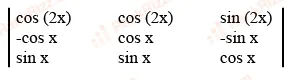
If f(x) = 

Figure for JEE Advanced 2017 Mathematics question on Optimization word and geometry problems

, then

  1. A

    f'(x) = 0 at exactly three points in −π,π-\pi,\pi

  2. B

    f'(x) = 0 at more than three points in −π,π-\pi,\pi

  3. C

    f(x) attains its maximum at x=0

  4. D

    f(x) attains its minimum at x=0

JEE ADVANCED 2017 · PAPER 1Monotonicity and intervals of increase/decreaseTRANSCRIBED

Which of the following options is the only CORRECT combination?

  1. A

    (I) (i) (P)

  2. B

    (II) (ii) (Q)

  3. C

    (III) (iii) (R)

  4. D

    (IV) (iv) (S)

JEE ADVANCED 2017 · PAPER 1Monotonicity and intervals of increase/decreaseTRANSCRIBED

Which of the following options is the only CORRECT combination?

  1. A

    (I) (ii) (R)

  2. B

    (II) (iii) (S)

  3. C

    (III) (iv) (P)

  4. D

    (IV) (i) (S)

JEE ADVANCED 2017 · PAPER 1Monotonicity and intervals of increase/decreaseTRANSCRIBED

Which of the following options is the only INCORRECT combination?

  1. A

    (I) (iii) (P)

  2. B

    (II) (iv) (Q)

  3. C

    (III) (i) (R)

  4. D

    (II) (iii) (P)

JEE ADVANCED 2016 · PAPER 1Optimization word and geometry problemsTRANSCRIBED

The least value of α∈R\alpha \in R for which 4αx2+1x≥14 \alpha x^2 + \frac{1}{x} \geq 1, for all x > 0, is

  1. A

    164\frac{1}{64}

  2. B

    132\frac{1}{32}

  3. C

    127\frac{1}{27}

  4. D

    125\frac{1}{25}

JEE ADVANCED 2016 · PAPER 2Optimization word and geometry problemsTRANSCRIBED

Let f:R→(0,∞)f : R \rightarrow (0, \infty) and g:R→Rg : R \rightarrow R be be twice differentiable functions such that f′′f'' and g′′g'' are continuous functions on R. Suppose f′(2)=g(2)=0,f′′(2)≠0f'(2) = g(2) = 0, f''(2) \neq 0 and g′(2)≠0g'(2) \neq 0. If lim⁡x→2f(x)g(x)f′(x)g′(x)=1\lim_{x \rightarrow 2}\frac{f(x)g(x)}{f'(x)g'(x)} = 1, then

  1. A

    f has a local minimum at x = 2

  2. B

    f has a local maximum at x = 2

  3. C

    f′′(2)>f(2)f''(2) > f(2)

  4. D

    f(x)−f′′(x)=0f(x) - f''(x) = 0 for at least one xϵRx \epsilon R.

JEE ADVANCED 2015 · PAPER 1Optimization word and geometry problemsTRANSCRIBED

A cylindrical container is to be made from certain solid material with the following constraints: It has a fixed inner volume of Vmm3V mm^3, has a 2 mm thick solid wall and is open at the top. The bottom of the container is a solid circular disc of thickness 2 mm and is of radius equal to the outer radius of the container. If the volume of the material used to make the container is minimum when the inner radius of the container is 10 mm, then the value of V250π\frac{V}{250 \pi} is

JEE ADVANCED 2015 · PAPER 2Rolle's theorem and Lagrange's mean value theoremTRANSCRIBED

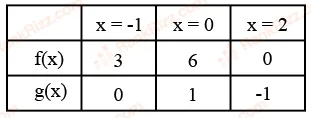
Let f,g:[−1,2]→Rf,g:[-1, 2] \rightarrow R be continuous functions which are twice differentiable on the interval (-1, 2). Let the valuesof f and g at the points —1, 0 and 2 be as given in the following table:

Figure for JEE Advanced 2015 Mathematics question on Rolle's theorem and Lagrange's mean value theorem


In each of the intervals (-1,0) and (0, 2) the function (f−3g)"(f - 3g)" never vanishes. Then the correct statement(s) is(are)

  1. A

    f′(x)−3g′(x)=0f'(x) - 3g'(x) = 0 has exactly three solutions in (−1,0)∪(0,2)(-1, 0) \cup (0, 2)

  2. B

    f′(x)−3g′(x)=0f'(x) - 3g'(x) = 0 has exactly one solution in (-1, 0)

  3. C

    f′(x)−3g′(x)=0f'(x) - 3g'(x) = 0 has exactly one solution in (0, 2)

  4. D

    f′(x)−3g′(x)=0f'(x) - 3g'(x) = 0 has exactly two solutions in (-1, 0) and exactly two solutions in (0, 2)