RankRizz

Inverse Trigonometric Functions — JEE Advanced Previous Year Questions

Every Inverse Trigonometric Functions question JEE Advanced has set from 2007–2026, grouped by the idea it tests rather than the order of the syllabus. 16 questions across 4 distinct ideas. Free to read, answer key on every one.

Questions

16

Distinct ideas

4

Share of marks

2.6%

Difficulty

HARD

The ideas inside Inverse Trigonometric Functions

A chapter is not one subject — it is a handful of procedures the examiner reuses. These are the ones Inverse Trigonometric Functions questions actually test.

01Domain, range and principal valuesset 7×
02Properties and simplification of inverse trigonometric functionsset 5×
03Sum and difference formulasset 1×
04Inverse trigonometric equations and inequalitiesNot set in Advanced
05Series of inverse trigonometric functionsset 3×

Inverse Trigonometric Functions weightage, year by year

The share of each year’s Maths questions that came from Inverse Trigonometric Functions, counted from the 19 papers we hold for the last 10 years, and paper by paper inside a year.

Steady: 3.0% of Maths questions in 2024–2026 against 2.6% in 2017–2023, and between 0.0% and 5.9% in every year shown. Not asked at all in 2017, 2020.

20261 / 342.9%PAPER 1 6.3%PAPER 2 0.0%
20251 / 323.1%PAPER 1 0.0%PAPER 2 6.3%
20241 / 342.9%PAPER 1 0.0%PAPER 2 5.9%
20232 / 345.9%PAPER 1 5.9%PAPER 2 5.9%
20221 / 362.8%PAPER 1 5.6%PAPER 2 0.0%
20211 / 382.6%PAPER 1 5.3%PAPER 2 0.0%
20200 / 360.0%PAPER 1 0.0%PAPER 2 0.0%
20191 / 362.8%PAPER 1 0.0%PAPER 2 5.6%
20181 / 185.6%1 PAPER
20170 / 360.0%PAPER 1 0.0%PAPER 2 0.0%

“QS” is Inverse Trigonometric Functions questions out of all Maths questions that year. A year with more sittings asks more questions, which is why the share, not the count, is the number to compare.

Inverse Trigonometric Functions: quick answers

How many Inverse Trigonometric Functions questions has JEE Advanced asked?

16 questions from 2007–2026. Over the last 20 papers, Inverse Trigonometric Functions carried about 2.6% of Maths marks.

Which Inverse Trigonometric Functions topics come up most?

Domain, range and principal values (7 questions), Properties and simplification of inverse trigonometric functions (5 questions), Series of inverse trigonometric functions (3 questions). Start with these, they are what the examiner keeps coming back to.

Is Inverse Trigonometric Functions important for JEE Advanced?

Steady: 3.0% of Maths questions in 2024–2026 against 2.6% in 2017–2023, and between 0.0% and 5.9% in every year shown. Not asked at all in 2017, 2020. It has carried about 2.6% of Maths marks in recent papers, rated hard on our difficulty scale. The year-by-year table above shows how that has moved.

Do these Inverse Trigonometric Functions PYQs have answers and solutions?

Yes. Every question shows its official answer key, and a worked solution opens on the question’s own page wherever we have one. Reading and checking answers is free, no sign-up needed.

What’s the fastest way to revise Inverse Trigonometric Functions?

Do one past question per idea first: Inverse Trigonometric Functions has 4 distinct ideas, listed above. Then practise the topics you get wrong, or build a timed test from this chapter.

Every Inverse Trigonometric Functions question

1–16 OF 16 · NEWEST FIRST

JEE ADVANCED 2026 · PAPER 1Domain, range and principal valuesTRANSCRIBED

Considering only the principal values of the inverse trigonometric functions, the value of

cot⁡−1(cot⁡(−11))+10 sin⁡ ⁣(2cos⁡−1 ⁣(12))+10sin⁡(2tan⁡−1(2))\cot^{-1}(\cot(-11))+10\,\sin\!\left(2\cos^{-1}\!\left(\tfrac{1}{\sqrt{2}}\right)\right)+10\sin(2\tan^{-1}(2))

is

  1. A

    3π+73\pi+7

  2. B

    77

  3. C

    4π+74\pi+7

  4. D

    3π−53\pi-5

JEE ADVANCED 2025 · PAPER 2Domain, range and principal valuesTRANSCRIBED

The total number of real solutions of the equation

θ=tan⁡−1(2tan⁡θ)−12sin⁡−1(6tan⁡θ9+tan⁡2θ)\theta = \tan^{-1}(2\tan\theta) - \frac{1}{2}\sin^{-1}\left(\frac{6\tan\theta}{9 + \tan^2\theta}\right)

is

(Here, the inverse trigonometric functions sin⁡−1x\sin^{-1} x and tan⁡−1x\tan^{-1} x assume values in [−π2,π2]\left[-\frac{\pi}{2}, \frac{\pi}{2}\right] and (−π2,π2)\left(-\frac{\pi}{2}, \frac{\pi}{2}\right), respectively.)

  1. A

    11

  2. B

    22

  3. C

    33

  4. D

    55

JEE ADVANCED 2024 · PAPER 2Domain, range and principal valuesTRANSCRIBED

Considering only the principal values of the inverse trigonometric functions, the value of tan⁡(sin⁡−1(35)−2cos⁡−1(25))\tan\left(\sin^{-1}\left(\frac{3}{5}\right) - 2\cos^{-1}\left(\frac{2}{\sqrt{5}}\right)\right) is

  1. A

    724\frac{7}{24}

  2. B

    −724\frac{-7}{24}

  3. C

    −524\frac{-5}{24}

  4. D

    524\frac{5}{24}

JEE ADVANCED 2023 · PAPER 2Properties and simplification of inverse trigonometric functionsTRANSCRIBED

For any y∈Ry \in \mathbb{R}, let cot⁡−1(y)∈(0,π)\cot^{-1}(y) \in (0, \pi) and tan⁡−1(y)∈(−π2,π2)\tan^{-1}(y) \in \left(-\frac{\pi}{2}, \frac{\pi}{2}\right). Then the sum of all the solutions of the equation tan⁡−1(6y9−y2)+cot⁡−1(9−y26y)=2π3\tan^{-1}\left(\frac{6y}{9 - y^2}\right) + \cot^{-1}\left(\frac{9 - y^2}{6y}\right) = \frac{2\pi}{3} for 0<∣y∣<30 < |y| < 3, is equal to

  1. A

    23−32\sqrt{3} - 3

  2. B

    3−233 - 2\sqrt{3}

  3. C

    43−64\sqrt{3} - 6

  4. D

    6−436 - 4\sqrt{3}

JEE ADVANCED 2023 · PAPER 1Properties and simplification of inverse trigonometric functionsTRANSCRIBED

Let tan⁡−1(x)∈(−π2,π2)\tan^{-1}(x) \in \left(-\frac{\pi}{2}, \frac{\pi}{2}\right), for x∈Rx \in \mathbb{R}. Then the number of real solutions of the equation 1+cos⁡(2x)=2tan⁡−1(tan⁡x)\sqrt{1 + \cos(2x)} = \sqrt{2} \tan^{-1}(\tan x) in the set (−3π2,π2)∪(−π2,π2)∪(π2,3π2)\left(-\frac{3\pi}{2}, \frac{\pi}{2}\right) \cup \left(-\frac{\pi}{2}, \frac{\pi}{2}\right) \cup \left(\frac{\pi}{2}, \frac{3\pi}{2}\right) is equal to

JEE ADVANCED 2022 · PAPER 1Domain, range and principal valuesTRANSCRIBED

Considering only the principal values of the inverse trigonometric functions, the value of

32cos⁡−122+π2+14sin⁡−122π2+π2+tan⁡−12π\frac{3}{2} \cos^{-1} \sqrt{\frac{2}{2+\pi^2}} + \frac{1}{4} \sin^{-1} \frac{2\sqrt{2}\pi}{2+\pi^2} + \tan^{-1} \frac{\sqrt{2}}{\pi}

is ______.

JEE ADVANCED 2021 · PAPER 1Series of inverse trigonometric functionsTRANSCRIBED

For any positive integer n, let Sn:(0,∞)→RS_n : (0, \infty) \rightarrow R be defined by
Sn(x)=∑k=1ncot⁡−1(1+k(k+1)x2x)S_n(x) = \sum_{k=1}^n \cot^{-1}\left(\frac{1 + k(k + 1)x^2}{x}\right),
where for any x∈R,cot⁡−1(x)∈(0,π)x \in R, \cot^{-1}(x) \in (0, \pi) and tan⁡−1(x)∈(−π2,π2)\tan^{-1}(x) \in \left(-\frac{\pi}{2}, \frac{\pi}{2}\right). Then which of the following statements is (are) TRUE ?

  1. A

    S10(x)=π2−tan⁡−1(1+11x210x)S_{10}(x) = \frac{\pi}{2} - \tan^{-1}\left(\frac{1 + 11 x^2}{10 x}\right), for all x>0x > 0

  2. B

    lim⁡n→∞cot⁡(Sn(x))=x\lim_{n \rightarrow \infty} \cot(S_n(x)) = x, for all x > 0

  3. C

    The equation S3(x)=π4S_3(x) = \frac{\pi}{4} has a root in (0,∞)(0, \infty)

  4. D

    tan⁡(Sn(x))≤12\tan(S_n(x)) \leq \frac{1}{2}, for all n≥1n \geq 1 and x>0x > 0

JEE ADVANCED 2019 · PAPER 2Domain, range and principal valuesTRANSCRIBED

The value of
sec⁡−1(14∑k=010sec⁡(7π12+kπ2)sec⁡(7π12+(k+1)π2))\sec^{-1} \left(\frac{1}{4}\sum_{k = 0}^{10} \sec \left(\frac{7\pi}{12} + \frac{k\pi}{2}\right) \sec \left(\frac{7\pi}{12} + \frac{\left(k + 1\right)\pi}{2}\right) \right)
in the interval [−π4,3π4]\begin{bmatrix}-\frac {\pi}{4}, & \frac{3\pi}{4} \end{bmatrix} equals _______

JEE ADVANCED 2018 · PAPER 1Series of inverse trigonometric functionsTRANSCRIBED

The number of real solutions of the equation
sin⁡−1(∑i=1∞Xi+1−x∑i=1∞(x2)i)=π2−cos⁡−1(∑i=1∞(−x2)i−∑i=1∞(−x)i)\sin^{-1}\left(\sum_{i=1}^\infty X^{i+1} -x\sum_{i=1}^\infty \left(\frac{x}{2}\right)^{i} \right )=\frac{\pi}{2}-\cos^{-1}\left(\sum_{i=1}^\infty \left(\frac{-x}{2}\right)^{i}-\sum_{i=1}^\infty \left(-x\right)^{i}\right) lying in the interval (−12,12)(- \frac{1}{2},\frac{1}{2})(Here, the inverse trigonometric functions sin⁡−1xandcos⁡−1x\sin^{−1}x and \cos^{−1}x assume values in [−π2,π2- \frac{\pi}{2},\frac{\pi}{2}] and and [0,π][0, \pi], respectively.)

JEE ADVANCED 2015 · PAPER 2Domain, range and principal valuesTRANSCRIBED

If α=3sin⁡−1(611)\alpha = 3 \sin^{-1} \left(\frac{6}{11}\right) and $$\beta = 3 \cos^{-1} \left(\frac{4}{9}\right) where the inverse trigonometric functions take only the principal values, then the correct option(s) is(are)

  1. A

    cos⁡β>0\cos \beta > 0

  2. B

    sin⁡β<0\sin \beta < 0

  3. C

    cos⁡(α+β)>0\cos (\alpha + \beta) > 0

  4. D

    cos⁡α<0\cos \alpha < 0

JEE ADVANCED 2014 · PAPER 1Domain, range and principal valuesTRANSCRIBED

Let f:[0,4π]→[0,π]f: [0, 4 \pi] \rightarrow [0, \pi] be defined by f(x)=cos⁡−1(cos⁡x).f(x) = \cos^{-1} (\cos x). The number of points x∈[0,4π]x \in [0, 4 \pi] satisfying the equation f(x)=10−x10f(x) = \frac{10 - x}{10} is

JEE ADVANCED 2013 · PAPER 1Series of inverse trigonometric functionsTRANSCRIBED

The value of cot⁡(∑n=123cot⁡−1(1+∑k=1n2k))\cot \left(\sum_{n = 1}^{23}\cot^{-1} \left(1 + \sum_{k = 1}^n 2k\right)\right) is

  1. A

    2325\frac{23}{25}

  2. B

    2523\frac{25}{23}

  3. C

    2324\frac{23}{24}

  4. D

    2423\frac{24}{23}

JEE ADVANCED 2013 · PAPER 2Properties and simplification of inverse trigonometric functionsTRANSCRIBED

Match List I with List II and select the correct answer using the code given below the lists:
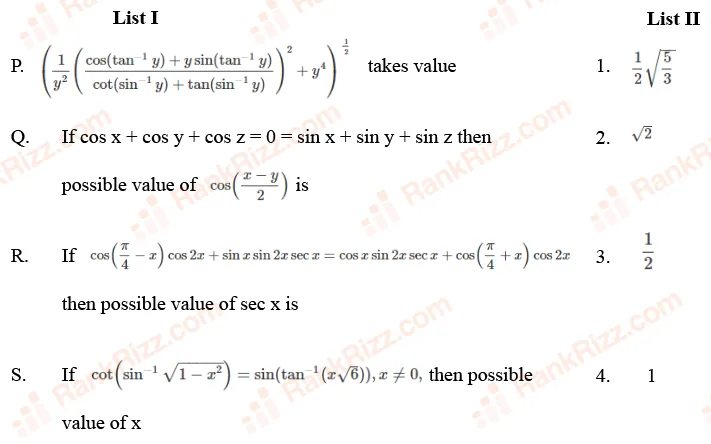
Figure for JEE Advanced 2013 Mathematics question on Properties and simplification of inverse trigonometric functions
  1. A

    P-4, Q-3, R-1, S-2

  2. B

    P-4, Q-3, R-2, S-1

  3. C

    P-3, Q-4, R-2, S-1

  4. D

    P-3, Q-4, R-1, S-2

JEE ADVANCED 2008 · PAPER 1Properties and simplification of inverse trigonometric functionsTRANSCRIBED

If 0<x<10 < x < 1, then
1+x2[{xcos⁡(cot⁡−1x)+sin⁡(cot⁡−1x)}2−1]12=\sqrt{1 + x^2}[\left\{x \cos (\cot^{-1} x) + \sin(\cot^{-1} x)\right\}^2 - 1]^{\frac{1}{2}}=

  1. A

    x1+x2\frac{x}{\sqrt{1 + x^2}}

  2. B

    xx

  3. C

    x1+x2x\sqrt{1 + x^2}

  4. D

    1+x2\sqrt{1 + x^2}

JEE ADVANCED 2007 · PAPER 1Sum and difference formulasTRANSCRIBED

Let F(x)F(x) be an indefinite integral of sin⁡2x\sin^2 x.
STATEMENT-1 : The function F(x)F(x) satisfies F(x+π)=F(x)F(x + \pi) = F(x) for all real x.
because
STATEMENT-2: sin⁡2(x+π)=sin⁡2x\sin^2 (x + \pi) = \sin^2 x for all real x.

  1. A

    Statement-1 is True, Statement-2 is True; Statement-2 is a correct explanation for Statement-1

  2. B

    Statement-1 is True, Statement-2 is True; Statement-2 is NOT a correct explanation for Statement-1

  3. C

    Statement-1 is True, Statement-2 is False

  4. D

    Statement-1 is False, Statement-2 is True

JEE ADVANCED 2007 · PAPER 2Properties and simplification of inverse trigonometric functionsTRANSCRIBED

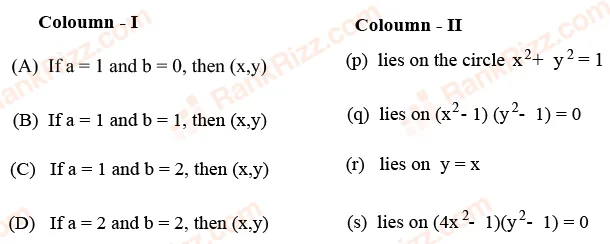
Let (x, y) be such that sin⁡−1(ax)+cos⁡−1(y)+cos⁡−1(bxy)=π2.\sin^{-1}(ax) + \cos^{-1}(y) + \cos^{-1}(bxy) = \frac{\pi}{2}.
Match the statements in Column I with statements in Column II and indicate your answer by darkening the appropriate bubbles in the 4×44 \times 4 matrix given in the ORS.

Figure for JEE Advanced 2007 Mathematics question on Properties and simplification of inverse trigonometric functions