RankRizz

Straight Lines — JEE Advanced Previous Year Questions

Every Straight Lines question JEE Advanced has set from 2007–2025, grouped by the idea it tests rather than the order of the syllabus. 10 questions across 9 distinct ideas. Free to read, answer key on every one.

Questions

10

Distinct ideas

9

Share of marks

0.3%

Difficulty

MEDIUM

The ideas inside Straight Lines

A chapter is not one subject — it is a handful of procedures the examiner reuses. These are the ones Straight Lines questions actually test.

01Distance, section formula and shifting of originNot set in Advanced
02Area of triangle and collinearityset 1×
03Centroid, incentre, circumcentre and orthocentreset 1×
04Equations of a line in various formsset 1×
05Angle between lines, parallel and perpendicular linesset 1×
06Distance from a line, foot of perpendicular and imageset 1×
07Position of a point relative to linesNot set in Advanced
08Concurrency and family of linesset 1×
09Angle bisectorsset 1×
10Pair of straight linesset 1×
11Locus problems in coordinate geometryset 2×

Straight Lines weightage, year by year

The share of each year’s Maths questions that came from Straight Lines, counted from the 19 papers we hold for the last 10 years, and paper by paper inside a year.

Rising: 1.0% of Maths questions in 2024–2026, up from 0.0% in 2017–2023. Its heaviest year was 2025, at 3.1%. Not asked at all in 2017, 2018, 2019, 2020, 2021, 2022, 2023, 2024, 2026.

20260 / 340.0%PAPER 1 0.0%PAPER 2 0.0%
20251 / 323.1%PAPER 1 0.0%PAPER 2 6.3%
20240 / 340.0%PAPER 1 0.0%PAPER 2 0.0%
20230 / 340.0%PAPER 1 0.0%PAPER 2 0.0%
20220 / 360.0%PAPER 1 0.0%PAPER 2 0.0%
20210 / 380.0%PAPER 1 0.0%PAPER 2 0.0%
20200 / 360.0%PAPER 1 0.0%PAPER 2 0.0%
20190 / 360.0%PAPER 1 0.0%PAPER 2 0.0%
20180 / 180.0%1 PAPER
20170 / 360.0%PAPER 1 0.0%PAPER 2 0.0%

“QS” is Straight Lines questions out of all Maths questions that year. A year with more sittings asks more questions, which is why the share, not the count, is the number to compare.

Straight Lines: quick answers

How many Straight Lines questions has JEE Advanced asked?

10 questions from 2007–2025. Over the last 20 papers, Straight Lines carried about 0.3% of Maths marks.

Which Straight Lines topics come up most?

Locus problems in coordinate geometry (2 questions), Area of triangle and collinearity (1 questions), Centroid, incentre, circumcentre and orthocentre (1 questions). Start with these, they are what the examiner keeps coming back to.

Is Straight Lines important for JEE Advanced?

Rising: 1.0% of Maths questions in 2024–2026, up from 0.0% in 2017–2023. Its heaviest year was 2025, at 3.1%. Not asked at all in 2017, 2018, 2019, 2020, 2021, 2022, 2023, 2024, 2026. It has carried about 0.3% of Maths marks in recent papers, rated medium on our difficulty scale. The year-by-year table above shows how that has moved.

Do these Straight Lines PYQs have answers and solutions?

Yes. Every question shows its official answer key, and a worked solution opens on the question’s own page wherever we have one. Reading and checking answers is free, no sign-up needed.

What’s the fastest way to revise Straight Lines?

Do one past question per idea first: Straight Lines has 9 distinct ideas, listed above. Then practise the topics you get wrong, or build a timed test from this chapter.

Every Straight Lines question

1–10 OF 10 · NEWEST FIRST

JEE ADVANCED 2025 · PAPER 2Locus problems in coordinate geometryTRANSCRIBED

Let SS denote the locus of the point of intersection of the pair of lines

4x−3y=12α4x - 3y = 12\alpha,

4αx+3αy=124\alpha x + 3\alpha y = 12,

where α\alpha varies over the set of non-zero real numbers. Let TT be the tangent to SS passing through the points (p,0)(p, 0) and (0,q)(0, q), q>0q > 0, and parallel to the line 4x−32y=04x - \frac{3}{\sqrt{2}} y = 0.

Then the value of pqpq is

  1. A

    −62-6\sqrt{2}

  2. B

    −32-3\sqrt{2}

  3. C

    −92-9\sqrt{2}

  4. D

    −122-12\sqrt{2}

JEE ADVANCED 2014 · PAPER 1Distance from a line, foot of perpendicular and imageTRANSCRIBED

For a point P in the plane, let d1(P)d_1 (P) and d2(P)d_2 (P) be the distances of the point P from the lines x − y = 0 and x + y = 0 respectively. The area of the region R consisting of all points P lying in the first quadrant of the plane and satisfying 2≤d1(P)+d2(P)≤4,2 \leq d_1 (P) + d_2 (P) \leq 4, is

JEE ADVANCED 2013 · PAPER 1Equations of a line in various formsTRANSCRIBED

For a > b > c > 0, the distance between (1, 1) and the point of intersection of the lines ax + by + c = 0 and bx + ay + c = 0 is less than 222 \sqrt 2. Then

  1. A

    a + b - c > 0

  2. B

    a - b + c < 0

  3. C

    a - b + c > 0

  4. D

    a + b - c < 0

JEE ADVANCED 2011 · PAPER 1Angle between lines, parallel and perpendicular linesTRANSCRIBED

A straight line L through the point (3, -2) is inclined at an angle 60∘60^\circ to the line 3x+y=1\sqrt{3} x + y = 1. If L also intersects the x-axis, then the equation of L is

  1. A

    y+3x+2−33=0y + \sqrt{3} x + 2 - 3 \sqrt{3} = 0

  2. B

    y−3x+2+33=0y - \sqrt{3} x + 2 + 3 \sqrt{3} = 0

  3. C

    3y−x+3+23=0\sqrt{3} y - x + 3 + 2 \sqrt{3} = 0

  4. D

    3y+x−3+23=0\sqrt{3} y + x - 3 + 2 \sqrt{3} = 0

JEE ADVANCED 2009 · PAPER 2Locus problems in coordinate geometryTRANSCRIBED

The locus of the orthocentre of the triangle formed by the lines
(1 + p)x - py + p(1 + p) = 0,
(1 + q)x - qy + q(1 + q) = 0,
and y = 0, where p≠qp \neq q, is

  1. A

    a hyperbola

  2. B

    a parabola

  3. C

    a nellipse

  4. D

    a straight line

JEE ADVANCED 2008 · PAPER 1Pair of straight linesTRANSCRIBED

Let a and b be non-zero real numbers. Then, the equation
(ax2+by2+c)(x2−5xy+6y2)=0(ax^2 + by^2 + c)(x^2 - 5xy + 6y^2) = 0
represents

  1. A

    four straight lines, when c = 0 and a, b are of the same sign

  2. B

    two straight lines and a circle, when a = b, and c is of sign opposite to that of a

  3. C

    two straight lines and a hyperbola, when a and b are of the same sign and c is of sign opposite to that of a

  4. D

    a circle and an ellipse, when a and b are of the same sign and is of sign opposite to that of a

JEE ADVANCED 2008 · PAPER 2Area of triangle and collinearityTRANSCRIBED

Consider three points P=(−sin⁡(β−α),−cos⁡β),Q=(cos⁡(β−α),sin⁡β)P = (-\sin (\beta - \alpha), -\cos \beta), Q = (\cos(\beta - \alpha), \sin \beta) and R=(cos⁡(β−α+θ),sin⁡(β−θ))R = (\cos(\beta - \alpha + \theta), \sin(\beta - \theta)), where 0<α,β,θ<π40 < \alpha, \beta, \theta < \frac{\pi}{4}. Then,

  1. A

    P lies on the line segment RQ

  2. B

    Q lies on the line segment PR

  3. C

    R lies on the line segment QP

  4. D

    P, Q, R are non-collinear

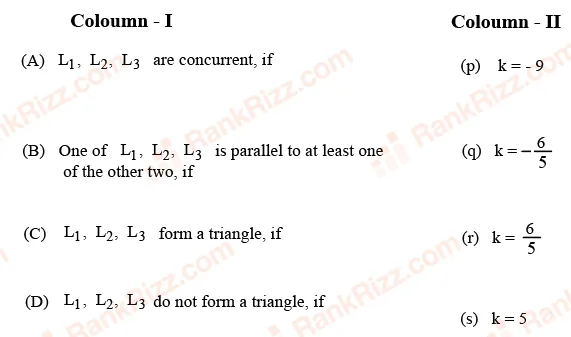
JEE ADVANCED 2008 · PAPER 2Concurrency and family of linesTRANSCRIBED

Consider the lines given by
L1:x+3y−5=0L_1: x + 3y - 5 = 0
L2:3x−ky−1=0L_2: 3x - ky - 1 = 0
L3:5x+2y−12=0L_3: 5x + 2y - 12 = 0
Match the Statements / Expressions in Column I with the Statements / Expressions in Column II and indicate your answer by darkening the appropriate bubbles in the 4×44 \times 4 matrix given in the ORS.

Figure for JEE Advanced 2008 Mathematics question on Concurrency and family of lines
JEE ADVANCED 2007 · PAPER 2Centroid, incentre, circumcentre and orthocentreTRANSCRIBED

Let O(0, 0), P(3, 4), Q(6, 0) be the vertices of the triangle OPQ. The point R inside the triangle OPQ is such that the triangles OPR, PQR, OQR are of equal area. The coordinates of R are

  1. A

    (43,3)\left(\frac{4}{3}, 3\right)

  2. B

    (3,23)\left(3, \frac{2}{3}\right)

  3. C

    (3,43)\left(3, \frac{4}{3}\right)

  4. D

    (43,23)\left(\frac{4}{3}, \frac{2}{3}\right)

JEE ADVANCED 2007 · PAPER 2Angle bisectorsTRANSCRIBED

Lines L1:y−x=0L_1 : y - x = 0 and L2:2x+y=0L_2 : 2x + y = 0 intersect the line L3:y+2=0L_3 : y + 2 = 0 at P and Q, respectively. The bisector of the acute angle between L1L_1 and L2L_2 intersects L3L_3 at R.
STATEMENT-1: The ratio PR : RQ equals 22:5.2\sqrt{2} : \sqrt{5}.
because
STATEMENT-2: In any triangle, bisector of an angle divides the triangle into two similar triangles.

  1. A

    Statement-1 is True, Statement-2 is True; Statement-2 is a correct explanation for Statement-1

  2. B

    Statement-1 is True, Statement-2 is True; Statement-2 is NOT a correct explanation for Statement-1

  3. C

    Statement-1 is True, Statement-2 is False

  4. D

    Statement-1 is False, Statement-2 is True