JEE Advanced 2025 Mathematics question — Differentiability at a point
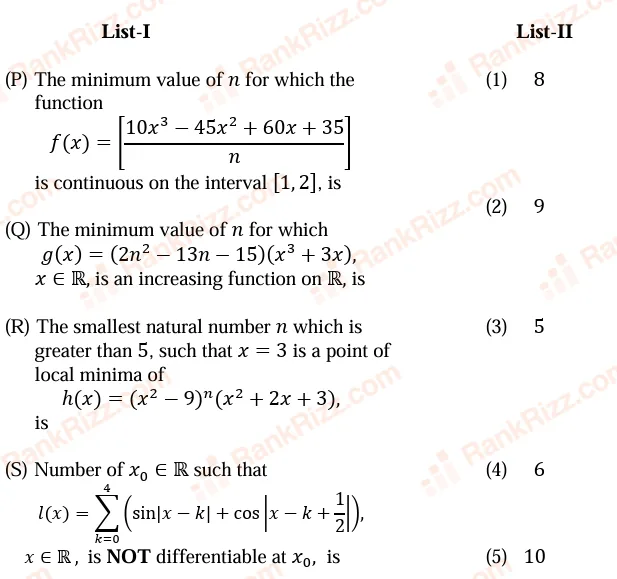
Let R denote the set of all real numbers. For a real number x, let [x] denote the greatest integer less than or equal to x. Let n denote a natural number.
Match each entry in List-I to the correct entry in List-II and choose the correct option.
SOLUTION
Case P: We need the smallest natural number n such that the function f(x)=[n10x3−45x2+60x+35] is continuous on [1,2].
The inner polynomial is p(x)=10x3−45x2+60x+35.
Evaluate at the end-points:
p(1)=10−45+60+35=60,p(2)=80−180+120+35=55.
Since p′(x)=30(x−1)(x−2) is negative for 1<x<2,p(x) decreases strictly from 60 to 55, so on [1,2] we have55≤p(x)≤60.(The full range is actually [55,60].)
Hence np(x) lies in [n55,n60].
For f(x)=[p(x)/n] to be continuous, the entire interval [55/n,60/n] must be contained in one open interval (k,k+1) for some integer k (otherwise the greatest-integer function jumps inside [1,2]).
The length of this interval is n60−55=n5, so we first need n5<1⟹n>5.
Now test successive natural numbers n>5.
• n=6:[55/6,60/6]=[9.166…,10]. The right end equals an integer; f(x) jumps at x=1, so discontinuous.
• n=7:[7.857…,8.571…] crosses the integer 8⇒ discontinuous.
• n=8:[6.875,7.5] crosses the integer 7⇒ discontinuous.
• n=9:[6.111…,6.666…]⊂(6,7). No integer is touched; hence f(x) is continuous.
Thus the minimum n is 9. In List-II the number 9 is entry (2).
So (P) → (2).
Case Q: For g(x)=(2n2−13n−15)(x3+3x) to be increasing on all R we need g′(x)≥0 everywhere.
g′(x)=(2n2−13n−15)(3x2+3)=3(2n2−13n−15)(x2+1).
Since x2+1>0 for all x, the sign of g′(x) is governed by A(n)=2n2−13n−15.
Set A(n)>0:
2n2−13n−15>0.
The roots of 2n2−13n−15=0 are
n=413±169+120=413±17⇒n=−1,7.5.
The quadratic is positive for n>7.5 (or n<−1, which is irrelevant here).
Hence the least natural n making g increasing is n=8.
Entry 8 is (1) in List-II.
So (Q) → (1).
Case R: We need the smallest natural n>5 such that x=3 is a point of local minima of
h(x)=(x2−9)n(x2+2x+3).
Notice
(x2−9)n=(x−3)n(x+3)n,
and near x=3, the factor (x+3)n(x2+2x+3) is positive (its value at x=3 is 6n⋅18>0).
Thus near x=3, h(x) behaves like a positive constant times (x−3)n.
• If n is odd, (x−3)n changes sign about x=3, so x=3 is neither a local minimum nor a maximum.
• If n is even, (x−3)n≥0 with a zero at x=3 and positive values on both sides, giving a local minimum.
Therefore n must be the smallest even natural number >5, i.e. n=6.
Entry 6 is (4) in List-II.
So (R) → (4).
Case S: Define
l(x)=∑k=04(sin∣x−k∣+cosx−k+21).
A finite sum is nondifferentiable exactly where at least one summand is nondifferentiable.
1. sin∣t∣ is nondifferentiable at t=0 because
dtdsin∣t∣=cos∣t∣sgn(t),
whose one-sided limits at t=0 are +1 and −1.
2. cos∣t∣ is differentiable everywhere since
dtdcos∣t∣=−sin∣t∣sgn(t),
and both one-sided limits at t=0 are 0.
Hence nondifferentiability of l(x) occurs only where ∣x−k∣=0, i.e. at
x=k,k=0,1,2,3,4.
(The cos-terms never introduce new singularities.)
Thus there are 5 real numbers x0 at which l(x) is not differentiable.
Entry 5 in List-II corresponds to the number 5.
So (S) → (3).
Collecting all the matches:
(P) → (2), (Q) → (1), (R) → (4), (S) → (3).
Therefore the correct option is: Option B which is: (P)→(2), (Q)→(1), (R)→(4), (S)→(3).
Tagged Differentiability at a point. Machine-assigned, so read it as a strong shortlist rather than a verdict.