RankRizz

JEE Advanced 2024 Paper 1: Chemistry

The 17 Chemistry questions of JEE Advanced 2024 Paper 1, numbered across the whole paper. Pick an answer on any question to check it against the key. Free to read, nothing to download.

Chemistry

Q18Gas laws and ideal gas equationTRANSCRIBED

A closed vessel contains 10 g of an ideal gas X at 300 K, which exerts 2 atm pressure. At the same temperature, 80 g of another ideal gas Y is added to it and the pressure becomes 6 atm. The ratio of root mean square velocities of X and Y at 300 K is

  1. A

    22:32\sqrt{2} : \sqrt{3}

  2. B

    22:12\sqrt{2} : 1

  3. C

    1:21 : 2

  4. D

    2:12 : 1

Q19Dinitrogen, ammonia, nitric acid and oxides of nitrogenTRANSCRIBED

At room temperature, disproportionation of an aqueous solution of in situ generated nitrous acid (HNO2HNO_2) gives the species

  1. A

    H3O+H_3O^+, NO3−NO_3^- and NONO

  2. B

    H3O+H_3O^+, NO3−NO_3^- and NO2NO_2

  3. C

    H3O+H_3O^+, NO−NO^- and NO2NO_2

  4. D

    H3O+H_3O^+, NO3−NO_3^- and N2ON_2O

Q20Proteins and enzymesTRANSCRIBED

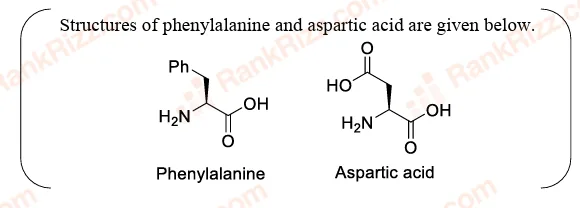
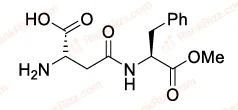
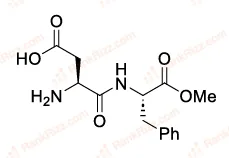
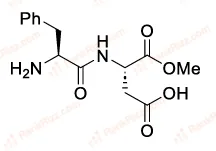
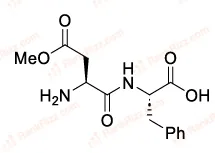
Aspartame, an artificial sweetener, is a dipeptide aspartyl phenylalanine methyl ester. The structure of aspartame is

Figure for JEE Advanced 2024 Chemistry question on Proteins and enzymes
  1. A
    Figure for JEE Advanced 2024 Chemistry question on Proteins and enzymes
  2. B
    Figure for JEE Advanced 2024 Chemistry question on Proteins and enzymes
  3. C
    Figure for JEE Advanced 2024 Chemistry question on Proteins and enzymes
  4. D
    Figure for JEE Advanced 2024 Chemistry question on Proteins and enzymes
Q21Geometrical and optical isomerism in complexesTRANSCRIBED

Among the following options, select the option in which each complex in Set-I shows geometrical isomerism and the two complexes in Set-II are ionization isomers of each other.

[en = H2NCH2CH2NH2H_2NCH_2CH_2NH_2]

  1. A

    Set-I: [Ni(CO)4][Ni(CO)_4] and [PdCl2(PPh3)2][PdCl_2(PPh_3)_2]
    Set-II: [Co(NH3)5Cl]SO4[Co(NH_3)_5Cl]SO_4 and [Co(NH3)5(SO4)]Cl[Co(NH_3)_5(SO_4)]Cl

  2. B

    Set-I: [Co(en)(NH3)2Cl2][Co(en)(NH_3)_2Cl_2] and [PdCl2(PPh3)2][PdCl_2(PPh_3)_2]
    Set-II: [Co(NH3)6][Cr(CN)6][Co(NH_3)_6][Cr(CN)_6] and [Cr(NH3)6][Co(CN)6][Cr(NH_3)_6][Co(CN)_6]

  3. C

    Set-I: [Co(NH3)3(NO2)3][Co(NH_3)_3(NO_2)_3] and [Co(en)2Cl2][Co(en)_2Cl_2]
    Set-II: [Co(NH3)5Cl]SO4[Co(NH_3)_5Cl]SO_4 and [Co(NH3)5(SO4)]Cl[Co(NH_3)_5(SO_4)]Cl

  4. D

    Set-I: [Cr(NH3)5Cl]Cl2[Cr(NH_3)_5Cl]Cl_2 and [Co(en)(NH3)2Cl2][Co(en)(NH_3)_2Cl_2]
    Set-II: [Cr(H2O)6]Cl3[Cr(H_2O)_6]Cl_3 and [Cr(H2O)5Cl]Cl2⋅H2O[Cr(H_2O)_5Cl]Cl_2 \cdot H_2O

Q22de Broglie wavelength and Heisenberg uncertainty principleTRANSCRIBED

Among the following the incorrect statement for electrons in an atom is

  1. A

    Uncertainty principle rules out the existence of definite paths for electrons.

  2. B

    The energy of an electron in 2s orbital of an atom is lower than the energy of an electron that is infinitely far away from the nucleus.

  3. C

    According to Bohr's model, the most negative energy value for an electron is given by n=1n = 1, which corresponds to the most stable orbit.

  4. D

    According to Bohr's model, the magnitude of velocity of electrons increases with increase in values of n.

Q23Reactions of phenolsTRANSCRIBED

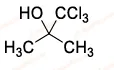
Reaction of iso-propylbenzene with O2O_2 followed by the treatment with H3O+H_3O^+ forms phenol and a by-product P. Reaction of P with 3 equivalents of Cl2Cl_2 gives compound Q. Treatment of Q with Ca(OH)2Ca(OH)_2 produces compound R and calcium salt S.

The correct statement(s) regarding P, Q, R and S is(are)

  1. A

    Reaction of P with R in the presence of KOH followed by acidification gives

    Figure for JEE Advanced 2024 Chemistry question on Reactions of phenols
  2. B

    Reaction of R with O2O_2 in the presence of light gives phosgene gas

  3. C

    Q reacts with aqueous NaOH to produce Cl3CCH2OHCl_3CCH_2OH and Cl3CCOONaCl_3CCOONa

  4. D

    S on heating gives P

Q24Fajans' rules, polarisation and covalent characterTRANSCRIBED

The option(s) in which at least three molecules follow Octet Rule is(are)

  1. A

    CO2CO_2, C2H4C_2H_4, NONO and HClHCl

  2. B

    NO2NO_2, O3O_3, HClHCl and H2SO4H_2SO_4

  3. C

    BCl3BCl_3, NONO, NO2NO_2 and H2SO4H_2SO_4

  4. D

    CO2CO_2, BCl3BCl_3, O3O_3 and C2H4C_2H_4

Q25First law: work, heat and internal energyTRANSCRIBED

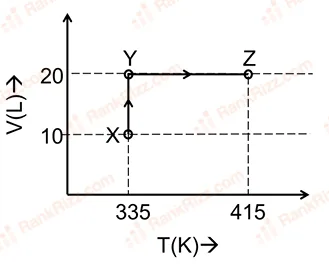
Consider the following volume-temperature (V-T) diagram for the expansion of 5 moles of an ideal monoatomic gas.

Figure for JEE Advanced 2024 Chemistry question on First law: work, heat and internal energy

Considering only P-V work is involved, the total change in enthalpy (in Joule) for the transformation of state in the sequence X→Y→ZX \rightarrow Y \rightarrow Z is ______.

[Use the given data: Molar heat capacity of the gas for the given temperature range, CV,m=12C_{V,m} = 12 J K−1K^{-1} mol−1mol^{-1} and gas constant, R=8.3R = 8.3 J K−1K^{-1} mol−1mol^{-1}]

Q26Methods to determine order of reactionTRANSCRIBED

Consider the following reaction,

2H2(g)+2NO(g)→N2(g)+2H2O(g)2H_2(g) + 2NO(g) \rightarrow N_2(g) + 2H_2O(g)

which follows the mechanism given below:

2NO(g)⇌k1k−1N2O2(g)2NO(g) \underset{k_{-1}}{\overset{k_1}{\rightleftharpoons}} N_2O_2(g)     (fast equilibrium)

N2O2(g)+H2(g)→k2N2O(g)+H2O(g)N_2O_2(g) + H_2(g) \overset{k_2}{\rightarrow} N_2O(g) + H_2O(g)     (slow reaction)

N2O(g)+H2(g)→k3N2(g)+H2O(g)N_2O(g) + H_2(g) \overset{k_3}{\rightarrow} N_2(g) + H_2O(g)     (fast reaction)

The order of the reaction is ______?

Q27Nucleophilic addition reactions of carbonyl compoundsTRANSCRIBED

Complete reaction of acetaldehyde with excess formaldehyde, upon heating with conc. NaOH solution, gives P and Q. Compound P does not give Tollens' test, whereas Q on acidification gives positive Tollens' test. Treatment of P with excess cyclohexanone in the presence of catalytic amount of p-toluenesulfonic acid (PTSA) gives product R.

Sum of the number of methylene groups (−CH2−-CH_2-) and oxygen atoms in R is ______.

Q28Colour and magnetic behaviour of complexes from CFTTRANSCRIBED

Among V(CO)6V(CO)_6, Cr(CO)5Cr(CO)_5, Cu(CO)3Cu(CO)_3, Mn(CO)5Mn(CO)_5, Fe(CO)5Fe(CO)_5, [Co(CO)3]3−[Co(CO)_3]^{3-}, [Cr(CO)4]4−[Cr(CO)_4]^{4-}, and Ir(CO)3Ir(CO)_3, the total number of species isoelectronic with Ni(CO)4Ni(CO)_4 is ______.

[Given atomic number : V = 23, Cr = 24, Mn = 25, Fe = 26, Co = 27, Ni = 28, Cu = 29, Ir = 77]

Q29Reactions of alkynesTRANSCRIBED

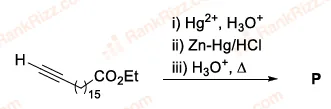
In the following reaction sequence, the major product P is formed.

Figure for JEE Advanced 2024 Chemistry question on Reactions of alkynes

Glycerol reacts completely with excess P in the presence of an acid catalyst to form Q. Reaction of Q with excess NaOH followed by the treatment with CaCl2CaCl_2 yields Ca-soap R, quantitatively. Starting with one mole of Q, the amount of R produced in gram is ______.

[Given, atomic weight: H = 1, C = 12, N = 14, O = 16, Na = 23, Cl = 35, Ca = 40]

Q30Colour and magnetic behaviour of complexes from CFTTRANSCRIBED

Among the following complexes, the total number of diamagnetic species is ______.

[Mn(NH3)6]3+[Mn(NH_3)_6]^{3+}, [MnCl6]3−[MnCl_6]^{3-}, [FeF6]3−[FeF_6]^{3-}, [CoF6]3−[CoF_6]^{3-}, [Fe(NH3)6]3+[Fe(NH_3)_6]^{3+} and [Co(en)3]3+[Co(en)_3]^{3+}

[Given, atomic number: Mn = 25, Fe = 26, Co = 27; en = H2NCH2CH2NH2H_2NCH_2CH_2NH_2]

Q31Conductance, conductivity and molar conductivityTRANSCRIBED

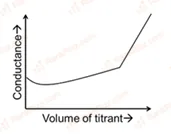
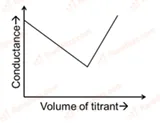
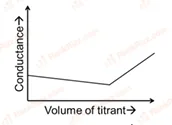
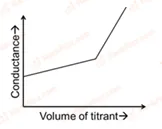
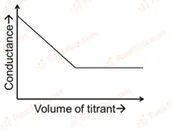
In a conductometric titration, small volume of titrant of higher concentration is added stepwise to a larger volume of titrate of much lower concentration, and the conductance is measured after each addition.

The limiting ionic conductivity (Λ0\Lambda_0) values (in mS m2m^2 mol−1mol^{-1}) for different ions in aqueous solutions are given below:

IonsAg+Ag^+K+K^+Na+Na^+H+H^+NO3−NO_3^-Cl−Cl^-SO42−SO_4^{2-}OH−OH^-CH3COO−CH_3COO^-
Λ0\Lambda_06.27.45.035.07.27.616.019.94.1

For different combinations of titrates and titrants given in List-I, the graphs of 'conductance' versus 'volume of titrant' are given in List-II.

Match each entry in List-I with the appropriate entry in List-II and choose the correct option.

List-IList-II
(P)Titrate: KCl
Titrant: AgNO3AgNO_3
(1)
Figure for JEE Advanced 2024 Chemistry question on Conductance, conductivity and molar conductivity
(Q)Titrate: AgNO3AgNO_3
Titrant: KCl
(2)
Figure for JEE Advanced 2024 Chemistry question on Conductance, conductivity and molar conductivity
(R)Titrate: NaOH
Titrant: HCl
(3)
Figure for JEE Advanced 2024 Chemistry question on Conductance, conductivity and molar conductivity
(S)Titrate: NaOH
Titrant: CH3COOHCH_3COOH
(4)
Figure for JEE Advanced 2024 Chemistry question on Conductance, conductivity and molar conductivity
(5)
Figure for JEE Advanced 2024 Chemistry question on Conductance, conductivity and molar conductivity
  1. A

    P-4, Q-3, R-2, S-5

  2. B

    P-2, Q-4, R-3, S-1

  3. C

    P-3, Q-4, R-2, S-5

  4. D

    P-4, Q-3, R-2, S-1

Q32VSEPR theory and shapes of molecules and ionsTRANSCRIBED

Based on VSEPR model, match the xenon compounds given in List-I with the corresponding geometries and the number of lone pairs on xenon given in List-II and choose the correct option.

List-IList-II
(P)XeF2XeF_2(1)Trigonal bipyramidal and two lone pair of electrons
(Q)XeF4XeF_4(2)Tetrahedral and one lone pair of electrons
(R)XeO3XeO_3(3)Octahedral and two lone pair of electrons
(S)XeO3F2XeO_3F_2(4)Trigonal bipyramidal and no lone pair of electrons
(5)Trigonal bipyramidal and three lone pair of electrons
  1. A

    P-5, Q-2, R-3, S-1

  2. B

    P-5, Q-3, R-2, S-4

  3. C

    P-4, Q-3, R-2, S-1

  4. D

    P-4, Q-2, R-5, S-3

Q33Nucleophilic addition reactions of carbonyl compoundsTRANSCRIBED

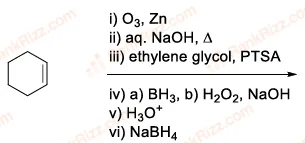
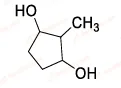
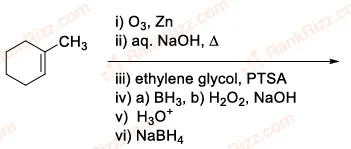
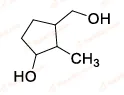
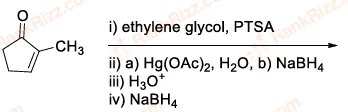
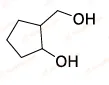
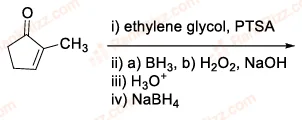
List-I contains various reaction sequences and List-II contains the possible products. Match each entry in List-I with the appropriate entry in List-II and choose the correct option.

List-IList-II
(P)
Figure for JEE Advanced 2024 Chemistry question on Nucleophilic addition reactions of carbonyl compounds
(1)
Figure for JEE Advanced 2024 Chemistry question on Nucleophilic addition reactions of carbonyl compounds
(Q)
Figure for JEE Advanced 2024 Chemistry question on Nucleophilic addition reactions of carbonyl compounds
(2)
Figure for JEE Advanced 2024 Chemistry question on Nucleophilic addition reactions of carbonyl compounds
(R)
Figure for JEE Advanced 2024 Chemistry question on Nucleophilic addition reactions of carbonyl compounds
(3)
Figure for JEE Advanced 2024 Chemistry question on Nucleophilic addition reactions of carbonyl compounds
(S)
Figure for JEE Advanced 2024 Chemistry question on Nucleophilic addition reactions of carbonyl compounds
(4)
Figure for JEE Advanced 2024 Chemistry question on Nucleophilic addition reactions of carbonyl compounds
(5)
Figure for JEE Advanced 2024 Chemistry question on Nucleophilic addition reactions of carbonyl compounds
  1. A

    P-3, Q-5, R-4, S-1

  2. B

    P-3, Q-2, R-4, S-1

  3. C

    P-3, Q-5, R-1, S-4

  4. D

    P-5, Q-2, R-4, S-1

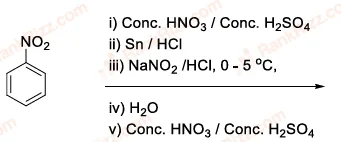
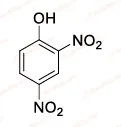
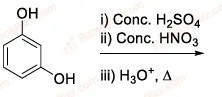
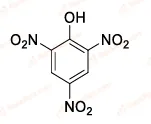
Q34Diazonium saltsTRANSCRIBED

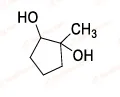
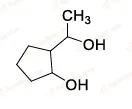
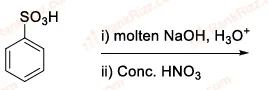
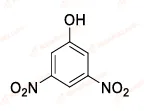
List-I contains various reaction sequences and List-II contains different phenolic compounds. Match each entry in List-I with the appropriate entry in List-II and choose the correct option.

List-IList-II
(P) Figure for JEE Advanced 2024 Chemistry question on Diazonium salts (1) Figure for JEE Advanced 2024 Chemistry question on Diazonium salts
(Q) Figure for JEE Advanced 2024 Chemistry question on Diazonium salts (2) Figure for JEE Advanced 2024 Chemistry question on Diazonium salts
(R) Figure for JEE Advanced 2024 Chemistry question on Diazonium salts (3) Figure for JEE Advanced 2024 Chemistry question on Diazonium salts
(S) Figure for JEE Advanced 2024 Chemistry question on Diazonium salts (4) Figure for JEE Advanced 2024 Chemistry question on Diazonium salts
(5) Figure for JEE Advanced 2024 Chemistry question on Diazonium salts
  1. A

    P-2, Q-3, R-4, S-5

  2. B

    P-2, Q-3, R-5, S-1

  3. C

    P-3, Q-5, R-4, S-1

  4. D

    P-3, Q-2, R-5, S-4

NEXT IN THIS PAPER →Maths, Q35 onwards