JEE Advanced 2024 Chemistry question — Reactions of alkynes
In the following reaction sequence, the major product P is formed.
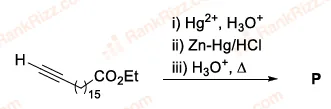
Glycerol reacts completely with excess P in the presence of an acid catalyst to form Q. Reaction of Q with excess NaOH followed by the treatment with yields Ca-soap R, quantitatively. Starting with one mole of Q, the amount of R produced in gram is ______.
[Given, atomic weight: H = 1, C = 12, N = 14, O = 16, Na = 23, Cl = 35, Ca = 40]
SOLUTION
Let the major product obtained in the earlier sequence be stearic acid, .
With an acid catalyst, glycerol esterifies completely with excess stearic acid to give the tri-ester (a triglyceride) , called tristearin.
Step-1 : Formation of
Glycerol possesses three -OH groups, so three molecules of stearic acid react with one molecule of glycerol and three molecules of water are eliminated:
Molar mass of glycerol g mol
Molar mass of stearic acid g mol
Molar mass of (tristearin):
Step-2 : Alkaline hydrolysis (saponification) of with excess
Thus 1 mol of gives 3 mol of sodium stearate.
Molar mass of sodium stearate:
Carboxylate anion has mass g.
Adding Na (23 g) gives
Step-3 : Conversion of sodium stearate to calcium stearate (Ca-soap ) using excess
Stoichiometry: 2 mol Na-stearate 1 mol Ca-stearate.
From Step-2 we have 3 mol Na-stearate, therefore
Number of moles of obtained
Molar mass of calcium stearate :
Mass of from 1 mol of :
Therefore, starting with one mole of , the amount of calcium soap produced is 909 g.
Tagged Reactions of alkynes. Machine-assigned, so read it as a strong shortlist rather than a verdict.