JEE Advanced 2024 Chemistry question — First law: work, heat and internal energy
Consider the following volume-temperature (V-T) diagram for the expansion of 5 moles of an ideal monoatomic gas.
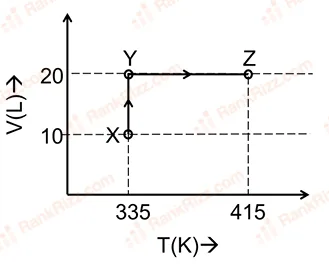
Considering only P-V work is involved, the total change in enthalpy (in Joule) for the transformation of state in the sequence is ______.
[Use the given data: Molar heat capacity of the gas for the given temperature range, J and gas constant, J ]
SOLUTION
For an ideal gas the molar enthalpy depends only on its temperature: . Hence the enthalpy change for any multi-step process depends only on the temperatures of the initial and final states, not on the path followed.
The V-T diagram supplied in the question gives the coordinates of the three states (all volumes are in litres, temperatures in kelvin):
• State
• State (isothermal expansion )
• State (isochoric heating )
Thus the overall temperature change for the complete transformation is
The given data are
• number of moles,
• molar heat capacity at constant volume,
• gas constant,
For an ideal gas, , therefore
The total enthalpy change is then
Hence, the total change in enthalpy for the given transformation is 8120 J.
Tagged First law: work, heat and internal energy. Machine-assigned, so read it as a strong shortlist rather than a verdict.