RankRizz
JEE ADVANCED 2022 · PAPER 1+3 / −1HARDTRANSCRIBED

JEE Advanced 2022 Physics question — Force on current-carrying conductors and between parallel wires

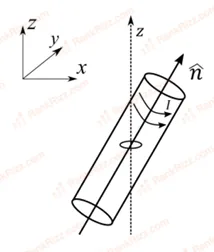
A small circular loop of area AA and resistance RR is fixed on a horizontal xyxy-plane with the center of the loop always on the axis n^\hat{n} of a long solenoid. The solenoid has mm turns per unit length and carries current II counterclockwise as shown in the figure. The magnetic field due to the solenoid is in n^\hat{n} direction. List-I gives time dependences of n^\hat{n} in terms of a constant angular frequency ω\omega.

List-II gives the torques experienced by the circular loop at time t=π6ωt = \frac{\pi}{6\omega}. Let α=A2μ02m2I2ω2R\alpha = \frac{A^2 \mu_0^2 m^2 I^2 \omega}{2R}.

Figure for JEE Advanced 2022 Physics question on Force on current-carrying conductors and between parallel wires
List-IList-II
(I) 12(sin⁡ωt j^+cos⁡ωt k^)\frac{1}{\sqrt{2}}(\sin \omega t \, \hat{j} + \cos \omega t \, \hat{k})(P) 0
(II) 12(sin⁡ωt i^+cos⁡ωt j^)\frac{1}{\sqrt{2}}(\sin \omega t \, \hat{i} + \cos \omega t \, \hat{j})(Q) −α4i^-\frac{\alpha}{4}\hat{i}
(III) 12(sin⁡ωt i^+cos⁡ωt k^)\frac{1}{\sqrt{2}}(\sin \omega t \, \hat{i} + \cos \omega t \, \hat{k})(R) 3α4i^\frac{3\alpha}{4}\hat{i}
(IV) 12(cos⁡ωt i^+sin⁡ωt k^)\frac{1}{\sqrt{2}}(\cos \omega t \, \hat{i} + \sin \omega t \, \hat{k})(S) α4j^\frac{\alpha}{4}\hat{j}
Which one of the following options is correct?(T) −3α4i^-\frac{3\alpha}{4}\hat{i}
SOLUTION

I. ϕ=BAk^⋅n^\phi = B A \hat{k} \cdot \hat{n}

ϕ=BA2cos⁡(ωt)\phi = \frac{BA}{\sqrt{2}} \cos(\omega t)

ε=BAω2sin⁡(ωt)\varepsilon = \frac{BA\omega}{\sqrt{2}} \sin(\omega t)

i=BAω2Rsin⁡(ωt)i = \frac{BA\omega}{\sqrt{2}R} \sin(\omega t)

m⃗=iAk^=BA2ω2Rsin⁡(ωt)k^\vec{m} = iA\hat{k} = \frac{BA^2\omega}{\sqrt{2}R}\sin(\omega t)\hat{k}

τ⃗=m⃗×B⃗=B2A2ω2Rsin⁡(ωt)(k^×n^)\vec{\tau} = \vec{m} \times \vec{B} = \frac{B^2A^2\omega}{\sqrt{2}R}\sin(\omega t)(\hat{k} \times \hat{n})

=−B2A2ω2R[i^]sin⁡2(ωt)= -\frac{B^2A^2\omega}{2R} \left[\hat{i}\right]\sin^2(\omega t)

τ=−B2A2ω2R[sin⁡2(π6)]=−α4i^\tau = -\frac{B^2A^2\omega}{2R} \left[\sin^2\left(\frac{\pi}{6}\right)\right] = -\frac{\alpha}{4}\hat{i}

(I) →\rightarrow Q.

II. ϕ=0\phi = 0

(II) →\rightarrow P.

III. ϕ=BA2cos⁡(ωt)\phi = \frac{BA}{\sqrt{2}} \cos(\omega t)

i=BAω2Rsin⁡(ωt)i = \frac{BA\omega}{\sqrt{2}R}\sin(\omega t)

m⃗=BA2ω2Rsin⁡(ωt)k^\vec{m} = \frac{BA^2\omega}{\sqrt{2}R}\sin(\omega t)\hat{k}

τ⃗=m⃗×B⃗=B2A2ω2⋅2Rsin⁡ωt(k^×(sin⁡ωti^+cos⁡ωtk^))\vec{\tau} = \vec{m} \times \vec{B} = \frac{B^2A^2\omega}{\sqrt{2} \cdot \sqrt{2} R}\sin\omega t\left(\hat{k} \times (\sin\omega t\hat{i} + \cos\omega t\hat{k})\right)

τ=B2A2ωsin⁡(ωt)2Rsin⁡(ωt)j^\tau = \frac{B^2A^2\omega\sin(\omega t)}{2R}\sin(\omega t)\hat{j}

=B2A2ω2Rsin⁡2(ωt)j^= \frac{B^2A^2\omega}{2R}\sin^2(\omega t)\hat{j}

=α4j^= \frac{\alpha}{4}\hat{j}

(III) →\rightarrow S.

IV. ϕ=BA2sin⁡(ωt)\phi = \frac{BA}{\sqrt{2}}\sin(\omega t)

i=−BAω2Rcos⁡(ωt)i = -\frac{BA\omega}{\sqrt{2}R}\cos(\omega t)

m⃗=−BA2ω2Rcos⁡ωt(k^)\vec{m} = -\frac{BA^2\omega}{\sqrt{2}R}\cos\omega t(\hat{k})

τ⃗=m⃗×B⃗=−B2A2ω2R(k^×i^)cos⁡2(ωt)\vec{\tau} = \vec{m} \times \vec{B} = -\frac{B^2A^2\omega}{2R}(\hat{k} \times \hat{i})\cos^2(\omega t)

τ=+B2A2ω2R(i^)⋅cos⁡2(π6)\tau = +\frac{B^2A^2\omega}{2R}(\hat{i}) \cdot \cos^2\left(\frac{\pi}{6}\right)

=+34αi^= +\frac{3}{4}\alpha\hat{i}

(IV) →\rightarrow R.

Tagged Force on current-carrying conductors and between parallel wires. Machine-assigned, so read it as a strong shortlist rather than a verdict.
SubjectPhysics
TopicForce on current-carrying conductors and between parallel wires
TypeMultiple choice