Electrode potentials, electrochemical series and cell EMF
ASKED 120× · 2004–2026, 20 DIFFERENT YEARS · 105 MAIN, 15 ADVANCED
Given at 298 K :
Volt
Volt
The in Volt at 298 K is given by :
- A
- B
- C
- D
Every idea JEE has asked in Electrochemistry, one past question each — the most recently set — with how many times the examiner has come back to it. Do these 8; where one goes wrong, practise every question on that idea.
Past questions
258
Ideas
8
Set again later
0
Years
2004–26
How these ideas are grouped
An idea here is one syllabus topic — the finest tag our past questions carry. A topic can hold more than one technique, so treat each question as the door into an idea, not the whole of it. Every topic in Electrochemistry has at least one past question, so none is missing from this sheet.
ASKED 120× · 2004–2026, 20 DIFFERENT YEARS · 105 MAIN, 15 ADVANCED
Given at 298 K :
Volt
Volt
The in Volt at 298 K is given by :
ASKED 84× · 2005–2026, 19 DIFFERENT YEARS · 70 MAIN, 14 ADVANCED
At 300 K, the molar conductivities of the aqueous solutions of three salts at two different concentrations are given below:
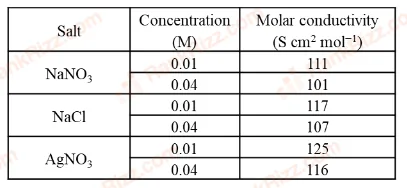
The conductivity of a saturated aqueous solution of AgCl is S cm at 300 K. If the solubility of AgCl in water at 300 K is mol L, then is
(Assume that AgCl dissolved in water ionizes completely and that the molar conductivity of saturated AgCl solution is equal to its limiting molar conductivity.)

ASKED 20× · 2004–2026, 10 DIFFERENT YEARS · 17 MAIN, 3 ADVANCED
Consider the following two half-cell reactions along with the standard reduction potential given :
A fuel cell was set up using the above two reactions such that the cell operates under the standard condition of 1 bar pressure and 298 K temperature. The fuel cell works with 80% efficiency. If the work derived from the cell using 1 mol of CHOH is used to compress an ideal gas isothermally against a constant pressure of 1 kPa, then the change in the volume of the gas, _____ m. (nearest integer)
Given: C mol
NUMERICAL ANSWER · CHECK IT ON THE QUESTION PAGE
ASKED 16× · 2004–2025, 11 DIFFERENT YEARS
A solution of aluminium chloride is electrolysed for 30 minutes using a current of 2 A . The amount of the aluminium deposited at the cathode is [Given : molar mass of aluminium and chlorine are 27g and 35.5 g respectively. Faraday constant ]
1.660 g
0.336 g
0.441 g
1.007 g
ASKED 8× · 2004–2026, 7 DIFFERENT YEARS
Equivalent conductivity of , and are and at infinite dilution. If the conductivity of saturated solution is , then of is:
ASKED 5× · 2004–2010, 5 DIFFERENT YEARS
The Gibbs energy for the decomposition of at C is as follows: , kJ mol. The potential difference needed for electrolytic reduction of at C is at least
V
V
V
V
ASKED 4× · 2004, 2008, 2011, 2015
At 298 K, the standard reduction potentials are 1.51 V for , 1.36 V for , 1.07 V for , 0.54 V for . At pH = 3, permanganate is expected to oxidize:
and
and
only
, and
ASKED 1× · 2015
A variable, the opposite external potential is applied to the cell Zn | Zn (1M) || Cu (1M) | Cu, of potential 1.1 V. When V and V, respectively electrons flow from
anode to cathode in both the cases.
anode to cathode and cathode to anode.
cathode to anode and anode to cathode.
cathode to anode in both cases.
Got one wrong? Practise that idea, graded.
A free account opens every past question on an idea with the answer checked as you go, and files your mistakes by idea.
Not ready? Get new sheets by email
OTHER CHEMISTRY SHEETS