RankRizz
UNIQUE CONCEPTS · CHEMISTRY

Chemical Kinetics: 263 past questions, 8 ideas

Every idea JEE has asked in Chemical Kinetics, one past question each — the most recently set — with how many times the examiner has come back to it. Do these 8; where one goes wrong, practise every question on that idea.

Past questions

263

Ideas

8

Set again later

0

Years

2004–26

Download PDFEvery Chemical Kinetics question

How these ideas are grouped

An idea here is one syllabus topic — the finest tag our past questions carry. A topic can hold more than one technique, so treat each question as the door into an idea, not the whole of it. Every topic in Chemical Kinetics has at least one past question, so none is missing from this sheet.

The 8 ideas, most asked first

01

Integrated rate laws and half-life (zero and first order)

ASKED 92× · 2004–2026, 20 DIFFERENT YEARS · 85 MAIN, 7 ADVANCED

set 92×
JEE ADVANCED 2026 · PAPER 1MOST RECENTLY SETTRANSCRIBED

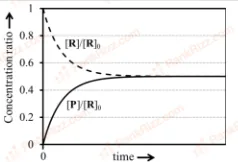
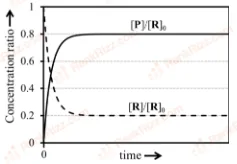
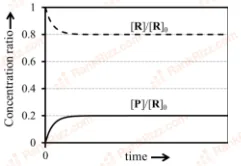
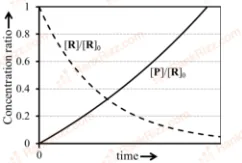
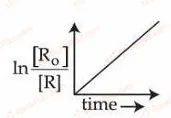
For a reversible reaction R⇌P\mathbf{R}\rightleftharpoons\mathbf{P}, at constant temperature, both the forward and the backward reactions are first order elementary reactions with rate constants kfk_f and kbk_b, respectively. At time zero, the concentration of R\mathbf{R} is [R]0[\mathbf{R}]_0 and the concentration of P\mathbf{P} is zero. At any given time, [R][\mathbf{R}] and [P][\mathbf{P}] are the concentrations of R\mathbf{R} and P\mathbf{P}, respectively. If kb=4kfk_b=4k_f, the correct graphical representation of the reaction is

  1. A
    Figure for JEE Advanced 2026 Chemistry question on Integrated rate laws and half-life (zero and first order)
  2. B
    Figure for JEE Advanced 2026 Chemistry question on Integrated rate laws and half-life (zero and first order)
  3. C
    Figure for JEE Advanced 2026 Chemistry question on Integrated rate laws and half-life (zero and first order)
  4. D
    Figure for JEE Advanced 2026 Chemistry question on Integrated rate laws and half-life (zero and first order)
02

Arrhenius equation and activation energy

ASKED 61× · 2005–2026, 16 DIFFERENT YEARS

set 61×
JEE MAIN 2026MOST RECENTLY SETTRANSCRIBED

A first order reaction is 50% completed in 20 minutes at 27 °C and in 5 minutes at 47 °C. The energy of activation of the reaction is:

(Given: ln 4=1.386)

  1. A

    43.85 kJ/mol

  2. B

    55.31 kJ/mol

  3. C

    11.91 kJ/mol

  4. D

    6.65 kJ/mol

03

Rate law, order and molecularity

ASKED 46× · 2004–2026, 18 DIFFERENT YEARS · 40 MAIN, 6 ADVANCED

set 46×
JEE MAIN 2026 · 02 APR S2MOST RECENTLY SETTRANSCRIBED

Consider the reaction aX→bYaX \to bY, for which the rate constant at 30°C is 1×10⁻³¹ \times 10^{-3} mol−1^{-1} L s−1^{-1}. Which of the following statements are true?
A. When concentration of 'X' is increased to four times, the rate of reaction becomes 16 times.
B. The reaction is a second order reaction.
C. The half-life period is independent of the concentration of X.
D. Decomposition of N2O5N_2O_5 is an example of the above reaction.
E.

Figure for JEE Main 2026 Chemistry question on Rate law, order and molecularity

is valid for the above reaction.
Choose the correct answer from the option given below:

  1. A

    A and B Only

  2. B

    A, B and C Only

  3. C

    A, B, D and E Only

  4. D

    C and D Only

04

Methods to determine order of reaction

ASKED 29× · 2007–2026, 14 DIFFERENT YEARS · 24 MAIN, 5 ADVANCED

set 29×
JEE MAIN 2026 · 05 APR S2MOST RECENTLY SETTRANSCRIBED

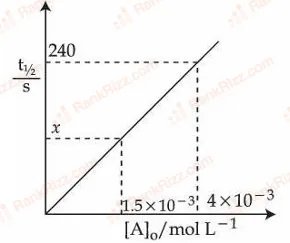
For the reaction A→pA \to p at  TKT K, the half  life (t1/2t_{1/2}) is plotted as a function of initial concentration [A]o[A]_o of  AA as give below.

Figure for JEE Main 2026 Chemistry question on Methods to determine order of reaction


The value of xx in the given figure is ______ s (Nearest integer) 

NUMERICAL ANSWER · CHECK IT ON THE QUESTION PAGE

05

Radioactivity and nuclear reactions

ASKED 27× · 2004–2026, 19 DIFFERENT YEARS · 16 MAIN, 11 ADVANCED

set 27×
JEE MAIN 2026 · 24 JAN S2MOST RECENTLY SETTRANSCRIBED

The half-life of 65Zn{}^{65}Zn is 245 days. After x days, 75% of original activity remained. The value of x in days is ___ . (Nearest integer)
(Given: log 3 = 0.4771 and log 2 = 0.3010)

NUMERICAL ANSWER · CHECK IT ON THE QUESTION PAGE

06

Collision theory and effect of catalyst on rate

ASKED 5× · 2007–2017, 5 DIFFERENT YEARS · 1 MAIN, 4 ADVANCED

set 5×
JEE ADVANCED 2017 · PAPER 2MOST RECENTLY SETTRANSCRIBED

In a bimolecular reaction, the steric factor P was experimentally determined to be 4.5. The correct option(s) among the following is(are)

  1. A

    The activation energy of the reaction is unaffected by the value of the steric factor

  2. B

    Experimentally determined value of frequency factor is higher than that predicted by Arrhenius equation

  3. C

    Since P = 4.5, the reaction will not proceed unless an effective catalyst is used

  4. D

    The value of frequency factor predicted by Arrhenius equation is higher than that determined experimentally

07

Rate of reaction

ASKED 2× · 2008, 2025

set 2×
JEE MAIN 2025 · 24 JAN S1MOST RECENTLY SETTRANSCRIBED

For a reaction, N2O5(g)→2NO2(g)+12O2(g)N_2O_5(g) \rightarrow 2NO_2(g) + \frac{1}{2}O_2(g) in a constant volume container, no products were present initially.  The final pressure of the system when 50%50\% of reaction gets completed is:

  1. A

    5 times of initial pressure5 \text{ times of initial pressure}

  2. B

    52 times of initial pressure\frac{5}{2} \text{ times of initial pressure}

  3. C

    72 times of initial pressure\frac{7}{2} \text{ times of initial pressure}

  4. D

    74 times of initial pressure\frac{7}{4} \text{ times of initial pressure}

08

Parallel, consecutive and reversible reactions

ASKED 1× · 2019

set 1×
JEE MAIN 2019 · 08 APR S2MOST RECENTLY SETTRANSCRIBED

For a reaction scheme A →k1\xrightarrow{k_1} B →k2\xrightarrow{k_2} C, if the net rate of formation of B is set to be zero then the concentration of B is given by:

  1. A

    k1+k2[A]k_1 + k_2[A]

  2. B

    k1k2[A]k_1 k_2[A]

  3. C

    k1k2[A]\frac{k_1}{k_2}[A]

  4. D

    k1−k2[A]k_1 - k_2[A]

Got one wrong? Practise that idea, graded.

A free account opens every past question on an idea with the answer checked as you go, and files your mistakes by idea.

Not ready? Get new sheets by email

A note when a chapter’s sheet changes or a new one is added. No account, no spam, one click to leave.

OTHER CHEMISTRY SHEETS