RankRizz
UNIQUE CONCEPTS · CHEMISTRY

Solutions: 225 past questions, 7 ideas

Every idea JEE has asked in Solutions, one past question each — the most recently set — with how many times the examiner has come back to it. Do these 7; where one goes wrong, practise every question on that idea.

Past questions

225

Ideas

7

Set again later

0

Years

2004–26

Download PDFEvery Solutions question

How these ideas are grouped

An idea here is one syllabus topic — the finest tag our past questions carry. A topic can hold more than one technique, so treat each question as the door into an idea, not the whole of it. Every topic in Solutions has at least one past question, so none is missing from this sheet.

The 7 ideas, most asked first

01

Abnormal molar mass and van't Hoff factor

ASKED 57× · 2005–2026, 18 DIFFERENT YEARS · 51 MAIN, 6 ADVANCED

set 57×
JEE MAIN 2026 · 02 APR S1MOST RECENTLY SETTRANSCRIBED

19.5 g of fluoro acetic acid (molar mass = 78 g mol−1^{-1}) is dissolved in 500 g of water at 298 K. The depression in the freezing point was 1°C. What is Ka_a of fluoro acetic acid? (For water, Kf_f = 1.86 K kg mol−1^{-1}). Assume molarity and molality to have same values.

  1. A

    10−610^{-6}

  2. B

    4×10−44 \times 10^{-4}

  3. C

    3×10−53 \times 10^{-5}

  4. D

    3×10⁻³³ \times 10^{-3}

02

Relative lowering of vapour pressure

ASKED 54× · 2006–2026, 16 DIFFERENT YEARS · 50 MAIN, 4 ADVANCED

set 54×
JEE MAIN 2026 · 08 APR S2MOST RECENTLY SETTRANSCRIBED

Given below are two statements :
Given : Molar mass of C, H, O, Cl are 12, 1, 16 and 35.5 g mol−1^{-1}, respectively
Statement I : In 30% (w/w) solution of methanol in CCl4_4(at T K), the mole fraction of CCl4_4 is equal to 0.33.
Statement II : Mixture of methanol and CCl4_4 shows positive deviation from Raoult's law.
In the light of the above statements, choose the correct answer from the options given below :

  1. A

    Both Statement I and Statement II are true

  2. B

    Both Statement I and Statement II are false

  3. C

    Statement I is true but Statement II is false

  4. D

    Statement I is false but Statement II is true

03

Depression in freezing point

ASKED 35× · 2004–2026, 17 DIFFERENT YEARS · 31 MAIN, 4 ADVANCED

set 35×
JEE MAIN 2026 · 08 APR S2MOST RECENTLY SETTRANSCRIBED

Which of the following statements are not correct?
A. For water, magnitude of KbK_b is more than the magnitude of KfK_f.
B. The elevation in boiling point of water when a non-volatile solute is added to it is larger in magnitude than its depression in freezing point.
C. Osmotic pressure measurement is preferred over any other colligative property to determine molar mass of proteins and polymers.
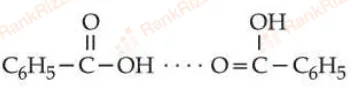
D. The dimerised form of benzoic acid in benzene is 

Figure for JEE Main 2026 Chemistry question on Depression in freezing point


Choose the correct answer from the options given below :

  1. A

    A and B only

  2. B

    A and D only

  3. C

    A, B and D only

  4. D

    A, C and D only

04

Osmosis and osmotic pressure

ASKED 27× · 2007–2026, 9 DIFFERENT YEARS · 25 MAIN, 2 ADVANCED

set 27×
JEE MAIN 2026 · 06 APR S2MOST RECENTLY SETTRANSCRIBED

Given below are two statements :

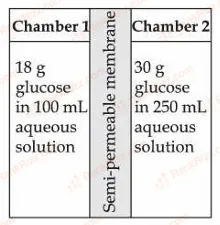
Figure for JEE Main 2026 Chemistry question on Osmosis and osmotic pressure


Statement I : H2_2O molecules move from the chamber 1 to chamber 2.

Statement II : The osmotic pressure of a solution prepared by dissolving 50 mg of potassium sulphate (molar mass = 174 g/mol) in 2 L of water (at 27 °C) is 0.0107 bar. (Given: R = 0.083 dm3^3 bar K−1^{-1} mol−1^{-1} and assume complete dissociation of electrolyte)

In the light of the above statements, choose the correct answer from the options given below :

  1. A

    Both Statement I and Statement II are true

  2. B

    Both Statement I and Statement II are false

  3. C

    Statement I is true but Statement II is false

  4. D

    Statement I is false but Statement II is true

05

Elevation in boiling point

ASKED 26× · 2004–2026, 11 DIFFERENT YEARS · 21 MAIN, 5 ADVANCED

set 26×
JEE MAIN 2026 · 28 JAN S2MOST RECENTLY SETTRANSCRIBED

Consider the following aqueous solutions.
I. 2.2 g Glucose in 125 ml of solution.
II. 1.9 g Calcium chloride in 250 ml of solution.
111. 9.0 g Urea in 500 ml of solution.
IV. 20.5 g Aluminium sulphate in 750 ml of solution.
The correct increasing order of boiling point of these solutions will be:
[Given : Molar mass in g mol−1mol^{-1}: H = 1, C=12, N= 14, 0=16, Cl =35.5, Ca=40, Al=27 and S=32]

  1. A

    II<III<I<IVII < III < I < IV

  2. B

    III<I<II<IVIII < I < II < IV

  3. C

    II<III<IV<III < III < IV < I

  4. D

    I<II<III<IVI < II < III < IV

06

Solubility of gases and Henry's law

ASKED 14× · 2009–2026, 8 DIFFERENT YEARS · 13 MAIN, 1 ADVANCED

set 14×
JEE MAIN 2026 · 24 JAN S2MOST RECENTLY SETTRANSCRIBED

At 298 K, the mole percentage of N2N_{2}(g) in air is 80%. Water is in equilibrium with air at a pressure of 10 atm. What is the mole fraction of N2N_{2}(g) in water at 298 K?
(KHK_{H} for N2N_{2} is 6.5×1076.5 \times 10^{7} mm Hg)

  1. A

    1.17×10−41.17 \times 10^{-4}

  2. B

    9.35×1059.35 \times 10^{5}

  3. C

    9.35×10−59.35 \times 10^{-5}

  4. D

    1.23×10−71.23 \times 10^{-7}

07

Raoult's law, ideal and non-ideal solutions

ASKED 12× · 2004–2026, 9 DIFFERENT YEARS · 8 MAIN, 4 ADVANCED

set 12×
JEE ADVANCED 2026 · PAPER 2MOST RECENTLY SETTRANSCRIBED

Question Stem (Q15 & Q16): Two volatile liquids A and B form an ideal solution. Consider a 5 molal solution of B in A inside a closed container having a total vapour pressure of 100 mm Hg at 300 K. The vapour pressure of pure A at 300 K is 105 mm Hg. Assume that A and B behave as ideal gases in the vapour phase.

Given: The gas constant R=0.08R=0.08 L atm K−1^{-1} mol−1^{-1};
Molar mass of A is 50 g mol−1^{-1};
Molar mass of B is 57 g mol−1^{-1};
Density of liquid B at 300 K is 0.5 g/mL; 1 atm =760=760 mm Hg.

The mole fraction of B in vapour phase which is in equilibrium with this solution is ___.

NUMERICAL ANSWER · CHECK IT ON THE QUESTION PAGE

Got one wrong? Practise that idea, graded.

A free account opens every past question on an idea with the answer checked as you go, and files your mistakes by idea.

Not ready? Get new sheets by email

A note when a chapter’s sheet changes or a new one is added. No account, no spam, one click to leave.

OTHER CHEMISTRY SHEETS