Electrochemistry
CHEMISTRY · 8 IDEAS · 258 PAST QUESTIONS · JEE MAIN + ADVANCED · 2004–2026
HOW TO USE THIS SHEET
One past question per idea, most-asked idea first; each is the most recent time the examiner set it. Answer it cold. Check your answer at the address printed beside it — there is no key in this sheet. An idea here is one syllabus topic — the finest tag our past questions carry. A topic can hold more than one technique, so treat each question as the door into an idea, not the whole of it.
- 01Electrode potentials, electrochemical series and cell EMFset 120×
Given at 298 K :
Volt
Volt
The in Volt at 298 K is given by :- (A)
- (B)
- (C)
- (D)
CHECK IT: rankrizz.com/jee-main/chemistry/electrochemistry/q/8-apr-2026-s2-q56
- (A)
- 02Conductance, conductivity and molar conductivityset 84×
At 300 K, the molar conductivities of the aqueous solutions of three salts at two different concentrations are given below:
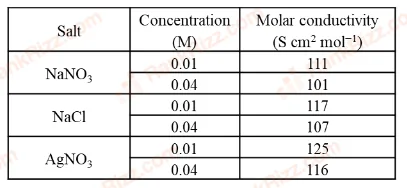
The conductivity of a saturated aqueous solution of AgCl is S cm at 300 K. If the solubility of AgCl in water at 300 K is mol L, then is
(Assume that AgCl dissolved in water ionizes completely and that the molar conductivity of saturated AgCl solution is equal to its limiting molar conductivity.)
- (A)
- (B)
- (C)
- (D)
CHECK IT: rankrizz.com/jee-advanced/chemistry/electrochemistry/q/2026-paper-2-q19
- (A)
- 03Batteries, fuel cells and corrosionset 20×
Consider the following two half-cell reactions along with the standard reduction potential given :

A fuel cell was set up using the above two reactions such that the cell operates under the standard condition of 1 bar pressure and 298 K temperature. The fuel cell works with 80% efficiency. If the work derived from the cell using 1 mol of CHOH is used to compress an ideal gas isothermally against a constant pressure of 1 kPa, then the change in the volume of the gas, _____ m. (nearest integer)
Given: C molAnswer: ____________
CHECK IT: rankrizz.com/jee-main/chemistry/electrochemistry/q/2-apr-2026-s2-q73
- 04Electrolysis and Faraday's lawsset 16×
A solution of aluminium chloride is electrolysed for 30 minutes using a current of 2 A . The amount of the aluminium deposited at the cathode is [Given : molar mass of aluminium and chlorine are 27g and 35.5 g respectively. Faraday constant ]
- (A)
1.660 g
- (B)
0.336 g
- (C)
0.441 g
- (D)
1.007 g
CHECK IT: rankrizz.com/jee-main/chemistry/electrochemistry/q/22-jan-2025-s1-q66
- (A)
- 05Kohlrausch's law and its applicationsset 8×
Equivalent conductivity of , and are and at infinite dilution. If the conductivity of saturated solution is , then of is:
- (A)
- (B)
- (C)
- (D)
CHECK IT: rankrizz.com/jee-main/chemistry/electrochemistry/q/2026-chemistry-516677
- (A)
- 06Relation of EMF with Gibbs energy and equilibrium constantset 5×
The Gibbs energy for the decomposition of at C is as follows: , kJ mol. The potential difference needed for electrolytic reduction of at C is at least
- (A)
V
- (B)
V
- (C)
V
- (D)
V
CHECK IT: rankrizz.com/jee-main/chemistry/electrochemistry/q/2010-chemistry-499695
- (A)
- 07Nernst equation and concentration cellsset 4×
At 298 K, the standard reduction potentials are 1.51 V for , 1.36 V for , 1.07 V for , 0.54 V for . At pH = 3, permanganate is expected to oxidize:
- (A)
and
- (B)
and
- (C)
only
- (D)
, and
CHECK IT: rankrizz.com/jee-main/chemistry/electrochemistry/q/11-apr-2015-online-q46
- (A)
- 08Galvanic cells, cell notation and salt bridgeset 1×
A variable, the opposite external potential is applied to the cell Zn | Zn (1M) || Cu (1M) | Cu, of potential 1.1 V. When V and V, respectively electrons flow from
- (A)
anode to cathode in both the cases.
- (B)
anode to cathode and cathode to anode.
- (C)
cathode to anode and anode to cathode.
- (D)
cathode to anode in both cases.
CHECK IT: rankrizz.com/jee-main/chemistry/electrochemistry/q/10-apr-2015-online-q46
- (A)
Past questions are reproduced with their sitting. Not affiliated with NTA or the IITs. Every question on each idea: rankrizz.com/jee-main/chemistry/electrochemistry