VSEPR theory and shapes of molecules and ions
ASKED 131× · 2004–2026, 20 DIFFERENT YEARS · 118 MAIN, 13 ADVANCED
JEE ADVANCED 2026 · PAPER 2MOST RECENTLY SETTRANSCRIBED
The correct order of ONO bond angle in the given species is
- A
- B
- C
- D
Every idea JEE has asked in Chemical Bonding and Molecular Structure, one past question each — the most recently set — with how many times the examiner has come back to it. Do these 11; where one goes wrong, practise every question on that idea.
Past questions
347
Ideas
11
Set again later
1
Years
2004–26
How these ideas are grouped
An idea here is one syllabus topic — the finest tag our past questions carry. A topic can hold more than one technique, so treat each question as the door into an idea, not the whole of it. Every topic in Chemical Bonding and Molecular Structure has at least one past question, so none is missing from this sheet.
ASKED 131× · 2004–2026, 20 DIFFERENT YEARS · 118 MAIN, 13 ADVANCED
The correct order of ONO bond angle in the given species is
ASKED 89× · 2004–2026, 22 DIFFERENT YEARS · 79 MAIN, 10 ADVANCED
Which of the following statement is correct?
O₂, B₂, C₂ are paramagnetic
C₂, NO, B₂ are diamagnetic
NO, B₂, O₂ are paramagnetic
O₂, NO, C₂ are diamagnetic
ASKED 34× · 2006–2026, 17 DIFFERENT YEARS · 30 MAIN, 4 ADVANCED
Arrange the following compounds according to increasing order of boiling points.
n-CHOH (A), n-CHNH (B), n-CH (C) and CHNHCH (D).
C < B < A < D
D < C < B < A
C < D < B < A
D < B < A < C
ASKED 32× · 2012–2026, 12 DIFFERENT YEARS · 29 MAIN, 3 ADVANCED
The correct order of dipole moments for the given species is
ASKED 18× · 2007–2026, 8 DIFFERENT YEARS · 17 MAIN, 1 ADVANCED
The covalent radii of atoms A and B are and respectively. The covalent bond length and total length of molecule are respectively :
,
,
,
,
ASKED 15× · 2005–2024, 11 DIFFERENT YEARS · 14 MAIN, 1 ADVANCED
The option(s) in which at least three molecules follow Octet Rule is(are)
, , and
, , and
, , and
, , and
ASKED 10× · 2023, 2024, 2025, 2026
Given below are two statements :
Statement I : The number of compounds among SO, SO, SF, SF and HS in which sulphur does not obey the Octet rule is 3.
Statement II : Among [HO, ClF, SF], [NH, BrF, SF], [BrF, ClF, XeF] and [XeF, ClF, HO], the number of sets in which all the molecules have one lone pair of electrons on the central atom is 1.
In the light of the above statements, choose the correct answer from the options given below :
Both Statement I and Statement II are true
Both Statement I and Statement II are false
Statement I is true but Statement II is false
Statement I is false but Statement II is true
ASKED 8× · 2004–2025, 7 DIFFERENT YEARS
In the given structure, the number of hybridized carbon atoms present respectively are:
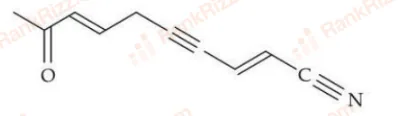
4 and 5
3 and 5
3 and 6
4 and 6
ASKED 6× · 2005, 2014, 2022, 2024 · 5 MAIN, 1 ADVANCED
Number of and bonds present in ethylene molecule is respectively :
4 and 1
5 and 2
3 and 1
5 and 1
ASKED 3× · 2009, 2014, 2019
The correct statement among the following is:
is planar and less basic than
is pyramidal and more basic than
is pyramidal and less basic than
is planar and more basic than
ASKED 1× · 2005
Lattice energy of an ionic compounds depends upon
Charge on the ion only
Size of the ion only
Packing of ions only
Charge on the ion and size of the ion
Got one wrong? Practise that idea, graded.
A free account opens every past question on an idea with the answer checked as you go, and files your mistakes by idea.
Not ready? Get new sheets by email
OTHER CHEMISTRY SHEETS