RankRizz
UNIQUE CONCEPTS · CHEMISTRY

Chemical Thermodynamics: 269 past questions, 7 ideas

Every idea JEE has asked in Chemical Thermodynamics, one past question each — the most recently set — with how many times the examiner has come back to it. Do these 7; where one goes wrong, practise every question on that idea.

Past questions

269

Ideas

7

Set again later

0

Years

2004–26

Download PDFEvery Chemical Thermodynamics question

How these ideas are grouped

An idea here is one syllabus topic — the finest tag our past questions carry. A topic can hold more than one technique, so treat each question as the door into an idea, not the whole of it. Every topic in Chemical Thermodynamics has at least one past question, so none is missing from this sheet.

The 7 ideas, most asked first

01

Enthalpies of reaction and Hess's law

ASKED 84× · 2004–2026, 18 DIFFERENT YEARS · 75 MAIN, 9 ADVANCED

set 84×
JEE MAIN 2026 · 08 APR S2MOST RECENTLY SETTRANSCRIBED

Consider the reaction
2H2S(g)+3O2(g)→2H2O(l)+2SO2(g)2\text{H}_2\text{S(g)} + 3\text{O}_2\text{(g)} \to 2\text{H}_2\text{O(l)} + 2\text{SO}_2\text{(g)}
The magnitude of enthalpy change for the reaction in kJ mol−1^{-1} is __________. (Nearest integer)
Given :
ΔfH⊖(H2S)=−20.1\Delta_f H^\ominus(\text{H}_2\text{S}) = -20.1 kJ mol−1^{-1}
ΔfH⊖(H2O)=−286.0\Delta_f H^\ominus(\text{H}_2\text{O}) = -286.0 kJ mol−1^{-1}
ΔfH⊖(SO2)=−297.0\Delta_f H^\ominus(\text{SO}_2) = -297.0 kJ mol−1^{-1}

NUMERICAL ANSWER · CHECK IT ON THE QUESTION PAGE
02

First law: work, heat and internal energy

ASKED 68× · 2004–2026, 18 DIFFERENT YEARS · 55 MAIN, 13 ADVANCED

set 68×
JEE ADVANCED 2026 · PAPER 1MOST RECENTLY SETTRANSCRIBED

An ideal gas (0.5 mol)(0.5\ \mathrm{mol}), initially at 22 bar pressure, is compressed at a constant temperature of 600 K600\ \mathrm{K} in two steps: first, against a constant external pressure of PP bar (2<P<8)(2 \lt P \lt 8), and then against constant external pressure of 88 bar. At each step, the compression is stopped only when the pressure of the gas becomes equal to the external pressure. The total work done on the gas in these steps is WW. Considering all possible values of PP (2<P<8)(2 \lt P \lt 8) and taking the gas constant as RR (in J K−1 mol−1\mathrm{J\ K^{-1}\ mol^{-1}}), the minimum value of ∣W∣|W| (in J\mathrm{J}) is

  1. A

    207R207R

  2. B

    600R600R

  3. C

    630R630R

  4. D

    900R900R

03

Gibbs energy and spontaneity

ASKED 66× · 2007–2026, 18 DIFFERENT YEARS · 54 MAIN, 12 ADVANCED

set 66×
JEE ADVANCED 2026 · PAPER 1MOST RECENTLY SETTRANSCRIBED

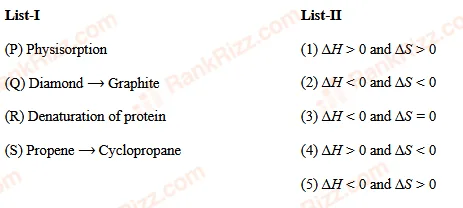
List-I contains various physical/chemical processes, and List-II contains combinations of changes in enthalpy (ΔH)(\Delta H) and entropy (ΔS)(\Delta S). Match each entry in List-I to the appropriate entry in List-II, and choose the correct option.

Figure for JEE Advanced 2026 Chemistry question on Gibbs energy and spontaneity
  1. A

    (P)→\to(2), (Q)→\to(3), (R)→\to(5), (S)→\to(4)

  2. B

    (P)→\to(4), (Q)→\to(3), (R)→\to(5), (S)→\to(1)

  3. C

    (P)→\to(2), (Q)→\to(5), (R)→\to(1), (S)→\to(4)

  4. D

    (P)→\to(2), (Q)→\to(5), (R)→\to(1), (S)→\to(3)

04

Heat capacity and calorimetry

ASKED 22× · 2005–2026, 13 DIFFERENT YEARS · 21 MAIN, 1 ADVANCED

set 22×
JEE MAIN 2026 · 05 APR S2MOST RECENTLY SETTRANSCRIBED

The correct order of molar heat capacities measured at 298 K and 1 bar is :

  1. A

    Copper(s)>Bromine2(l)>Helium(g)\text{Copper}(s) > \text{Bromine}_2(l) > \text{Helium}(g)

  2. B

    Bromine2(l)>Copper(s)>Helium(g)\text{Bromine}_2(l) > \text{Copper}(s) > \text{Helium}(g)

  3. C

    Helium(g)>Bromine2(l)>Copper(s)\text{Helium}(g) > \text{Bromine}_2(l) > \text{Copper}(s)

  4. D

    Helium(g)>Bromine2(l)=Copper(s)\text{Helium}(g) > \text{Bromine}_2(l) = \text{Copper}(s)

05

Bond enthalpy, atomisation, phase-change and solution enthalpies

ASKED 12× · 2005–2026, 9 DIFFERENT YEARS

set 12×
JEE MAIN 2026 · 22 JAN S2MOST RECENTLY SETTRANSCRIBED

If the enthalpy of sublimation of Li is 155 kJ mol−1mol^{-1}, enthalpy of dissociation of F2F_{2} is 150 kJ mol−1mol^{-1}, ionization enthalpy of Li is 520 kJ mol−1mol^{-1}, electron gain enthalpy of F is - 313 kJ mol−1mol^{-1}, standard enthalpy of formation of LiF is - 594 kJ mol−1mol^{-1}. The magnitude of lattice enthalpy of LiF is _________ kJ mol−1mol^{-1}. (Nearest Integer)

NUMERICAL ANSWER · CHECK IT ON THE QUESTION PAGE

06

Entropy and the second law

ASKED 11× · 2007–2023, 7 DIFFERENT YEARS · 9 MAIN, 2 ADVANCED

set 11×
JEE MAIN 2020 · 09 JAN S2MOST RECENTLY SETTRANSCRIBED

The true statement amongst the following is:

  1. A

    Both ΔS\Delta S and SS are functions of temperature.

  2. B

    Both SS and ΔS\Delta S are not functions of temperature

  3. C

    SS is not a function of temperature but ΔS\Delta S is a function of temperature

  4. D

    SS is a function of temperature but ΔS\Delta S is not a function of temperature

07

System, surroundings and state functions

ASKED 6× · 2009–2023, 6 DIFFERENT YEARS · 3 MAIN, 3 ADVANCED

set 6×
JEE MAIN 2023 · 11 APR S2MOST RECENTLY SETTRANSCRIBED

The total number of intensive properties from the following is _______
Volume, Molar heat capacity, molarity, Ecell∘E^\circ_{cell}, Gibbs free energy change, Molar mass, Mole

NUMERICAL ANSWER · CHECK IT ON THE QUESTION PAGE

Got one wrong? Practise that idea, graded.

A free account opens every past question on an idea with the answer checked as you go, and files your mistakes by idea.

Not ready? Get new sheets by email

A note when a chapter’s sheet changes or a new one is added. No account, no spam, one click to leave.

OTHER CHEMISTRY SHEETS