RankRizz

Kepler's laws and planetary motion — JEE Main Previous Year Questions

Every JEE Main question on Kepler's laws and planetary motion, one of the ideas inside Gravitation: 45 questions from 2004–2026, 21 of them in the last five years. Newest first, answer key on every one. Free to read.

Questions

45

Years asked

13

Since

2004

Of the chapter

22%

Every Kepler's laws and planetary motion question

21–40 OF 45 · NEWEST FIRST

JEE MAIN 2022 · 29 JUN S2Kepler's laws and planetary motionTRANSCRIBED

The time period of a satellite revolving around earth in a given orbit is 7 hours. If the radius of orbit is increased to three times its previous value, then approximate new time period of the satellite will be

  1. A

    36 hours

  2. B

    40 hours

  3. C

    30 hours

  4. D

    25 hours

JEE MAIN 2021 · 16 MAR S1Kepler's laws and planetary motionTRANSCRIBED

The maximum and minimum distances of a comet from the Sun are 1.6×10121.6 \times 10^{12} m and 8.0×10108.0 \times 10^{10} m respectively. If the speed of the comet at the nearest point is 6×1046 \times 10^{4} m s−1^{-1}, the speed at the farthest point is:

  1. A

    1.5×1031.5 \times 10^{3} m s−1^{-1}

  2. B

    6.6×1036.6 \times 10^{3} m s−1^{-1}

  3. C

    3.0×1033.0 \times 10^{3} m s−1^{-1}

  4. D

    4.5×1034.5 \times 10^{3} m s−1^{-1}

JEE MAIN 2021 · 25 FEB S1Kepler's laws and planetary motionTRANSCRIBED

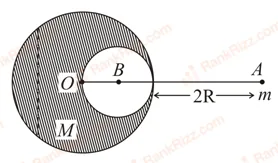
A solid sphere of radius RR gravitationally attracts a particle placed at 3R3R from its centre with a force F1F_1. Now a spherical cavity of radius R2\frac{R}{2} is made in the sphere (as shown in figure) and the force becomes F2F_2. The value of F1:F2F_1 : F_2 is:

Figure for JEE Main 2021 Physics question on Kepler's laws and planetary motion
  1. A

    41 : 50

  2. B

    50 : 41

  3. C

    25 : 36

  4. D

    36 : 25

JEE MAIN 2021 · 24 FEB S1Kepler's laws and planetary motionTRANSCRIBED

Four identical particles of equal mass of 1 kg are made to move along the circumference of a circle of radius 1 m under the action of their own mutual gravitational attraction. The speed of each particle will be:

  1. A

    G(1+22)\sqrt{G(1 + 2\sqrt{2})}

  2. B

    12G(1+22)\dfrac{1}{2} \sqrt{G(1 + 2\sqrt{2})}

  3. C

    12G(22−1)\dfrac{1}{2} \sqrt{G(2\sqrt{2} - 1)}

  4. D

    G(1+22)4\sqrt{\dfrac{G(1 + 2\sqrt{2})}{4}}

JEE MAIN 2021 · 25 JUL S1Kepler's laws and planetary motionTRANSCRIBED

The minimum and maximum distances of a planet revolving around the Sun are x1x_1 and x2x_2. If the minimum speed of the planet on its trajectory is v0v_0, then its maximum speed will be:

  1. A

    v0x12x22\frac{v_0 x_1^2}{x_2^2}

  2. B

    v0x22x12\frac{v_0 x_2^2}{x_1^2}

  3. C

    v0x1x2\frac{v_0 x_1}{x_2}

  4. D

    v0x2x1\frac{v_0 x_2}{x_1}

JEE MAIN 2021 · 24 FEB S1Kepler's laws and planetary motionTRANSCRIBED

Two stars of masses mm and 2m2m at a distance dd rotate about their common centre of mass in free space. The period of revolution is:

  1. A

    2πd33Gm2\pi\sqrt{\frac{d^3}{3Gm}}

  2. B

    2π3Gmd32\pi\sqrt{\frac{3Gm}{d^3}}

  3. C

    12π3Gmd3\frac{1}{2\pi}\sqrt{\frac{3Gm}{d^3}}

  4. D

    12πd33Gm\frac{1}{2\pi}\sqrt{\frac{d^3}{3Gm}}

JEE MAIN 2021 · 27 JUL S2Kepler's laws and planetary motionTRANSCRIBED

Two identical particles of mass 1 kg each go round a circle of radius RR, under the action of their mutual gravitational attraction. The angular speed of each particle is:

  1. A

    G2R3\sqrt{\frac{G}{2R^3}}

  2. B

    12GR3\frac{1}{2}\sqrt{\frac{G}{R^3}}

  3. C

    12R1G\frac{1}{2R}\sqrt{\frac{1}{G}}

  4. D

    2GR3\sqrt{\frac{2G}{R^3}}

JEE MAIN 2021 · 18 MAR S2Kepler's laws and planetary motionTRANSCRIBED

The angular momentum of a planet of mass MM moving around the sun in an elliptical orbit is L⃗\vec{L}. The magnitude of the areal velocity of the planet is :

  1. A

    4LM\frac{4L}{M}

  2. B

    LM\frac{L}{M}

  3. C

    2LM\frac{2L}{M}

  4. D

    L2M\frac{L}{2M}

JEE MAIN 2021 · 01 SEP S2Kepler's laws and planetary motionTRANSCRIBED

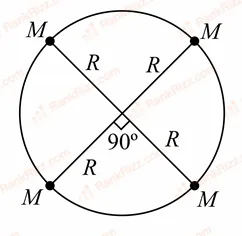
Four particles each of mass MM, move along a circle of radius RR under the action of their mutual gravitational attraction as shown in figure. The speed of each particle is:

Figure for JEE Main 2021 Physics question on Kepler's laws and planetary motion
  1. A

    12GMR(22+1)\frac{1}{2}\sqrt{\frac{GM}{R}(2\sqrt{2}+1)}

  2. B

    12GMR(22+1)\frac{1}{2}\sqrt{\frac{GM}{R(2\sqrt{2}+1)}}

  3. C

    12GMR(22−1)\frac{1}{2}\sqrt{\frac{GM}{R}(2\sqrt{2}-1)}

  4. D

    GMR\sqrt{\frac{GM}{R}}

JEE MAIN 2021 · 01 SEP S2Kepler's laws and planetary motionTRANSCRIBED

Two satellites revolve around a planet in coplanar circular orbits in anticlockwise direction. Their period of revolutions are 1 hour and 8 hours respectively. The radius of the orbit of nearer satellite is 2×1032 \times 10^3 km. The angular speed of the farther satellite as observed from the nearer satellite at the instant when both the satellites are closest is πx\frac{\pi}{x} rad h−1^{-1}, where xx is _________.

JEE MAIN 2020 · 06 SEP S1Kepler's laws and planetary motionTRANSCRIBED

A satellite is in an elliptical orbit around a planet PP. It is observed that the velocity of the satellite when it is farthest from the planet is 6 times less than that when it is closest to the planet. The ratio of distances between the satellite and the planet at closest and farthest points is:

  1. A

    1 : 6

  2. B

    1 : 3

  3. C

    1 : 2

  4. D

    3 : 4

JEE MAIN 2019 · 08 APR S1Kepler's laws and planetary motionTRANSCRIBED

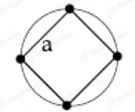
Four identical particles of mass M are located at the corners of a square of side 'a'. What should be their speed if each of them revolves under the influence of other's gravitational field in a circular orbit circumscribing the square?

Figure for JEE Main 2019 Physics question on Kepler's laws and planetary motion
  1. A

    1.35GMa1.35\sqrt{\frac{GM}{a}}

  2. B

    1.21GMa1.21\sqrt{\frac{GM}{a}}

  3. C

    1.41GMa1.41\sqrt{\frac{GM}{a}}

  4. D

    1.16GMa1.16\sqrt{\frac{GM}{a}}

JEE MAIN 2019 · 12 JAN S1Kepler's laws and planetary motionTRANSCRIBED

A straight rod of length L extends from x=ax = a to x=L+ax = L + a. The gravitational force it exerts on a point mass 'm' at x=0x = 0, if the mass per unit length of the rod is A+Bx2A + Bx^2, is given by:

  1. A

    Gm[A(1a+L−1a)+BL]Gm\left[A\left(\frac{1}{a+L} - \frac{1}{a}\right) + BL\right]

  2. B

    Gm[A(1a+L−1a)−BL]Gm\left[A\left(\frac{1}{a+L} - \frac{1}{a}\right) - BL\right]

  3. C

    Gm[A(1a−1a+L)−BL]Gm\left[A\left(\frac{1}{a} - \frac{1}{a+L}\right) - BL\right]

  4. D

    Gm[A(1a−1a+L)+BL]Gm\left[A\left(\frac{1}{a} - \frac{1}{a+L}\right) + BL\right]

JEE MAIN 2019 · 09 JAN S1Kepler's laws and planetary motionTRANSCRIBED

If the angular momentum of a planet of mass mm, moving around the Sun in a circular orbit is LL, about the center of the Sun, its areal velocity is:

  1. A

    Lm\frac{L}{m}

  2. B

    4Lm\frac{4L}{m}

  3. C

    L2m\frac{L}{2m}

  4. D

    2Lm\frac{2L}{m}

JEE MAIN 2019 · 10 APR S2Kepler's laws and planetary motionTRANSCRIBED

A spaceship orbits around a planet at a height of 20 km from its surface. Assuming that only gravitational field of the planet acts on the spaceship, what will be the number of complete revolutions made by the spaceship in 24 hours around the planet?
[Given: Mass of planet = 8×10228 \times 10^{22} kg, Radius of planet = 2×1062 \times 10^6 m, Gravitational constant G = 6.67×10−116.67 \times 10^{-11} Nm2^2/kg2^2]

  1. A

    17

  2. B

    9

  3. C

    13

  4. D

    11

JEE MAIN 2018 · 15 APR S1Kepler's laws and planetary motionTRANSCRIBED

A body of mass m is moving in a circular orbit of radius R about a planet of mass M. At some instant, it splits into two equal masses. The first mass moves in a circular orbit of radius R2\frac{R}{2}, and the other mass, in a circular orbit of radius 3R2\frac{3R}{2}. The difference between the final and initial total energies is:

  1. A

    −GMm2R-\frac{GMm}{2R}

  2. B

    +GMm6R+\frac{GMm}{6R}

  3. C

    −GMm6R-\frac{GMm}{6R}

  4. D

    GMm2R\frac{GMm}{2R}

JEE MAIN 2018 · 15 APR S1Kepler's laws and planetary motionTRANSCRIBED

Take the mean distance of the moon and the sun from the earth to be 0.4×1060.4 \times 10^6 km and 150×106150 \times 10^6 km respectively. Their masses are 8×10228 \times 10^{22} kg and 2×10302 \times 10^{30} kg respectively. The radius of the earth is 6400 km. Let ΔF1\Delta F_1 be the difference in the forces exerted by the moon at the nearest and farthest points on the earth and ΔF2\Delta F_2 be the difference in the force exerted by the sun at the nearest and farthest points on the earth. Then, the number closest to ΔF1ΔF2\frac{\Delta F_1}{\Delta F_2} is:

  1. A

    2

  2. B

    6

  3. C

    10−210^{-2}

  4. D

    0.6

JEE MAIN 2018 · 08 APR OFFLINEKepler's laws and planetary motionTRANSCRIBED

A particle is moving with a uniform speed in a circular orbit of radius R in a central force inversely proportional to the nthn^{th} power of R. If the period of rotation of the particle is T, then:

  1. A

    T∝Rn/2T \propto R^{n/2}

  2. B

    T∝R3/2T \propto R^{3/2} for any n

  3. C

    T∝Rn2+1T \propto R^{\frac{n}{2}+1}

  4. D

    T∝Rn+12T \propto R^{\frac{n+1}{2}}

JEE MAIN 2016 · 09 APR ONLINEKepler's laws and planetary motionTRANSCRIBED

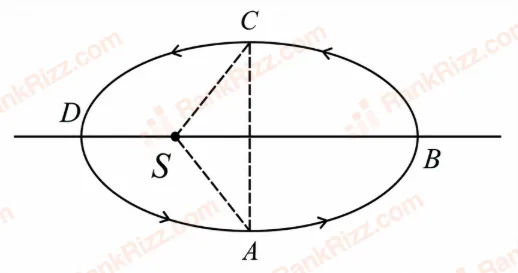
The figure shows an elliptical path ABCDABCD of a planet around the sun SS such that the area of triangle CSACSA is 14th\frac{1}{4}^\text{th} the area of the ellipse (see the figure below) with DBDB as the major axis, and CACA as the minor axis. If t1t_1 is the time taken for the planet to go over the path ABCABC and t2t_2 for the path taken over CDACDA then:

Figure for JEE Main 2016 Physics question on Kepler's laws and planetary motion
  1. A

    t1=4t2t_1 = 4t_2

  2. B

    t1=2t2t_1 = 2t_2

  3. C

    t1=3t2t_1 = 3t_2

  4. D

    t1=t2t_1 = t_2

JEE MAIN 2016 · 10 APR ONLINEKepler's laws and planetary motionTRANSCRIBED

An astronaut of mass mm is working on a satellite orbiting the earth at a distance hh from the earth's surface. The radius of the earth is RR, while its mass is MM. The gravitational pull FGF_G on the astronaut is

  1. A

    Zero since astronaut feels weightless

  2. B

    GMm(R+h)2<FG<GMmR2\frac{GMm}{(R+h)^2} < F_G < \frac{GMm}{R^2}

  3. C

    FG=GMm(R+h)2F_G = \frac{GMm}{(R+h)^2}

  4. D

    0<FG<GMmR20 < F_G < \frac{GMm}{R^2}