RankRizz
JEE MAIN 2016 · 09 APR ONLINE+4 / −1MEDIUMTRANSCRIBED

JEE Main 2016 Physics question — Kepler's laws and planetary motion

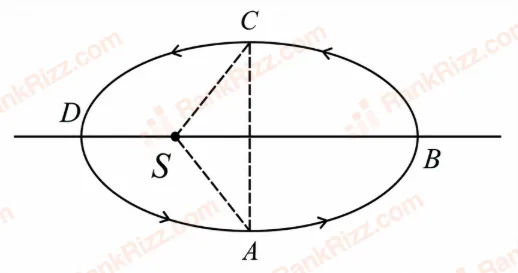
The figure shows an elliptical path ABCDABCD of a planet around the sun SS such that the area of triangle CSACSA is 14th\frac{1}{4}^\text{th} the area of the ellipse (see the figure below) with DBDB as the major axis, and CACA as the minor axis. If t1t_1 is the time taken for the planet to go over the path ABCABC and t2t_2 for the path taken over CDACDA then:

Figure for JEE Main 2016 Physics question on Kepler's laws and planetary motion
SOLUTION

Kepler's Second Law states that a line joining a planet and the Sun sweeps out equal areas during equal intervals of time.

t∝Area sweptt \propto \text{Area swept}

The minor axis CACA divides the ellipse into two equal halves. Therefore, the area of the elliptical sector to the left of line CACA is exactly A2\frac{A}{2}.

Area swept over path CDA=(Area of the half-ellipse to the left of CA)−(Area of △CSA)\text{Area swept over path } CDA = (\text{Area of the half-ellipse to the left of } CA) - (\text{Area of } \triangle CSA)

Area swept for t2=A2−A4=A4\text{Area swept for } t_2 = \frac{A}{2} - \frac{A}{4} = \frac{A}{4}

Area swept for t1=Total Area−(Area swept for t2)\text{Area swept for } t_1 = \text{Total Area} - (\text{Area swept for } t_2)

Area swept for t1=A−A4=3A4\text{Area swept for } t_1 = A - \frac{A}{4} = \frac{3A}{4}

t1t2=Area for t1Area for t2\frac{t_1}{t_2} = \frac{\text{Area for } t_1}{\text{Area for } t_2}

t1t2=3A/4A/4=3\frac{t_1}{t_2} = \frac{3A/4}{A/4} = 3

t1=3t2t_1 = 3t_2

Tagged Kepler's laws and planetary motion. Machine-assigned, so read it as a strong shortlist rather than a verdict.

SubjectPhysics
TopicKepler's laws and planetary motion
TypeMultiple choice