RankRizz

Kepler's laws and planetary motion — JEE Main Previous Year Questions

Every JEE Main question on Kepler's laws and planetary motion, one of the ideas inside Gravitation: 45 questions from 2004–2026, 21 of them in the last five years. Newest first, answer key on every one. Free to read.

Questions

45

Years asked

13

Since

2004

Of the chapter

22%

Every Kepler's laws and planetary motion question

41–45 OF 45 · NEWEST FIRST

JEE MAIN 2014 · 09 APR ONLINEKepler's laws and planetary motionTRANSCRIBED

India's Mangalyan was sent to the Mars by launching it into a transfer orbit EOM around the sun. It leaves the earth at E and meets Mars at M. If the semi-major axis of Earth's orbit is ae=1.5×10¹¹a_e = 1.5 \times 10^{11} m, that of Mar's orbit am=2.28×10¹¹a_m = 2.28 \times 10^{11} m, taking Kepler's laws, give the estimate of time for Mangalyan to reach Mars from Earth.
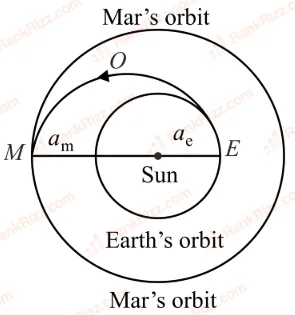
Figure for JEE Main 2014 Physics question on Kepler's laws and planetary motion
  1. A

    220 days

  2. B

    500 days

  3. C

    260 days

  4. D

    320 days

JEE MAIN 2014 · 11 APR ONLINEKepler's laws and planetary motionTRANSCRIBED

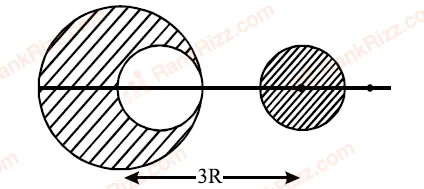
From a sphere of mass M and radius R, a smaller sphere of radius R2\frac{R}{2} is carved out such that the cavity made in the original sphere is between its centre and the periphery (see the figure). For the configuration in the figure where the distance between the centre of the original sphere and the removed sphere is 3R, the gravitational force between the two spheres is:

Figure for JEE Main 2014 Physics question on Kepler's laws and planetary motion
  1. A

    41GM23600R2\frac{41GM^2}{3600R^2}

  2. B

    41GM2450R2\frac{41GM^2}{450R^2}

  3. C

    59GM2450R2\frac{59GM^2}{450R^2}

  4. D

    GM2225R2\frac{GM^2}{225R^2}

JEE MAIN 2014 · 06 APR OFFLINEKepler's laws and planetary motionTRANSCRIBED

Four particles, each of mass MM and equidistant from each other, move along a circle of radius RR under the action of their mutual gravitational attraction. The speed of each particle is:

  1. A

    GMR\sqrt{\frac{GM}{R}}

  2. B

    22GMR\sqrt{2\sqrt{2}\frac{GM}{R}}

  3. C

    GMR(1+22)\sqrt{\frac{GM}{R}\left(1 + 2\sqrt{2}\right)}

  4. D

    12GMR(1+22)\frac{1}{2}\sqrt{\frac{GM}{R}\left(1 + 2\sqrt{2}\right)}

JEE MAIN 2013 · 22 APR ONLINEKepler's laws and planetary motionTRANSCRIBED

The change in the value of acceleration of earth towards sun, when the moon comes from the position of solar eclipse to the position on the other side of earth in line with sun is: (mass of the moon = 7.36×10227.36 \times 10^{22} kg, radius of the moon's orbit = 3.8×1083.8 \times 10^8 m).

  1. A

    6.73×10−56.73 \times 10^{-5} m/s2^2

  2. B

    6.73×10−36.73 \times 10^{-3} m/s2^2

  3. C

    6.73×10−26.73 \times 10^{-2} m/s2^2

  4. D

    6.73×10−46.73 \times 10^{-4} m/s2^2

JEE MAIN 2004Kepler's laws and planetary motionTRANSCRIBED

Suppose the gravitational force varies inversely as the nnth power of distance. Then the time period planet in circular orbit of radius RR around the sun will be proportional to

  1. A

    R(n+12)R^{\left(\frac{n+1}{2}\right)}

  2. B

    R(n−12)R^{\left(\frac{n-1}{2}\right)}

  3. C

    RnR^n

  4. D

    R(n−22)R^{\left(\frac{n-2}{2}\right)}